
by Robyn Bolton | Jul 16, 2025 | Leadership, Strategic Foresight
You’ve done everything to set Strategic Foresight efforts up for success. Executive authority? Check. Challenging inputs? Check. Process integration? Check. Now you just need to flip the switch and you’re off to the races.
Not so fast.
While the wrong set-up is guaranteed to cause failure, the right set-up doesn’t guarantee success. Research shows that strategic foresight initiatives with the right set-up fail because of “organizational pathologies” that sabotage even well-designed efforts.
If you aren’t leading the right people to do the right things in the right way, you’re not going to get the impact you need.
Here’s what to watch out for (and what to do when it happens).
Your Teams Misunderstand Foresight’s Purpose
People naturally assume that strategic foresight predicts the future. When it doesn’t, they abandon it faster than last year’s digital transformation initiative.
Shell learned this the hard way. In 1965, they built the Unified Planning Machinery, a computerized forecasting tool designed to predict cash flow based on trends. It was abandoned because executives feared “it would suppress discussion rather than encourage debate on differing perspectives.”
When they shifted from prediction to preparation, specifically to “modify the mental model of decision-makers faced with an uncertain future,” strategic foresight became an invaluable decision-making tool.
Help your team approach strategic foresight as preparation, not prediction, by measuring success by the improvement in discussion and decision-making, not scenario accuracy. When teams build mental flexibility rather than make predictions, wrong scenarios stop being failed scenarios.
People are Paralyzed by Fear of Being Wrong
Even when your teams understand foresight’s purpose, managers are often unwilling “to use foresight to plan beyond a few quarters, fearing that any decisions today could be wrong tomorrow.”
This is profoundly human. As Webb wrote, “When faced with uncertainty, we become inflexible. We revert to historical patterns, we stick to a predetermined plan, or we simply refuse to adopt a new mental model.” We nod along in scenario sessions, then make decisions exactly like we always have.
Shell’s scenario planning efforts succeeded because it made being wrong acceptable. Even though executives initially scoffed at the idea of oil prices quadrupling, they prepared for the scenario and took near-term “no regrets” decisions to restructure their portfolio.
To help people get past their fear, reward them for making foresight-informed decisions. For example, establish incentives and promotion criteria where exploring “wrong” scenarios leads to career advancement.
Your Culture Confuses Activity with Achievement
Between insight and action, the Tyranny of Now reigns. In even the most committed organizations, the very real and immediate needs of the business call us away from our planning efforts and consume our time and energy, meaning strategic foresight is embraced only when it doesn’t interfere with their “real” jobs.
Disney’s approach made strategic foresight a required element of people’s “real jobs” by integrating foresight activities and insights directly into performance management and strategic planning. When foresight teams identified that traditional media consumption was fracturing in 2012, Disney began preparing for that future by actively exploring and investing in new potential solutions.
Resist the Tyranny of Now’s pull by making strategic foresight activities just as tyrannical – require decisions based on foresight insights to occur in 90 days or less. These decisions should trigger resource allocation reviews, even if the resources are relatively small (e.g., one or a few people, tens or hundreds of thousands of dollars). If strategic foresight doesn’t force hard choices about investments and priorities, it’s activity without achievement.
How You Lead and What People Do Determine Strategic Foresight’s Success
Executive authority, challenging inputs, and process integration are necessary but not sufficient. Success requires conquering the deeper organizational and human behaviors that determine whether strategic foresight is a corporate ritual or a competitive advantage.

by Robyn Bolton | Apr 15, 2025 | Innovation, Leadership
“The call is coming from inside the house” is one of those classic quotes that crossed over from urban legend and horror movies to become a common pop-culture phrase. While originally a warning to teenage babysitters, recent research indicates that it’s also a warning to corporate execs that murderous business threats are closer than they think.
In the early weeks of 2025, Box of Crayons, a Toronto-based learning and development company, partnered with The Harris Poll to survey over 1500 business leaders and knowledge workers to diagnose and understand the greatest challenges facing organizations.
They found that “while there is a tendency to focus on external pressures like economic uncertainty, technological disruptions, and labor market issues, our research shows the most critical challenges are unfolding within the workplace itself.”
The threat is coming from inside your house.
Here’s what they found and what you can do about it
Nearly 1 day each workweek “is lost to the fear of making mistakes.”
Fear is at the core of all the issues making headlines – burnout, disengagement, lost productivity. It “breeds doubt, prompting individuals to question themselves and others, instigating anxiety, hindering productivity, and promoting blame instead of teamwork.”
Fear is also a virus, spreading rapidly from one person to their team members and on and on until it infects the entire organization, embedding itself in the culture.
Executives and managers are key to breaking the cycle of fear that kills innovation, initiative, and growth. By reframing mistakes and learnings, rewarding smart risks even if they result in unexpected outcomes, and role-modeling behaviors that encourage trust and psychological safety, their daily and consistent actions can encourage bravery and remaking the culture.
70% of people don’t see value in listening to people they disagree with.
Unless you’re employed by Lumon Industries, it’s impossible to be a completely different person at work compared to who you are outside of work. So, it should come as no surprise that most people no longer listen to opinions, perspectives, or evidence with which they disagree.
The problem is that different perspectives and experiences are essential to elements of the problem-solving process. Without them, we cannot learn, develop new solutions, and innovate.
Again, executives and managers play a critical role in helping to surface diverse points of view and helping employees to engage in “productive conflict.” Rather than rushing to “consensus” or rapidly making a decision, by expressing curiosity and asking questions, people-leaders create space for new points of view and role model how to encourage and use it.
87% of leaders lack the skills needed to adapt. 64% say funding to build those skills has been cut.
Business leaders are fully aware of the changes happening within their teams, organizations, and the broader world. They recognize the need to constantly adapt, learn, and develop the skills required to respond to these changes. They can even articulate what they need help with, why, and how it will benefit the team or organization.
But leadership training is often one of the first items to be cut, leaving new and experienced people-leaders “ill-equipped to manage the increasing complexity of today’s workplace, stifling their ability to inspire, guide, and support their teams effectively.”
The solution is simple – invest in people. Given the acute need for support and training, forget big programs, multi-day offsites, and centralized learning agendas. Talk to the people asking for help to understand what they want and need and how they learn best. Share what you can do right now with the resources you have and engage them in creating a plan that helps them within the constraints of the current context.
Answer the phone
Just like that terrifying movie moment, the call threatening your business isn’t coming from mysterious outside forces—it’s echoing through your own hallways. The good news? Unlike those helpless babysitters in horror films, you can change the ending by confronting these internal threats head-on.
What internal “call” is your organization ignoring that deserves immediate attention?

by Robyn Bolton | Apr 9, 2025 | Innovation, Leadership, Tips, Tricks, & Tools
“A Few Good Men” is one of my favorite movies. As much as I love Jack Nicholson’s classic line, “You can’t handle the truth!” lately, I’ve been thinking more about a line delivered by Lt. Daniel Kaffee, played by Tom Cruise – “And the hits just keep on comin’.”
But, just like Lt. Kaffee had to make peace with Lt. Cdr JoAnne Galloway joining his Cuba trip, we must make peace with uncertainty and find the guts to move forward.
This is much easier said than done, but these three steps make it possible. Even profitable.
Where We Begin
Imagine you’re the CEO of Midwest Precision Components (MPW), a $75 million manufacturer of specialized valves and fittings. Forty percent of your components come from suppliers now subject to new tariffs, which, if they stay in effect, threaten an increase of 15% in material costs. This increase would devastate your margins and could require you to reduce staff.
Your competitors are scrambling to replace foreign suppliers with domestic ones. But you know that such rapid changes are also risky since higher domestic prices eat into your margins (though hopefully less than 15%), and insufficient time to quality test new parts could lead to product issues and lost customers. And all this activity assumes that the tariffs stay in place and aren’t suddenly paused or withdrawn.
3 Steps Forward
Entering the boardroom, you notice that the CFO looks more nervous than usual, and your head of Supply Chain is fighting a losing battle with a giant stack of catalogs. Taking a deep breath, you resolve to be creative, not reactive (same letters, different outcomes), and get to work.
Step 1: Start with the goal and work backward. The goal isn’t changing suppliers to reduce tariff impact. It’s maintaining profit margins without reducing headcount or product quality. With your CFO, you whiteboard a Reverse Income Statement, a tool that starts with required (not desired) profits to calculate necessary revenues and allowable costs. After running several scenarios, you land on believable assumptions that result in no more than a 4% increase in costs.
Step 2: Identify and prioritize assumptions. With the financial assumptions identified, you ask the leadership team to list everything that must be true to deliver the financial assumptions, their confidence that each of their assumptions is true, and the impact on the business and its bottom line if the assumption is wrong.
Knowing that your head of Sales is an unrelenting optimist and your Supply Chain head is mired in a world of doom and gloom, you set a standard scale: High confidence means betting your annual salary, medium is a team dinner at a Michelin-starred restaurant, and low is a cup of coffee. High impact puts the company out of business, medium requires major shifts, and low means extra work but nothing crazy.
Step 3: Attack the deal killers. Going around the room, each person lists their “Deal Killers,” the Low Confidence – High Impact assumptions that pose the highest risk to the business. After some discussion to determine the primary assumptions at the beginning of causal chains, you select two for immediate action: (1) Alternative domestic suppliers can be found for the two highest-cost components, and (2) Current manufacturing processes can be quickly adapted to accommodate parts from new suppliers.
A Plan. A Timeline. A Sense of Calm.
With this new narrowed focus, your team sets a shared goal of resolving these two assumptions within 30 days. Together, they set clear weekly deliverables and reallocate time and people to help meet deadlines.
A sense of calm settles on the team. Not because they have everything figured out, but because they know exactly what the most important things to be done are, that those things are doable, and they are working together to do them.
How could you use these three steps to help you move forward through uncertainty?

by Robyn Bolton | Mar 4, 2025 | Automation & Tech, Leadership
Imagine a manufacturing company. On the factory floor, machines whirl and grind, torches flare up as welding helmets click closed, and parts and products fall off the line and into waiting hands or boxes, ready to be shipped to customers. Elsewhere, through several doors and a long hallway, you leave the cacophony of the shop floor for the quiet hum of the office. Computers ping with new emails while fingers clickety-clack across the keyboard. Occasionally, a printer whirs to life while forcing someone to raise their voice as they talk to a customer on the other end of the phone.
Now, imagine that you ask each person whether AI and automation will positively or negatively affect their jobs. Who will champion new technology and who will resist it?
Most people expect automation acceptance to be separated by the long hallway, with the office workers welcoming while the factory workers resist.
Most people are wrong.
The Business Case for Problem-Solving Job Design
Last week, I wrote about findings from an MIT study that indicated that trust, not technology, is the leading indicator of whether workers will adopt new AI and automation tools.
But there’s more to the story than that. Researchers found that the type of work people do has a bigger influence on automation perception than where they do it. Specifically, people who engage in work requiring high levels of complex problem-solving alongside routine work are more likely to see the benefit of automation than any other group.
Or, to put it more simply
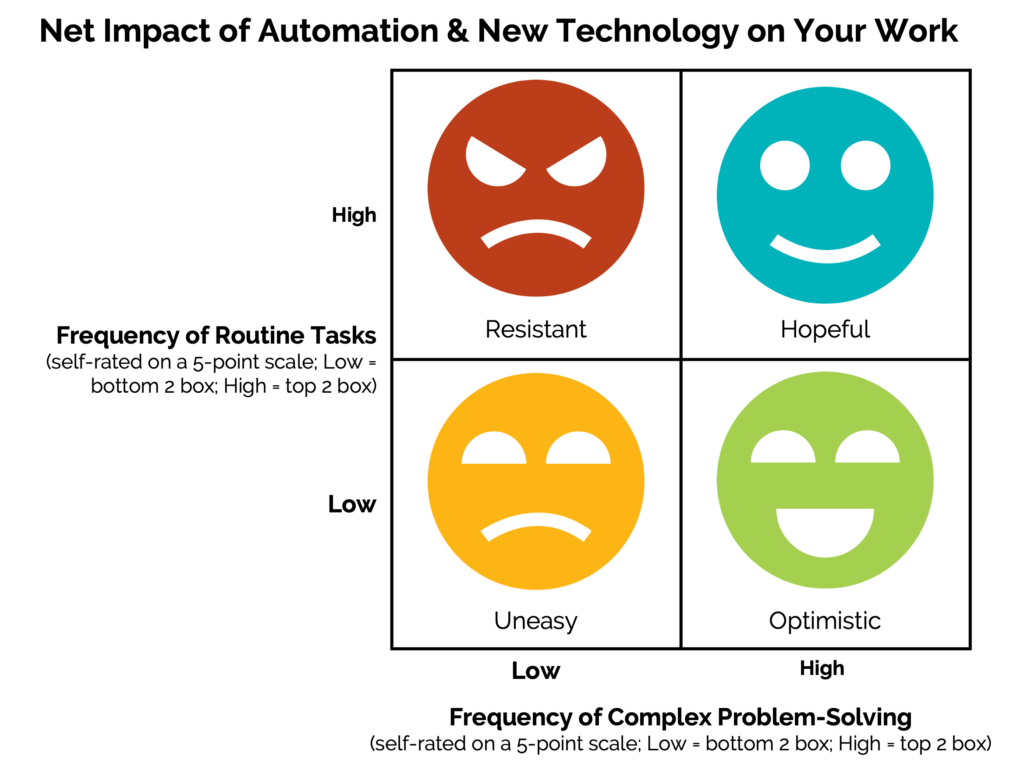
While it’s not surprising that people who perform mostly routine tasks are more resistant than those who engage in complex tasks, it is surprising that this holds true for both office-based and production-floor employees.
Even more notable, this positive perception is significantly higher for complex problem solvers vs. the average across all workers::
- Safety: 43% and 41% net positive for office and physical workers, respectively (vs. 32% avg)
- Pay: 27% and 25% net positive for physical and office workers, respectively (vs. 3.9% avg)
- Autonomy: 33% net positive for office workers (vs. 18% average)
- Job security: 25% and 22% net positive for office and physical workers, respectively (vs. 3.5%)
Or, to put it more simply, blend problem-solving into routine-heavy roles, and you’ll transform potential technology resistors into champions.
3 Ways to Build Problem-Solving Into Any Role
The importance of incorporating problem-solving into every job isn’t just a theory – it’s one of the core principles of the Toyota Production System (TPS). Jidoka, or the union of automation with human intelligence, is best exemplified by the andon cord system, where employees can stop manufacturing if they perceive a quality issue.
But you don’t need to be a Six-Sigma black belt to build human intelligence into each role:
- Create troubleshooting teams with decision authority
Workers who actively diagnose and fix process issues develop a nuanced understanding of where technology helps versus hinders. Cross-functional troubleshooting creates the perfect conditions for technology champions to emerge.
- Design financial incentives around problem resolution
The MIT study’s embedded experiment showed that financial incentives significantly improved workers’ perception of new technologies while opportunities for input alone did not. When workers see personal benefit in solving problems with technology, adoption accelerates.
- Establish learning pathways connected to problem complexity
Workers motivated by career growth (+33.9% positive view on automation’s impact on upward mobility) actively seek out technologies that help them tackle increasingly complex problems. Create visible advancement paths tied to problem-solving mastery.
Innovation’s Human Catalyst
The most powerful lever for technology adoption isn’t better technology—it’s better job design. By restructuring roles to include meaningful problem-solving, you transform the innovation equation.
So here’s the million-dollar question every executive should be asking: Are you designing jobs that create automation champions, or are you merely automating jobs as they currently exist?

by Robyn Bolton | Feb 12, 2025 | Innovation, Leadership
When times get tough, the first things most companies cut are the “luxuries.” That includes their innovation teams. But as companies dismantle their labs, teams, and other structures, a crucial question emerges: Who’s working on growth?
Cutting innovation teams doesn’t just cut a branch off the org chart. It eliminates capabilities that are fundamental to sustaining and growing a business and culture.
So why throw the baby out with the bathwater? Here’s a scenario that might sound familiar: Your innovation team created something brilliant. The prototype works, early users love it, and the business case is solid. But six months later, it’s gathering dust because no one in the core business knew how to—or wanted to—move it forward.
This isn’t a failure of innovation. It’s a failure of integration.
Wait, I thought integrating innovation with the core business was bad
The traditional innovation team structure – a separate unit with its own space, processes, and culture – solved one problem but created another.
As innovation teams were given the freedom to think differently, they were also given shiny, new, fun, and amenity-filled spaces cordoned off from everyone else. Meanwhile, “everyone else” was stuck in their usual offices and doing the usual things that keep the business running and fund the innovation team’s luxe life.
The resulting us-versus-them mentality fueled resentment, making it easy for “everyone else” to stonewall the innovation team’s efforts by pointing out flaws, uncertainties, and risks.
To be fair, they weren’t doing this to be mean – they were protecting the business. The innovators, meanwhile, grew frustrated, sought help from higher-ups who were happy to help until times got tough and cuts had to be made.
So, one team should work on both innovation and the core business?
Just like we need multiple words to describe the what and why of innovation, we need different operating models that embed innovation capabilities across the organization while protecting the space for them to flourish.
Here’s what it looks like:
- For Core Improvements, let your operational teams lead. They know the problems best, but give them innovation tools and methods. Think of this as equipping your existing workforce with new superpowers, not replacing them with superheroes.
- For Adjacent Expansions, create hybrid teams that combine operational experience with innovation expertise. When expanding into new markets or launching new products, you need both an innovative mindset and operational know-how. Neither alone is sufficient.
- For Radical Reinvention, you still need dedicated teams—but not isolated ones. Their job is to create offerings that reinvent the company and the culture that enables everyone to participate. Establish bridges that connect them with business units and enforce quarterly meetings to share progress, insights, and tools.
This isn’t theory.
Companies like Amazon have been doing this for years with their “working backwards” innovation process used by all teams, not just a special innovation unit. When I worked at P&G, the brand teams worked on core improvements, the New Business Development teams (where I worked) physically sat next to the brand teams and worked on Adjacent expansion, and the radical reinvention teams were co-located with R&D at the technical centers.
Put it into practice
Here’s where to start:
- Map your innovation portfolio to understand what types of innovation you need to hit your goals
- Match your team structures to your innovation types
- Start embedding innovation capabilities across the organization
- Create clear paths for innovations to move from idea to implementation
The transition isn’t easy. It requires rethinking roles and reimagining how innovation happens in your organization. But the alternative – watching your innovation investments evaporate because they can’t cross the bridge back to the core business – is far more painful.
What’s your experience? Drop your stories and strategies in the comments. Let’s figure this out together.
