
by Robyn Bolton | Nov 11, 2025 | Leadership, Leading Through Uncertainty
The business press has a new obsession with courageous leadership.
Harvard Business Review dedicated their September cover story to it. Nordic Business Forum built an entire 2024 conference around it. BetterUp, McKinsey, and dozens of thought leaders and influencers can’t stop talking about it.
Here’s what they’re all telling you: If you’re playing it safe, stuck in analysis paralysis, not innovating fast enough, or not making bold moves, then you are the problem because you lack courage.
Here’s what they’re not telling you: You don’t have a courage problem. You have a systems problem.
The Real Story Behind “Courage Gaps”
The VP was anything but cowardly. She had a track record of bold moves and wasn’t afraid of hard conversations. The CEO wanted to transform the company by moving from a product-only focus to one offering holistic solutions that combined hardware, software, and services. This VP was the obvious choice.
Her team came to her with a ideas that would reposition the company for long-term growth. She loved it. They tested the ideas. Customers loved them. But not a single one ever launched.
It wasn’t because the VP or the CEO lacked courage. It was because the board measured success in annual improvements, the CEO’s compensation structure rewarded short-term performance, and the VP required sign-off from six different stakeholders who were evaluated on risk mitigation. At every level, the system was designed to kill bold ideas. And it worked.
This is the inconvenient truth the courage press ignores.
That success doesn’t just require leaders who are courageous, it requires organizational architecture that systematically rewards courage and manages risk.
What We’re Really Asking Leaders to Overcome
Consider what we’re actually asking leaders to be courageous against:
- Compensation structures tied to short-term metrics
- Risk management processes designed to say “no”
- Approval hierarchies where one skeptic can overrule ten enthusiasts
- Cultures where failed experiments end careers
The courage discourse lets broken systems off the hook.
It’s easier to sell “10 Ways to Build Leadership Courage” than to admit that organizational incentives, governance structures, and cultural norms are actively working against the bold moves we tell leaders to make.
What Actually Enables Courageous Leadership.
I’m not arguing that there isn’t a need for individual courage. There is.
But telling someone to “be braver” when their organizational architecture punishes bravery is like telling someone to swim faster in a pool filled with Jell-O.
If we want courage, we need to fix the things the systems that discourage it:
- Align incentives with the time horizon of the decisions you want made
- Create explicit permission structures for experimentation
- Build decision-making processes that don’t require unanimous consent
- Separate “learning investments” from “performance expectations” when measuring results
- Make the criteria for bold moves clear, not subject to whoever’s in the room
But doing this is a lot harder than buying books about courage.
The Bottom Line
When you fix the architecture, you don’t need to constantly remind people to be brave because the system enables. Individual courage becomes the expectation, not the exception.
The real question isn’t whether your leaders need courage.
It’s whether your organization has the architecture to let them use it.
If you can’t answer that question, that’s not a courage problem.
That’s a design problem.
And design is something that, as a leader, you can actually control.
by Robyn Bolton | Nov 1, 2025 | Innovation, Leading Through Uncertainty
“Is this what the dinosaurs did before the asteroid hit?”
That was the first question I was asked at IMPACT, InnoLead’s annual gathering of innovation practitioners, experts, and service providers.
It was also the first of many that provided insight into what’s on innovators and executives’ minds as we prepare for 2026
How can you prevent failure from being weaponized?
This is both a direct quote and a distressing insight into the state of corporate life. The era of “fail fast” is long gone and we’re even nostalgic for the days when we simply feared failure. Now, failure is now a weapon to be used against colleagues.
The answer is neither simple nor quick because it comes down to leadership and culture. Jit Kee Chin, Chief Technology Officer at Suffolk Construction, explained that Suffolk is able to stop the weaponization of failure because its Chairman goes to great lengths to role model a “no fault” culture within the company. “We always ask questions and have conversations before deciding on, judging, or acting on something,” she explained
How do you work with the Core Business to get things launched?
It’s long been innovation gospel that teams focused on anything other than incremental innovation must be separated, managerially and physically, from the core business to avoid being “infected” by the core’s unquestioning adherence to the status quo.
The reality, however, is the creation of Innovation Island, where ideas are created, incubated, and de-risked but remain stuck because they need to be accepted and adopted by the core business to scale.
The answer is as simple as it is effective: get input and feedback during concept development, find a core home and champion as your prototype, and work alongside them as you test and prepare to launch.
How do you organize for innovation?
For most companies, the residents of Innovation Island are a small group of functionally aligned people expected to usher innovations from their earliest stages all the way to launch and revenue-generation.
It may be time to rethink that.
Helen Riley, COO/CFO of Google X, shared that projects start with just one person working part-time until a prototype produces real-world learning. Tom Donaldson, Senior Vice President at the LEGO Group, explained that rather than one team with a large mandate, LEGO uses teams specially created for the type and phase of innovation being worked on.
What are you doing about sustainability?
Honestly, I was surprised by how frequently this question was asked. It could be because companies are combining innovation, sustainability, and other “non-essential” teams under a single umbrella to cut costs while continuing the work. Or it could be because sustainability has become a mandate for innovation teams.
I’m not sure of the reason and the answer is equally murky. While LEGO has been transparent about its sustainability goals and efforts, other speakers were more coy in their responses, for example citing the percentage of returned items that they refurbish or recycle but failing to mention the percentage of all products returned (i.e. 80% of a small number is still a small number).
How can humans thrive in an AI world?
“We’ll double down,” was Rana el Kaliouby’s answer. The co-founder and managing partner of Blue Tulip Ventures and host of Pioneers of AI podcast, showed no hesitation in her belief that humans will continue to thrive in the age of AI.
Citing her experience listening to Radiotopia Presents: Bot Love, she encouraged companies to set guardrails for how, when, and how long different AI services can be used. She also advocated for the need for companies to set metrics that go beyond measuring and maximizing usage time and engagement to considering the impact and value created by their AI-offerings.
What questions do you have?
by Robyn Bolton | Oct 19, 2025 | Leadership, Leading Through Uncertainty
One day, an architect visited the building site of his latest project. There he saw three people all laying bricks. He asked each what they were doing. “I’m laying bricks,” the first responded. “I’m building a wall,” said the second. “I’m building a cathedral,” exclaimed the third.
The parable of the Three Bricklayers is a favorite amongst motivational speakers, urging their audiences to think beyond today’s tasks and this quarter’s goals to commit to a grandiose vision of eternal success and glory.
But there’s a problem.
The narrative changed
The person who had a vision of building a cathedral? They now believe they’re building ruins.
Is the C-Suite Quietly Quitting?
Recently published research found that three out of four executives believe that “without fundamental transformation* their organization will cease to exist” in ten years. That’s based on data from interviews with twenty-four “current or former CEOs who have led successful transformations” and 1,360 survey responses from C-Suite and next-generation leaders.
And, somehow, the news gets worse.
While 77% of C-suite executives report that they’re committed to their companies’ transformation efforts, but 57% believe their organization is taking the wrong approach to that transformation. But that’s still better than the 68% of Next-Gen executives who disagree with the approach.
So, it should come as no surprise that 71% of executives rate their companies’ transformation efforts as not at all to moderately successful. After all, it’s hard to lead people along a path you don’t agree with to a vision you don’t believe in.
Did they just realize that “change is hard in human systems?”
We all fall into the trap of believing that understanding something results in commitment and change.
But that’s not how humans work.
That’s definitely not how large groups of humans, known as organizations, work.
Companies’ operations are driven only loosely by the purpose, structures, and processes neatly outlined in HR documents. Instead, they are controlled by the power and influence afforded to individuals by virtue of the collective’s culture, beliefs, histories, myths, and informal ways of working.
And when these “opaque dimensions” are challenged, they don’t result in resistance,
They result in inertia.
“Organizational inertia kills transformations”
Organizations are “complex organisms” that evolve to do things better, faster, cheaper over time. They will continue doing so unless changed by an external force (yes, that’s Newton’s first law of motion).
That external force, the drive for transformation, must be strong enough to overcome:
- Insight Inertia stops organizations from getting started because there is a lack of awareness or acceptance amongst leaders that change is needed.
- Psychological Inertia emerges when change demands abandoning familiar success strategies. People embrace the idea of transformation but resist personal adaptation, defaulting to comfortable old behaviors.
- Action Inertia sets in and gains power as the long and hard work of transformation drags on. Over time, people grow tired. Exhausted by continuous change, teams progressively disengage, becoming less responsive and decisive.
But is that possible when 74% of executives are simply biding their time and waiting for failure?
“There’s a crack in everything, that’s how the light gets in.”
Did you see the crack in all the doom and gloom above?
- 43% of executives believe their organizations are taking the right approach to transformation.
- 29% believe that their organizations’ transformations have been successful.
- 26% believe their company will still be around in ten years.
The majority may not believe in transformation but only 33% of bricklayers believed they were building a cathedral, and the cathedral still got built.
Next week, we’ll explore how.
by Robyn Bolton | Oct 13, 2025 | Innovation, Leading Through Uncertainty
As a kid, you’re taught that when you’re lost, stay put and wait for rescue. Most executives are following that advice right now—sitting tight amid uncertainty, hoping someone saves them from having to make hard choices and take innovation risk.
This year’s Nobel Prize winners in Economics have bad news: there is no rescue coming. Joel Mokyr, Philippe Aghion, and Peter Howitt demonstrated that disruption happens whether you participate or not. Freezing innovation investments doesn’t reduce innovation risk. It guarantees competitors destroy you while you stand still.
They also have good news: innovation follows predictable patterns based on competitive dynamics, offering a framework for making smarter investment decisions.
How We Turned Stagnation into a System for Growth
For 99.9% of human history, economic growth was essentially zero. There were occasional bursts of innovation, like the printing press, windmills, and mechanical clocks, but growth always stopped.
200 years ago, that changed. Mokyr identified that the Industrial Revolution created systems connecting two types of knowledge: Propositional knowledge (understanding why things work) and Prescriptive knowledge (practical instructions for how to execute).
Before the Industrial Revolution, these existed separately. Philosophers theorized. Artisans tinkered. Neither could build on the other’s work. But the Enlightenment created feedback loops between theory and practice allowing countries like Britain to thrive because they had people who could translate theory into commercial products.
Innovation became a system, not an accident.
Why We Need Creative Destruction
Every year in the US, 10% of companies go out of business and nearly as many are created. This phenomenon of creative destruction, where companies and jobs constantly disappear and are replaced, was identified in 1942. Fifty years later, Aghion and Howitt built a mathematical model proving its required for growth.
Their research also lays bare some hard truths:
- Creative destruction is constant and unavoidable. Cutting your innovation budget does not pause the game. It forfeits your position. Competitors are investing in R&D right now and their innovations will disrupt yours whether you participate or not.
- Competitive position predicts innovation investments. Neck-to-neck competitors invest heavily in innovation because it’s their only path to the top. Market leaders cut back and coast while laggards don’t have the funds to catch-up. Both under-invest and lose.
- Innovation creates winners and losers. Creative destruction leads to job destruction as work shifts from old products and skills to new ones. You can’t innovate and protect every job but you can (and should) help the people affected.
Ultimately, creative destruction drives sustained growth. It is painful and scary, but without it, economies and society stagnate. Ignore it at your peril. Work with it and prosper.
From Prize-winning to Revenue-generating
Even though you’re not collecting the one million Euro prize, these insights can still boost your bottom line if you:
- Connect your Why teams with your How teams. Too often, Why teams like Strategy, Innovation, and R&D, chuck the ball over the wall to the How teams in Operations, Sales, Supply Chain, and front-line operations. Instead, connect them early and often and ensure the feedback loop that drives growth
- Check your R&D and innovation investments. Are your R&D and innovation investments consistent with your strategic priorities or your competitive position? What are your investments communicating to your competitors? It’s likely that that “conserving cash” is actually coasting and ceding share.
- Invest in your people and be honest with them. Your employees aren’t dumb. They know that new technologies are going to change and eliminate jobs. Pretending that won’t happen destroys trust and creates resistance that kills innovation. Tell employees the truth early, then support them generously through transitions.
What’s Your Choice?
Playing it safe guarantees the historical default: stagnation. The 2025 Nobel Prize winners proved sustained growth requires building innovation systems and embracing creative destruction.
The only question is whether you will participate or stagnate.
by Robyn Bolton | Sep 30, 2025 | Leading Through Uncertainty, Strategy, Tips, Tricks, & Tools
Just as we got used to VUCA (volatile, uncertain, complex, ambiguous) futurists now claim “the world is BANI now.” BANI (brittle, anxious, nonlinear, incomprehensible) is much worse than VUCA and reflects “the fractured, unpredictable state of the modern world.”
Not to get too Gen X on the futurists who coined and are spreading this term but…shut up.
Is the world fractured and unpredictable? Yes.
Does it feel brittle? Are we more anxious than ever? Are things changing at exponential speed, requiring nonlinear responses? Does the world feel incomprehensible? Yes, to all.
Naming a problem is the first step in solving it. The second step is falling in love with the problem so that we become laser focused on solving it. BANI does the first but fails at the second. It wallows in the problem without proposing a path forward. And as the sign says, “Ain’t nobody got time for this.”
(Re)Introducing the Cynefin Framework
The Cynefin framework recognizes that leadership and problem-solving must be contextual to be effective. Using the Welsh word for “habitat,” the framework is a tool to understand and name the context of a situation and identify the approaches best suited for managing or solving the situation.
It’s grounded in the idea that every context – situation, challenge, problem, opportunity – exists somewhere on a spectrum between Ordered and Unordered. At the Ordered end of the spectrum, cause and affect are obvious and immediate and the path forward is based on objective, immutable facts. Unordered contexts, however, have no obvious or immediate relationship between cause and effect and moving forward requires people to recognize patterns as they emerge.
Both VUCA and BANI point out the obvious – we’re spending more time on the Unordered end of the spectrum than ever. Unlike the acronyms, Cynefin helps leaders decide and act.
5 Contexts. 5 Ways Forward
The Cynefin framework identifies five contexts, each with its own best practices for making decisions and progress.
On the Ordered end of the spectrum:
- Simple contexts are characterized by stability and obvious and undisputed right answers. Here, patterns repeat, and events are consistent. This is where leaders rely on best practices to inform decisions and delegation, and direct communication to move their teams forward.
- Complicated contexts have many possible right answers and the relationship between cause and effect isn’t known but can be discovered. Here, leaders need to rely on diverse expertise and be particularly attuned to conflicting advice and novel ideas to avoid making decisions based on outdated experience.
On the Unordered end of the spectrum:
- Complex contexts are filled with unknown unknowns, many competing ideas, and unpredictable cause and effects. The most effective leadership approach in this context is one that is deeply uncomfortable for most leaders but familiar to innovators – letting patterns emerge. Using small-scale experiments and high levels of collaboration, diversity, and dissent, leaders can accelerate pattern-recognition and place smart bets.
- Chaos are contexts fraught with tension. There are no right answers or clear cause and effect. There are too many decisions to make and not enough time. Here, leaders often freeze or make big bold decisions. Neither is wise. Instead, leaders need to think like emergency responders and rapidly response to re-establish order where possible to bring the situation into a Complex state, rather than trying to solve everything at once.
The final context is Disorder. Here leaders argue, multiple perspectives fight for dominance, and the organization is divided into fractions. Resolution requires breaking the context down into smaller parts that fit one of the four previous contexts and addressing them accordingly.
The Only Way Out is Through
Our VUCA/BANI world isn’t going to get any simpler or easier. And fighting it, freezing, or fleeing isn’t going to solve anything. Organizations need leaders with the courage to move forward and the wisdom and flexibility to do so in a way that is contextually appropriate. Cynefin is their map.
by Robyn Bolton | Sep 16, 2025 | Leading Through Uncertainty, Tips, Tricks, & Tools
When a project is stuck and your team is trying to manage uncertainty, what do you hear most often:
- “We’re so afraid of making the wrong decision that we don’t make any decisions.”
- “We don’t have time to explore a bunch of stuff. We need to make decisions and go.”
- “The problem is so multi-faceted, and everything affects everything else that we don’t know where to start.”
I’ve heard all three this week, each spoken by teams leads who cared deeply about their projects and teams.
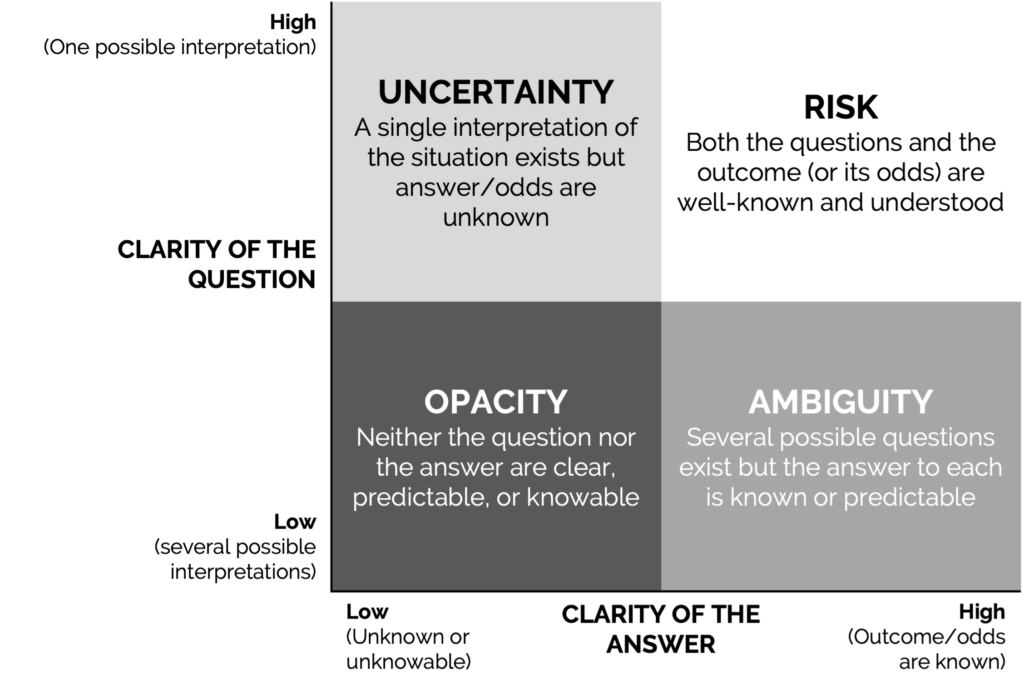
Differentiating between risk and uncertainty and accepting that uncertainty would never go away, just change focus helped relieve their overwhelm and self-doubt.
But without a way to resolve the fear, time-pressure, and complexity, the project would stay stuck with little change of progressing to success.
Turn uncertainty into an asset
It’s a truism in the field of innovation that you must fall in love with the problem, not the solution. Falling in love with the problem ensures that you remain focused on creating value and agnostic about the solution.
While this sounds great and logically makes sense, most struggle to do it. As a result, it takes incredible strength and leadership to wrestle with the problem long enough to find a solution.
Uncertainty requires the same strength and leadership because the only way out of it is through it. And, research shows, the process of getting through it, turns it into an asset.
3 Steps to turn uncertainty into an asset
Research in the music and pharmaceutical industries reveals that teams that embraced uncertainty engaged in three specific practices:
- Embrace It: Start by acknowledging the uncertainty and that things will change, go wrong, and maybe even fail. Then stay open to surprise and unpredictability, delving into the unknown “by being playful, explorative, and purposefully engaging in ventures with indeterminate outcome.”
- Fix It: Especially when dealing with Unknowable Uncertainty, which occurs when more info supports several different meanings rather than pointing to one conclusion, teams that succeed make provisional decisions to “fix” an uncertain dimension so they can move forward while also documenting the rationale for the fix, setting a date to revisit it, and criteria for changing it.
- Ignore It: It’s impossible to embrace every uncertainty at once and unwise to fix too many uncertainties at the same time. As a result, some uncertainties, you just need to ignore. Successful teams adopt “strategic ignorance” “not primarily for purposes of avoiding responsibility [but to] allow postponing decisions until better ideas emerge during the collaborative process.
This practice is iterative, often leading to new knowledge, re-examined fixes, and fresh uncertainties. It sounds overwhelming but the teams that are explicit and intentional about what they’re embracing, fixing, and ignoring are not only more likely to be successful, but they also tend to move faster.
Put it into practice
Let’s return to NatureComp, a pharmaceutical company developing natural treatments for heart disease.
Throughout the drug development process, they oscillated between addressing What, Who, How, and Where Uncertainties. They did that by changing whether they embraced, fixed, or ignored each type of uncertainty at a given point:
![]()
As you can see, they embraced only one type of uncertainty to ensure focus and rapid progress. To avoid the fear of making mistakes, they fixed uncertainties throughout the process and returned to them as more information came available, either changing or reaffirming the fix. Ignoring uncertainties helped relieve feelings of being overwhelmed because the team had a plan and timeframe for when they would shift from ignoring to embracing or fixing.
Uncertainty is dynamic. You need to be dynamic, too.
You’ll never eliminate uncertainty. It’s too dynamic to every fully resolve. But by dynamically embracing, fixing, and ignore it in all its dimensions, you can accelerate your path to success.