
Your Team’s First Fix Depends on What’s Missing. Not What Hurts.

Your Team’s First Fix Depends on What’s Missing. Not What Hurts.

“Here’s the team effectiveness playbook,” my manager said as he plopped an inches-thick binder onto the table between us. “Follow the instructions, update the slides, and the project should be pretty straightforward.”

It was not straightforward.

And that was before the Executive Director hurled a dictionary at the VP of Public Relations’ head.

That day, I learned two valuable lessons:
1. Teams, like people, are unique so there is no standard playbook that always works
2. Remove heavy objects from meeting rooms


Principles behind the patterns

Over the past few weeks, you’ve learned why teams stall and the four attributes of successful teams. We also discussed why teams that appear to have the same struggles often need completely different solutions to be more effective.

This last point is especially important given our (my) tendency to go straight to fixing the things that aren’t working, like the delayed handoff in last week’s article. But what isn’t working is actually a seam, a symptom of weakness in one or more of the four attributes.

To fix what’s not working, we must diagnose the Interaction Pattern across the four attributes and the leans in the Think-Do and Individual-Team axes. That diagnosis is rooted in three key principles:

Every pattern is a dynamic, not a score. Two teams with the same number of strengths can behave very differently. That’s why you get an Interaction Pattern, not a score. The pattern names the behavior, so the next move is the right one for that specific team.

Severity before shape. If even a single attribute is Underdeveloped (red in the Diagnostic report), something needs to change quickly. Even if every other attribute is Emerging (yellow) or Established (green), a single underdeveloped attribute throws the team off-track.

Thinking before doing. If all the attributes are Emerging or Established, look at the lean. Most teams lean towards Doing (Core Skill Mastery and Single Process) but if you start doing before you’ve done the thinking, you’re just running faster in the wrong direction.


One seam. Three patterns. Three fixes.

Remember the teams from last week? Three teams each missed a deadline for handing off a project from R&D to manufacturing. One seam (delayed handoff) but three different patterns. This is how we made each one seamless.

Aligned but Stuck: “Everyone agrees on the plan. It just doesn’t happen.”
Every attribute was Established except Single Process. So, we built one. This is where the usual meetings, trackers, and RACI charts worked, but only because the team already shared a Collaborative Mindset and agreed on Shared Goals & Principles.

Quiet Misalignment: “Everyone’s working hard, just not toward the same thing.”
The people were skilled and collaborative (strong individual lean), but the team had no shared answer to what wins when priorities collide. R&D optimized for performance. Manufacturing optimized for cost.

We started by establishing Shared Goals & Principles, deciding together what wins when performance and cost collide. Then we put status meetings and dashboards in place.
Why that order? Without shared principles, a better process simply tracks each function’s pursuit of their own goals more closely.

Fragile Foundation: “Too many things need fixing at once.”
Everything except Core Skill Mastery needed attention. The instinct is to pick one thing you can do to improve and focus there. Put in place a process. Add more oversight. But fixing one thing doesn’t work when most everything needs attention.

So, we focused on strengthening the thinking attributes and agreed on Shared Goals & Principles and made a Collaborative Mindset non-negotiable. Then built the Single Process.


Find your pattern first. Then pick the fixes.

The seam tells you something isn’t working. The pattern tells you where to start.

There are ten patterns, representing 81 different combinations. No wonder following the “team effectiveness playbook” wasn’t straightforward (still not sure that throwing a dictionary was the right answer, though).


Curious? Take the free Seamless Innovation Diagnostic. When your team is ready to take it, hit Reply and we’ll help you get everyone in.

FAQs

What should a team fix first when work keeps stalling?

Start with what’s missing, not what hurts. A delayed handoff is a seam, a symptom that one or more of the four attributes need attention. Find the Interaction Pattern first. If any attribute is Underdeveloped, change it quickly even if the rest are Emerging or Established. If none is, do the thinking before the doing.

Why doesn't adding process fix a team working toward different goals?

Because without shared principles, a better process simply tracks each function’s pursuit of its own goals more closely. On one team, R&D optimized for performance and manufacturing optimized for cost. The first fix was establishing Shared Goals & Principles, deciding together what wins when performance and cost collide. Only then did status meetings and dashboards go in.

Stop Fixing the Team Problem You Can See

Stop Fixing the Team Problem You Can See

The new product was supposed to move from R&D to manufacturing in March. By May, it was still in R&D.

It looked like a lack of coordination, so the team did what good teams do. They added a weekly handoff meeting to ensure regular communication. They built a tracker so everyone could see the status of the work. Someone made a RACI chart, and everyone signed off on it.

Six weeks later, the tracker is green, the meeting starts on time, and the product is still in R&D.

Why?


One seam, three patterns

I’ve seen this scenario play out at many clients. Teams first try to fix the process. If that doesn’t work, managers start swapping out people.

The team fixed what it could see. But what it saw was the seam, the stalled handoff. The cause sits underneath, in the four attributes we walked through last week.

The weekly meeting, the tracker, and the RACI all strengthen one attribute, Single Process. But attributes don’t act alone. They interact, so a seam that looks like a process problem may show up in one attribute when multiple others also need to be addressed.

I’ve run into the handoff seam over and over and always tried to solve it using meetings, Gantt charts, and RACIs. Sometimes it worked, most of the time it didn’t.

Then I used the Seamless Diagnostic and discovered why. The teams I was working with all showed the same seam but had different Interaction Patterns:


Aligned but Stuck: “Everyone agrees on the plan. It just doesn’t happen.”

This is where the usual bag of tricks worked. The team had strong Shared Goals & Principles, and each team member demonstrated a Collaborative Mindset and Core Skill Mastery. What they lacked was a Single Process and the meetings, schedules, and RACI gave them that.


Quiet Misalignment: “Everyone’s working hard, just not toward the same thing.”

People are skilled and collaborative, but the team has no shared answer to what wins when priorities collide. R&D optimizes for performance. Manufacturing optimizes for cost. The tracker makes the work visible, and the RACI makes ownership clear. But until we aligned on Shared Goals & Principles, everyone optimized for what was important to their function.


Fragile Foundation: “Too many things need fixing at once.”

Creating a Single Process is only one of several attributes that need attention. Strengthening it was real progress, but new seams kept appearing, and the team’s recurring problems didn’t stop until we established Shared Goals & Principles and made demonstrating a Collaborative Mindset non-negotiable.


Why you can’t fix recurring problems from where you sit

There’s another wrinkle in trying to diagnose and fix your team: you see it only from your perspective. The R&D lead sees a manufacturing team that won’t commit to dates. The plant manager sees designs that change every week. The finance partner sees a budget burning down. Everyone is right, and no one sees the whole picture.

The whole picture matters because what’s really going on comes from how all four attributes line up. A Collaborative Mindset that needs attention means one thing on a team with a strong Single Process. It means something entirely different on a team without one.

None of this is new. Each attribute rests on decades of research into what makes teams work, from Amy Edmondson’s work on psychological safety to studies showing that what individuals bring pays off only through how the team operates together. What Seamless adds is how the attributes interact. Those combinations, tested with real teams, form ten Interaction Patterns.

That’s why the whole team takes the Diagnostic. Each person’s view is one piece. Together, they reveal the pattern.

When you know the pattern, you know where to begin.

Next week, we’ll look at what to do first.

If you want a head start, take the free Seamless Innovation Diagnostic.

When your team is ready to take it, hit Reply and we’ll help you get everyone in.

FAQs

Why is a project still stuck after the team fixed the process?

Because the team fixed what it could see. A missed handoff gets a weekly meeting, a tracker, and a RACI. All three strengthen one attribute, Single Process. But the same handoff problem can come from very different Interaction Patterns underneath. If the real gap is Shared Goals & Principles or Collaborative Mindset, the tracker turns green and the product still doesn’t move.

How do you find what's really behind a team's recurring problems?

Have the whole team take the Seamless Innovation Diagnostic. Each person sees the team from one seat, and the cause comes from how all four attributes line up: Collaborative Mindset, Shared Goals & Principles, Core Skill Mastery, and Single Process. The Diagnostic looks at how those attributes interact, and the combinations form ten Interaction Patterns. Together, everyone’s answers reveal the pattern. Then you know where to begin.

Why the Fix That Worked for One Team Is Failing Another

Why the Fix That Worked for One Team Is Failing Another

It’s Sunday night and you look at your calendar, steeling yourself for Monday.

The day opens with a meeting of your functional peers to review progress on quarterly and annual goals. It’s usually upbeat because everyone claims they’re on target or has a plan to get there.

Then there’s the cross-functional launch team meeting. Everyone agrees on the launch date, but timelines are starting to slip and there’s growing tension over which priorities to preserve and which to let slide.

After lunch is a one-on-one with a direct report. She’s a top performer, but you are worried that she’s burning out because she keeps doing her team’s work. She always saves the day, but you wonder how much longer this can last.

And sometime before you leave, you have to go talk to Legal about the contract you sent three weeks ago. Each week you ask for a status update, and each week the contract is being reviewed by someone new.

Four meetings. Four team dynamics. Four different approaches required to move forward.


One you.

Last week’s article explained why individual assessments like Myers-Briggs, DiSC, Hogan, Kolbe, and StrengthsFinder aren’t effective tools for improving team effectiveness. Each tool focuses on you and assumes that you show up in the same way in every context.

Teams have their own dynamics that result in people dialing up or down different parts of their personalities. In one team, someone may appear quieter and more thoughtful while in a different team the same person may be decisive and action-oriented. “It is,” as a client of mine likes to say, “contextual.”

Where the context breaks down, seams appear: the hidden points where decisions, handoffs, and incentives don’t line up, often between functions and levels.


Four attributes of successful teams

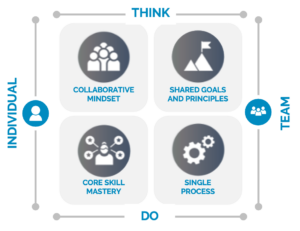
 Seamless Innovation uses that context to show which team dynamics drain progress and value. By examining the balance between Think and Do, and between Individual and Team, the framework creates a capability map of four attributes required for successful teams.

  • Collaborative Mindset (Individual/Think): How each person engages across boundaries like functions, age, tenure, and role. It shows up as curiosity, constructive challenge, and contributing beyond defined roles.
  • Shared Goals & Principles (Team/Think): The team’s shared understanding of priorities, measures of success, and how decisions are made.
  • Core Skill Mastery (Individual/Do): Each person’s skills, judgment, ownership, and discipline in getting the work done without the constant need for detailed direction.
  • Single Process (Team/Do): The team’s shared routines, decision pathways, handoffs, and feedback loops. It’s how everyone works together, regardless of what the org chart says, to get work done.


Four ways to succeed on Monday

Let’s go back to your Monday meetings. Each team has (at least) one attribute that needs attention.

  • Your functional peer meeting needs a stronger Collaborative Mindset because risks aren’t being raised. What’s a risk you might share for discussion to illustrate the benefit of curiosity and constructive challenge?
  • Your cross-functional team needs stronger Shared Goals & Principles because everyone agrees on the goal, but no one agrees on the trade-offs required to achieve it. How can you bring clarity to what wins when priorities collide?
  • Your direct report’s team relies on her Core Skill Mastery to save the project. But that means the project can only move as fast as one person. How might you help the rest of the team own more of the work?
  • The handoff to Legal needs a Single Process because it’s not clear who is doing what, when, and why. How might the process be transparently communicated and tracked?

But this is just the start. Next week we’ll dive deeper into how to tell which attributes your team needs to strengthen.

If you want a head start, take the free Seamless Innovation Diagnostic.

After all, there are many meetings and only one you.

FAQs

How do you get a cross-functional team to commit to a growth plan?

Look past the goal and check the trade-offs. A cross-functional team can agree on the goal and the launch date, then slip when priorities collide and no one agrees which to protect. That team needs stronger Shared Goals & Principles: a shared understanding of priorities, measures of success, and how decisions are made. Start by making clear what wins when priorities collide.

How do you fix accountability when no one owns a handoff?

Look at the process before you chase the people. When a contract sits for three weeks and someone new reviews it every week, it’s not clear who is doing what, when, and why. That team needs a stronger Single Process: shared routines, decision pathways, handoffs, and feedback loops that work regardless of the org chart. Make the process visible and track it.

How do you diagnose why one team moves and another doesn't?

Look at the team, not the individuals. People dial different parts of their personalities up or down depending on the team they’re in. The Seamless Innovation framework uses the Think–Do and Individual–Team axes to create a capability map of four attributes: Collaborative Mindset, Shared Goals & Principles, Core Skill Mastery, and Single Process. Each team has at least one that needs attention.

Why Teams Stall: It’s Not a People Problem

Why Teams Stall: It’s Not a People Problem

The Zoom gallery started with just nine boxes. Nine people tasked with recommending how AI could be integrated into the product development process to save $5 million next fiscal year.

The next week, there were twelve boxes. Half the meeting was bringing new people up to speed. The rest was agreeing to last week’s next steps.

A month later, three screens were required to show everyone, but most were on mute with their cameras off. The team was still working through Week 1’s To Do list.

Three months later, it was up to five screens because, concerned about the lack of progress, team members’ bosses wanted to join the call.

Six months after starting, every idea had been rejected by someone. The only surviving idea was to build an enterprise-wide chatbot.

The project was handed over to IT. The team disbanded. Millions were spent creating a chatbot that no one used.


Sound familiar?

The team wasn’t incompetent, lazy, or quietly rebelling against AI. It was people (lots of people) attending meetings, reading and sending emails, and executing their tasks. There were handoffs with no clear owner, and decisions that stalled and no one could say why.

The owner-less handoffs, stalled decisions, and quiet deaths are the result of seams, the hidden disconnects between functions, levels, and processes. Seams derail progress more reliably than a skill gap because they’re easy to mistake as “just how things are.”

You’ve seen this before, so you try to fix it. You get more involved. You add a high-potential employee to the team. You change the scope or the timing. Sometimes it helps. Usually, it takes up more of your time and only slows the project’s decline.


It’s not a people problem

When a team stalls, we reach for Myers-Briggs, DiSC, Hogan, or Kolbe to diagnose the problem, drive self-awareness, and solve all the problems.

They don’t.

A team is not a collection of individuals, yet those tools focus only on the individual. They assume a person shows up the same way in every single situation. We don’t. We show up differently depending on the topic, who else is in the room, the time of day, even whether we’ve eaten or had enough caffeine. Stack those variables against a dozen people and eight functions and a consolidated report of personality types is simply a comforting fiction.


It’s a team problem.

A team is a group of people who trust each other and share a common purpose. Tools to understand individuals aren’t designed to diagnose teams. They aren’t designed to dig into the systems, relationships, and competing priorities that create seams. And that’s why they can’t solve them.

Seamless Innovation examines how the team works as individuals AND together, revealing how seams are slowing progress and impacting results. Created by Jared Simmons, founder of OUTLAST Consulting, from his lived experiences at companies like P&G and Coca-Cola. When I discovered it, it felt like finding the Rosetta Stone because it translated what I experienced into something practical and actionable. Over the past year, we’ve worked together to develop and test it with real people and teams.

Seamless looks at whether the team runs as individuals or an interdependent group with a common goal and at the balance between Think and Do. Think is how people engage across boundaries, and whether the group shares priorities, success measures, and tradeoff rules. Do is whether people can deliver without constant direction and whether the processes and permissions make work move.

Together, these two axes create a capability map of four attributes critical to team success: Collaborative Mindset, Shared Goals & Principles, Core Skill Mastery, and Single Process.

Next week we’ll look at each attribute, what it is, why it’s important, and what “good” looks like in the context of real-world experiences.

Because a team problem can’t be fixed with individual assessments.


Curious to learn more?  Click this link to take the Seamless Diagnostic. 

But remember, the results reflect your individual perspective. To experience the full benefit Seamless offers, you need the rest of your team to take it, too.  For that, just hit Reply and we’ll make that happen!

FAQs

What causes strategic decisions to stall inside a company?

Seams: the hidden disconnects between functions, levels, and processes. They show up as handoffs with no clear owner, decisions that stall with no one able to say why, and projects that die quietly. Meanwhile, everyone keeps attending meetings, sending emails, and executing their tasks. Seams derail progress more reliably than a skill gap because they’re easy to mistake for just how things are.

How do you get a project moving after it's been stuck for months?

Stop treating it as a people problem. The usual fixes are to get more involved, add a high-potential employee, or change the scope or timing. Usually, they take more of your time and only slow the decline. Personality tools like Myers-Briggs, DiSC, Hogan, and Kolbe focus on individuals, and we show up differently depending on the topic and who’s in the room. A stuck team needs a team-level diagnosis.

Is there a framework for diagnosing why a team stalls?

Yes. Seamless Innovation, created by Jared Simmons, founder of OUTLAST Consulting, examines how a team works as individuals and together. Two axes, Individual–Team and Think–Do, create a capability map of four attributes: Collaborative Mindset, Shared Goals & Principles, Core Skill Mastery, and Single Process. It measures the team, not the people.