Automation Success Depends on Trust, Not Technology

Automation Success Depends on Trust, Not Technology

We’ve all seen the apocalyptic headlines about robots coming for our jobs. The AI revolution has companies throwing money at shiny new tech while workers polish their résumés, bracing for the inevitable pink slip. But what if we have it completely, totally, and utterly backward?  What if the real drivers of automation success have nothing to do with the technology itself?

That’s precisely what an MIT study of 9,000+ workers across nine countries asserts.  While the doomsayers have predicted the end of human workers since the introduction of the assembly line, those very workers are challenging everything we think we know about automation in the workplace.

The Secret Ingredient for Technology ROI

MIT surveyed workers across the manufacturing industry—50% of whom reported frequently performing routine tasks—and found that the majority ultimately welcome automation. But only when one critical condition is present. And it’s one that most executives completely miss while they’re busy signing purchase orders for the latest AI and automation systems.

Trust.

Read that again because while you’re focused on selecting the perfect technology, your actual return depends more on whether your team feels valued and believes you are invested in their safety and professional growth.

Workers Who Trust, Automate

This trust dynamic explains why identical technologies succeed in some organizations and fail in others. According to MIT’s research:

  • Job satisfaction is the second strongest indicator of technology acceptance, with a 10% improvement that researchers identified as consistently significant across all analytical models
  • Feeling valued by their employer shows a highly significant 9% increase in positive attitudes toward automation
  • Trust also consistently predicts automation acceptance, as workers scoring higher on trust measures are significantly more likely to view new technologies positively.

For example, Sam Sayer, an employee at a New Hampshire cutting tool manufacturer, has become an automation champion because his employer helped him experience how factory-floor robots could free him from routine tasks and allow him to focus on more complex problem-solving. “I worked in factories for years before I ever saw a robot. Now I’m teaching my colleagues on the factory floor how to use them.”

This contrasts with an aerospace manufacturer in Ohio that hired a third party to integrate a robot into its warehouse processes. Despite the company’s efforts to position the robot as a teammate, even giving it a name, workers resisted the technology because they didn’t trust the implementation process or see clear personal benefits.

These patterns hold across industries and countries: When workers perceive their employer as invested in their development and well-being, automation initiatives succeed. When that foundation is missing, even the most sophisticated technologies falter.


Four Steps to Convert Resistors to Champions

Whether it’s for the factory floor or the office laptop, if you want ROI and revenue growth from your automation investments, start with your people:

  1. Design roles that connect workers to outcomes: When people see how their input shapes results, they become natural technology allies.
  1. Create visible growth pathways. Workers motivated by career advancement are significantly more likely to embrace new technologies.
  1. Align financial incentives with implementation goals. When workers see the personal benefits of adoption, resistance evaporates faster than free donuts in the break room.
  1. Make safety improvements the leading edge of your technology story. It’s the most universally appreciated benefit of automation.


A Provocative Challenge

Ask yourself this (potentially) uncomfortable question: Are you investing as much in trust as you are in technology?

Because if not, you might as well set fire to a portion of your automation budget right now. At least you’d get some heat from it.

The choice isn’t between technology and workers—it’s between implementations that honor human relationships and those that don’t. The former generates returns; the latter generates résumé updates.

What are you choosing?

5 ways to Build Your Innovation Muscles in the New Year

5 ways to Build Your Innovation Muscles in the New Year

According to a 2018 survey by NPR and The Marist Poll, the most common New Year’s resolution is to exercise more.  Not surprisingly, losing weight and eating a more healthy diet ranked third and further, respectively (“stop smoking” was #2, in case you’re curious).

Hitting the gym to drop weight and build muscle is a great habit to build, but don’t forget about the regular work needed to build other muscles.

Specifically, your innovation muscles.

Innovation mindsets, skills, and behaviors can be learned but if you don’t continuously use them, like muscles, they can weaken and atrophy.  That’s why it’s important to create opportunities to flex them.

One of the tools I use with clients who are committed to building innovation as a capability, rather than scheduling it as an event, is QMWD – the Quarterly-Monthly-Weekly-Daily practices required to build and sustain innovation as a habit.


QUARTERLY

Leave the office and talk to at least 3 of your customers

It’s tempting to rely on survey results, research reports, and listening in on customer service calls as a means to understand what your customers truly think and feel.  But there’s incredible (and unintended) bias in those results.

Take, for example, this story from former P&G CEO AG Lafley:

One very quick story; I will never forget this. We used to do annual research in the laundry detergent business, and every year consumers would rate the Tide powder cardboard package as excellent; excellent to shop; excellent for opening; excellent in use–on, on, on.


So, probably 27 or 30 years ago, I’m in basements in Tennessee, in Kentucky, doing loads of laundry with women, and after three or four or five of these one-on-one sessions, I’ve realized that not a single woman has opened a box of Tide with her hand. Why not? You’ll break your fingernails!


So, how did they open the box? They had nail files; they had screwdrivers; they had all kinds of things sitting down on the shelf over their washing machine, and yet they thought our package was excellent. And we thought our package was excellent because they were telling us our package was excellent. We had to see it and experience it.


Here’s the problem–consumers cannot really tell us what they want. They can tell you why they like it or why they don’t like it, but they cannot tell you what they want.

Schedule a day each quarter to get out of the office and meet your customers.  Ask them what they like and what they don’t.  More importantly, watch them use your products and then share what you heard and saw with your colleagues.


MONTHLY

Share with your team a mistake you made and what you learned from it

Silicon Valley mantras like “fail fast” and “fail often” make for great office décor but, let’s be honest, no one likes to fail and very few companies reward it.

Instead of repeating these slogans, reframe them to “learn fast and learn often” and role model the behavior by sharing what you learned from things you did that didn’t go as expected.  You’ll build a culture of psychological safety, make smart risks acceptable, and increase your team’s resilience.  All things required to innovate in a sustainable, repeatable, and predictable manner.


Do 1 thing just for the fun of it.

In the research that fed into their book, The Innovator’s DNA, professors Jeff Dyer, Hal Gregersen, and Clayton Christensen, found that the most common characteristic amongst the great innovators of our time was their ability to associate – “to make surprising connections across areas of knowledge, industries, even geographies” (page 41).  Importantly, their associative thinking skills were fed by one or more “Discovery Skills” – questioning (asking “why,” “why not,” and “what if”), observing, experimenting, and networking.

Fuel your associative thinking ability by doing something NOT related to your job or other obligations.  Do something simply because it interests you.  You might be surprised where it takes you.  After all, Steve Jobs studied calligraphy, meditation, and car design and used all of those experiences in his “day job.”


WEEKLY

Make 1 small change for 1 day

Innovation requires change and, if you’re an innovator, that’s the exciting part.  But most people struggle with change, a fact that can be frustrating for change agents.

In order to lead people through change, you need to empathize with them and their struggles which is why you need to create regular moments of change in your work and life.  One day each week, make a conscious change – sit on the other side of the conference room table, take a different route to the bathroom, use a black pen instead of a blue one.  Even small changes like this can be a bit annoying and they’ll remind you that change isn’t always the fun adventure you think it is.


DAILY

Ask “How can we do this better?”

Innovation is something different that creates value.  Which is good news because that means that all it takes to be an Innovator is to DO something DIFFERENT and create VALUE.  The easiest way to do that is to find opportunities for improvement.

The next time you’re frustrated with or confused by a process, ask “how can we do this better?”  Better can be more simply, faster, cheaper, or even in a way that is more enjoyable but, whatever it means, the answer will point the way to creating value for you, your team, and maybe even your company.


In closing…

Block time on your calendar for these quarterly, monthly, weekly, and daily habits.  After all, the best reflection of your priorities are the things in your calendar.  And, if you stick with this, you’ll be among the 8% who achieve their New Year’s goals.


Originally published on December 5, 2019 on Forbes.com

The 5 Gifts of Uncertainty

The 5 Gifts of Uncertainty

“How are you doing?  How are you handling all this?”

It seems like 90% of conversations these days start with those two sentences.  We ask out of genuine concern and also out of a need to commiserate, to share our experiences, and to find someone that understands.

The connection these questions create is just one of the Gifts of Uncertainty that have been given to us by the pandemic.

Yes, I know that the idea of uncertainty, especially in big things like our lives and businesses, being a gift is bizarre.  When one of my friends first suggested the idea, I rolled my eyes pretty hard and then checked to make sure I was talk to my smart sarcastic fellow business owner and not the Dali Lama.

But as I thought about it more, started looking for “gifts” in the news and listening for them in conversations with friends and clients, I realized how wise my friend truly was.

Faced with levels of uncertainty we’ve never before experienced, people and businesses are doing things they’ve never imagined having to do and, as a result, are discovering skills and abilities they never knew they had.  These are the Gifts of Uncertainty

  1. Necessity of offering a vision – When we’re facing or doing something new, we don’t have all the answers. But we don’t need all the answers to take action.  The people emerging as leaders, in both the political and business realms, are the ones acknowledging this reality by sharing what they do know, offering a vision for the future, laying out a process to achieve it, and admitting the unknowns and the variables that will affect both the plan and the outcome.
  2. Freedom to experiment – As governments ordered businesses like restaurants to close and social distancing made it nearly impossible for other businesses to continue operating, business owners were suddenly faced with a tough choice – stop operations completely or find new ways to continue to serve. Restaurants began to offer carry out and delivery.  Bookstores, like Powell’s in Portland OR and Northshire Bookstore in Manchester VT, also got into curbside pick-up and delivery game.  Even dentists and orthodontists began to offer virtual visits through services like Wally Health and Orthodontic Screening Kit, respectively.
  3. Ability to change – Businesses are discovering that they can move quickly, change rapidly, and use existing capabilities to produce entirely new products. Nike and HP are producing face shields. Zara and Prada are producing face masks. Fanatics, makers of MLB uniforms, and Ford are producing gowns.  GM and Dyson are gearing up to produce ventilators. And seemingly every alcohol company is making hand sanitizer.  Months ago, all of these companies were in very different businesses and likely never imagined that they could or would pivot to producing products for the healthcare sector.  But they did pivot.
  4. Power of Relationships – Social distancing and self-isolation are bringing into sharp relief the importance of human connection and the power of relationships. The shift to virtual meetups like happy hours, coffees, and lunches is causing us to be thoughtful about who we spend time with rather than defaulting to whoever is nearby.  We are shifting to seeking connection with others rather than simply racking up as many LinkedIn Connections, Facebook friends, or Instagram followers as possible.  Even companies are realizing the powerful difference between relationships and subscribers as people unsubscribed en mass to the “How we’re dealing with COVID-19 emails” they received from every company with which they had ever provided their information.
  5. Business benefit of doing the right thing – In a perfect world, businesses that consistently operate ethically, fairly, and with the best interests of ALL their stakeholders (not just shareholders) in mind, would be rewarded. We are certainly not in a perfect world, but some businesses are doing the “right thing” and rea being rewarded.  Companies like Target are offering high-risk employees like seniors pregnant women, and those with compromised immune systems 30-days of paid leave.  CVS and Comcast are paying store employees extra in the form of one-time bonuses or percent increases on hourly wages.  Sweetgreen and AllBirds are donating food and shoes, respectively, to healthcare workers.  On the other hand, businesses that try to leverage the pandemic to boost their bottom lines are being taken to task.  Rothy’s, the popular shoe brand, announced on April 13 that they would shift one-third of their production capacity to making “disposable, non-medical masks to workers on the front line” and would donate five face masks for every item purchased.  Less than 12 hours later, they issued an apology for their “mis-step,” withdrew their purchase-to-donate program, and announced a bulk donation of 100,000 non-medical masks.

Before the pandemic, many of these things seemed impossibly hard, even theoretical.  In the midst of uncertainty, though, these each of these things became practical, even necessary.  As a result, in a few short weeks, we’ve proven to ourselves that we can do what we spent years saying we could not.

These are gifts to be cherished, remembered and used when the uncertainty, inevitably, fades.

Originally published on Mat 19, 2020 on Forbes.com

Is Your Brain Friend or Foe? Make It Your Friend with Positive Intelligence

Is Your Brain Friend or Foe? Make It Your Friend with Positive Intelligence

“If you spend a lot of time in your own head, you’re spending time in a bad neighborhood.”


I was deep in a bit of worry and self-doubt when my friend uttered that sentence.  Immediately, my mind conjured an image of falling gown building, boarded up doors and windows, overgrown yards, and empty streets (basically downtown Cleveland in the 1980s).


“Man, I do not want to be here!” I said, probably a bit too loudly.


Everyone I know spends a lot of time in their bad neighborhoods.  It’s a consequence of the world we live in – more demands, responsibilities, and expectations running into greater uncertainty, fewer options, and weaker safety nets.


There are lots of ways to spruce up our neighborhoods, cultivating a Growth Mindset is one.  In his book, Positive Intelligence: Why Only 20% of Teams and Individuals Achieve Their True Potential and How You Can Achieve Yours, author and executive coach Shirzad Chamine, lays out a powerful framework and action plan to build your Positive Intelligence by increasing your PQ (Positive Intelligence Quotient).


Why Should I Care about Positive Intelligence?

Because research proves that a high PQ creates better results

  • An analysis of more than 200 different scientific studies, which collectively tested more than 275,000 people, conduced that higher PQ leads to higher salary and greater success in the arenas of work, marriage, health, sociability, friendship, and creativity
  • Salespeople with higher PQ sell 37% more than their lower-PQ peers
  • Project teams managed by high-PQ managers perform 31% better
  • Doctors with a high PQ make accurate diagnoses 19% faster
  • People who demonstrated high PQ in their 20s (as evidence by journal entries) live, on average, 10 years longer

Better sales, better performance, better health, longer lives.

Seems like something worth learning more about.


What is Positive Intelligence and PQ?

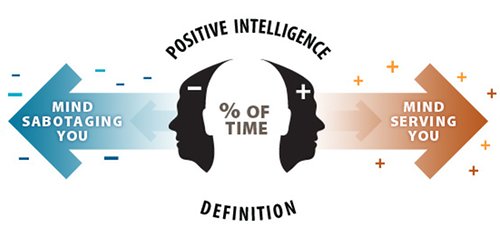
Chamine defines Positive Intelligence as “an indication of the control you have over your own mind and how well your mind acts in your best interest.”  Basically, what kind of neighborhood is your mind.

PQ, your Positive Intelligence Quotient, is “the percentage of your time your mind is acting as your friend rather than your enemy.”  It’s expressed on a scale of 0 to 100 and research shows that a PQ of 75 (meaning your mind is your friend, or a good neighborhood, 75% of the time) is a tipping point.  “Above it, you are generally being uplifted by the internal dynamics of the mind, below it you are constantly being dragged down by those dynamics.”  80% of teams and individuals score below the tipping point.


How you can increase your PQ

People with high PQs use one or more of the following 3 strategies:

STRATEGY 1 – Weaken your Saboteurs:

Saboteurs, also called Inner Critics, are the voices, beliefs, and assumptions in your head that work against you.

There are 10 and every person has at least two actively chattering away

  1. Judge: The “Master” Saboteur in everyone’s head. It constantly finds faults in you, others, your circumstances, and anything else it can get its hands on.
  2. Avoider: Focuses on the positive and pleasant to avoid dealing with difficult and unpleasant tasks, conflicts, and people.
  3. Controller: Takes charge, seeking to bend people to its will because it believes that the only way to get the best outcomes from people and situations is to control them
  4. Hyper-Achiever: Relies on constant external rewards, recognition, and praise as a way to feel self-respect and self-validation
  5. Hyper-Rational: Focuses on logic and reason as the sole means through which to understand people and situations, often leading to impatience or outright dismissal of anything or person deemed not logical
  6. Hyper-Vigilant: Sees threats in every moment and is constantly on guard and preparing for the worst-case scenario
  7. Pleaser: Seeks to gain acceptance and affection by constantly helping, pleasing, rescuing, or flattering others
  8. Restless: Searches for the next adventure, new thing, or adrenaline rush and distracts from the relationships and work that really matter
  9. Stickler: Needs perfection, order, and organization to such an extent that it makes everyone anxious and uptight
  10. Victim: Gains attention and affection by focusing on internal feelings, especially negatives ones

To weaken your saboteurs, first identify which one is currently active, then recognize the story its telling you (often, the story will seem helpful so this part is tricky), and then either call it out (“oh, it’s you again, making up stories) or thank it (“thank you for trying to keep me safe.  I’ve got this.”)

STRATEGY 2 – Strengthen your Sage: 

The Sage perspective is essentially the opposite of the Judge.  Whereas the Judge finds everything that is (or could be wrong), the Sage accepts every single thing as a gift or opportunity.

OK, I know this sounds like some new-age woo, especially in the midst of COVID-19 and its impact on every single thing in our lives.  Chamine’s C-Suite clients are skeptical of this too, which is why he teaches them the Three Gifts technique – write down the horrible thing then write down 3 ways it could turn out to be a gift or opportunity at some point in the future.

You can strengthen your Sage by using one (or more) of its 5 powers:

  1. Empathize: When strong feelings are involved and emotional reserves are running low, picture yourself, or the person or situation causing problems, as a small child and interact with it
  2. Explore: When the situation is complex or you want more information before making a decision, pretend to be a fascinated anthropologist and seek out info by asking questions
  3. Innovate: When the usual answers aren’t working, adopt an innovator’s mentality greet ideas with “yes….and….”
  4. Navigate: When faced with multiple options, “flash forward” and imagine yourself at some point in the distant future after having taken each path and consider how you feel in that future place
  5. Activate: When your Saboteurs are in control, preempt them by writing down everything they could say and recognize, respond, and thank it.

STRATEGY 3 – Strengthen your PQ brain

Your PQ brain is comprised of the middle prefrontal cortex, the right brain, the mirror neuron system, the ACC, and the Insular Cortex (these last three areas control your empathy reaction).

Strengthening your PQ brain is as “simple” as focusing all of your attention on your physical body and/or the experience of at least one of your 5 senses, for at least 10 seconds 100 separate times per day for 21 straight days

Yes, 100 times per days sounds like a lot, so Chamine offers some tip:

  • During Daily routines, for example when you’re brushing your teeth, focus on the feeling of the toothbrush against your gums
  • While working out
  • Before or when you’re eating
  • As you listen to music
  • When you’re playing sports (including e-sports)
  • Being with friends and family


Bottom Line

The data proves that Positive Intelligence has a real and tangible impact on your performance at work, in your relationships, and in life.  This book contains a variety of case stories to show the power of Positive Intelligence in action.  Even better, it offers an easy to understand framework and totally do-able approach to make Positive Intelligence work for you.


***

To learn more about Positive Intelligence, visit Shirzad Chamine’s site here.

To buy the book, visit you can buy it from independent online bookstores Bookshop or IndieBound, or at Amazon or Barnes & Noble.


How Looking at Art Can Make You a Better Thinker, Communicator, and Leader

How Looking at Art Can Make You a Better Thinker, Communicator, and Leader

“It was quite a sight!  A dozen senior executives from a big, conservative financial services firm, all sitting on the floor in front of a painting, talking about what it could mean and why they think that.”

On a typical dreary November day, and Suzi and I were sitting in the café inside Boston’s Museum of Fine Arts.  She had just left her job as Head of Design Thinking at Fidelity Investments and I was taking a sabbatical before deciding what would be next for my career.  Introduced by a mutual friend, we decided to swap stories over lunch and a walk through one of the museum’s special exhibitions.

She was describing a Visual Thinking (VTS) session she had recently facilitated and the nearly instant impact it had on the way executives expressed themselves and communicated with each other.  She saw them engage in a level of creative problem-solving and critical thinking that they hadn’t in the past.

Intrigued, I set off to learn more.  What I discovered was a powerful, proven, and gasp fun way to help my clients navigate the ambiguous early days of innovation and embrace their inner curiosity and creativity.


Why should you care about VTS?

Imagine someone says to you, “If you and your team spend 1-2 hours with me each month for 9 months, I guarantee an improvement in your abilities to:

  • Quickly gather and synthesize accurate and unique insights by listening deeply and re-phrasing what they heard ensure understanding
  • Think critically and creatively by examining information or an idea from all angles, rethinking it, and deciding whether to keep, revise, or discard it
  • Communicate more clearly, respectfully, and productively with a variety of people inside and outside the organization
  • Work cross-functionally because they can apply critical thinking skills confidently to topics outside of their expertise
  • Innovate and experiment because they have learned how to individually and as a team operate in uncertainty
  • Provide more effective feedback by phrasing criticisms as questions and engaging in collaborative discovery and problem-solving conversations

Would you make the time commitment?

Now, what if they said, “All you have to do each month is sit together in a conference room and take part in a conversation.  No travel.  No additional expenses.  Just turn off your email and your phone for one hour and have a conversation in a room you already pay rent on.”

Would you do it then?

Of course you would.

Because you’ve been to trainings that focus on only one of the items in the list above and those trainings are expensive, time-consuming, and not nearly as effective as they should be.


What is Visual Thinking Strategies (VTS)?

According to the book, Visual Thinking Strategies: Using Art to Deepen Learning Across School Disciplines, VTS “uses art to teach visual literacy, thinking, and communication skills – listening an expressing oneself.”

Philip Yenawine was the Director of Education at the Museum of Modern Art (MOMA) in New York from 1983 – 1993.  During that time, he noticed that despite the museum’s efforts to organize and craft detailed explanations and interpretations for each piece of art, visitors would still ask lots of “Why?” questions and would remember little, if anything, from their visit.

Frustrated but curious, he and his team began studying developmental research and theory and discovered that what MOMA visitors needed wasn’t explanations, details, and facts, it was “permission to be puzzled and to think.  Consent to use their powerful eyes and intelligent minds.  Time to noodle and figure things out.  The go-ahead to use what they already know to reflect on what they don’t; the first steps of learning.”

Philip and his team with MOMA partnered with cognitive psychologist Abigail Housen to develop and test a process now known as Visual Thinking Strategies (VTS).

In the 30 years since their initial experiments, Philip and Abigail’s work has been used in 28 countries and 58 museums, over 12,000 students have engaged in VTS discussions and 1,200 people have become trained facilitators.


How to do VTS

The secret to VTS’ effectiveness is in the facilitation so if you’re going to do this, invest in an expert facilitator.  An expert facilitator is the only way to get the results listed above.


Here’s how a VTS session works:

  • Facilitator shares a piece of art specially selected so that “the subjects are familiar… but they also contain elements of mystery.”
  • Attendees take one minute to silently focus on the art
  • Facilitator asks 3 questions over the hour:
    • What’s going on in this picture?
    • What do you see that makes you say that?
    • What more can you find?
  • As each individual answers a question, the Facilitator:
    • Points at what is being observed
    • Paraphrases what has been said
    • Links what has been said to what others have said
  • Facilitator wraps up the session by thanking everyone and sharing something s/he learned from listening. They do NOT give “the answer” because “this isn’t about right and wrong but about thinking and…that the students singly and together are capable of wonderful, grounded ideas.”

That’s it – 1 piece of art, 3 questions, and at least 5 major benefits if you commit to the process.


Seems like something worth sitting on an art gallery floor for, right?

To learn more, read Visual Thinking Strategies: Using Art to Deepen Learning Across School Disciplines by Philip Yenawine and visit the website Visual Thinking Strategies