Is Your Brain Friend or Foe? Make It Your Friend with Positive Intelligence

Is Your Brain Friend or Foe? Make It Your Friend with Positive Intelligence

“If you spend a lot of time in your own head, you’re spending time in a bad neighborhood.”


I was deep in a bit of worry and self-doubt when my friend uttered that sentence.  Immediately, my mind conjured an image of falling gown building, boarded up doors and windows, overgrown yards, and empty streets (basically downtown Cleveland in the 1980s).


“Man, I do not want to be here!” I said, probably a bit too loudly.


Everyone I know spends a lot of time in their bad neighborhoods.  It’s a consequence of the world we live in – more demands, responsibilities, and expectations running into greater uncertainty, fewer options, and weaker safety nets.


There are lots of ways to spruce up our neighborhoods, cultivating a Growth Mindset is one.  In his book, Positive Intelligence: Why Only 20% of Teams and Individuals Achieve Their True Potential and How You Can Achieve Yours, author and executive coach Shirzad Chamine, lays out a powerful framework and action plan to build your Positive Intelligence by increasing your PQ (Positive Intelligence Quotient).


Why Should I Care about Positive Intelligence?

Because research proves that a high PQ creates better results

  • An analysis of more than 200 different scientific studies, which collectively tested more than 275,000 people, conduced that higher PQ leads to higher salary and greater success in the arenas of work, marriage, health, sociability, friendship, and creativity
  • Salespeople with higher PQ sell 37% more than their lower-PQ peers
  • Project teams managed by high-PQ managers perform 31% better
  • Doctors with a high PQ make accurate diagnoses 19% faster
  • People who demonstrated high PQ in their 20s (as evidence by journal entries) live, on average, 10 years longer

Better sales, better performance, better health, longer lives.

Seems like something worth learning more about.


What is Positive Intelligence and PQ?

Chamine defines Positive Intelligence as “an indication of the control you have over your own mind and how well your mind acts in your best interest.”  Basically, what kind of neighborhood is your mind.

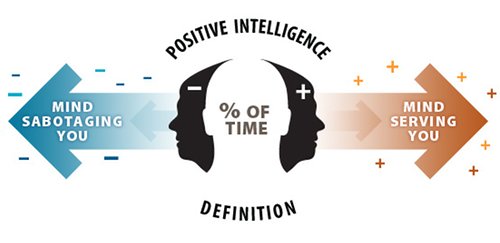
PQ, your Positive Intelligence Quotient, is “the percentage of your time your mind is acting as your friend rather than your enemy.”  It’s expressed on a scale of 0 to 100 and research shows that a PQ of 75 (meaning your mind is your friend, or a good neighborhood, 75% of the time) is a tipping point.  “Above it, you are generally being uplifted by the internal dynamics of the mind, below it you are constantly being dragged down by those dynamics.”  80% of teams and individuals score below the tipping point.


How you can increase your PQ

People with high PQs use one or more of the following 3 strategies:

STRATEGY 1 – Weaken your Saboteurs:

Saboteurs, also called Inner Critics, are the voices, beliefs, and assumptions in your head that work against you.

There are 10 and every person has at least two actively chattering away

  1. Judge: The “Master” Saboteur in everyone’s head. It constantly finds faults in you, others, your circumstances, and anything else it can get its hands on.
  2. Avoider: Focuses on the positive and pleasant to avoid dealing with difficult and unpleasant tasks, conflicts, and people.
  3. Controller: Takes charge, seeking to bend people to its will because it believes that the only way to get the best outcomes from people and situations is to control them
  4. Hyper-Achiever: Relies on constant external rewards, recognition, and praise as a way to feel self-respect and self-validation
  5. Hyper-Rational: Focuses on logic and reason as the sole means through which to understand people and situations, often leading to impatience or outright dismissal of anything or person deemed not logical
  6. Hyper-Vigilant: Sees threats in every moment and is constantly on guard and preparing for the worst-case scenario
  7. Pleaser: Seeks to gain acceptance and affection by constantly helping, pleasing, rescuing, or flattering others
  8. Restless: Searches for the next adventure, new thing, or adrenaline rush and distracts from the relationships and work that really matter
  9. Stickler: Needs perfection, order, and organization to such an extent that it makes everyone anxious and uptight
  10. Victim: Gains attention and affection by focusing on internal feelings, especially negatives ones

To weaken your saboteurs, first identify which one is currently active, then recognize the story its telling you (often, the story will seem helpful so this part is tricky), and then either call it out (“oh, it’s you again, making up stories) or thank it (“thank you for trying to keep me safe.  I’ve got this.”)

STRATEGY 2 – Strengthen your Sage: 

The Sage perspective is essentially the opposite of the Judge.  Whereas the Judge finds everything that is (or could be wrong), the Sage accepts every single thing as a gift or opportunity.

OK, I know this sounds like some new-age woo, especially in the midst of COVID-19 and its impact on every single thing in our lives.  Chamine’s C-Suite clients are skeptical of this too, which is why he teaches them the Three Gifts technique – write down the horrible thing then write down 3 ways it could turn out to be a gift or opportunity at some point in the future.

You can strengthen your Sage by using one (or more) of its 5 powers:

  1. Empathize: When strong feelings are involved and emotional reserves are running low, picture yourself, or the person or situation causing problems, as a small child and interact with it
  2. Explore: When the situation is complex or you want more information before making a decision, pretend to be a fascinated anthropologist and seek out info by asking questions
  3. Innovate: When the usual answers aren’t working, adopt an innovator’s mentality greet ideas with “yes….and….”
  4. Navigate: When faced with multiple options, “flash forward” and imagine yourself at some point in the distant future after having taken each path and consider how you feel in that future place
  5. Activate: When your Saboteurs are in control, preempt them by writing down everything they could say and recognize, respond, and thank it.

STRATEGY 3 – Strengthen your PQ brain

Your PQ brain is comprised of the middle prefrontal cortex, the right brain, the mirror neuron system, the ACC, and the Insular Cortex (these last three areas control your empathy reaction).

Strengthening your PQ brain is as “simple” as focusing all of your attention on your physical body and/or the experience of at least one of your 5 senses, for at least 10 seconds 100 separate times per day for 21 straight days

Yes, 100 times per days sounds like a lot, so Chamine offers some tip:

  • During Daily routines, for example when you’re brushing your teeth, focus on the feeling of the toothbrush against your gums
  • While working out
  • Before or when you’re eating
  • As you listen to music
  • When you’re playing sports (including e-sports)
  • Being with friends and family


Bottom Line

The data proves that Positive Intelligence has a real and tangible impact on your performance at work, in your relationships, and in life.  This book contains a variety of case stories to show the power of Positive Intelligence in action.  Even better, it offers an easy to understand framework and totally do-able approach to make Positive Intelligence work for you.


***

To learn more about Positive Intelligence, visit Shirzad Chamine’s site here.

To buy the book, visit you can buy it from independent online bookstores Bookshop or IndieBound, or at Amazon or Barnes & Noble.


Innovation Starts with EPIC Conversations

Innovation Starts with EPIC Conversations

Innovation doesn’t start with an idea.  It starts with a problem.  Sometimes those problems are easy to observe and understand but, more often, those problems are multi-layered and nuanced.  As a result, you need a multi-layered and nuanced approach to understanding them.

You need to have EPIC Conversations.

EPIC stands for Empathy, Perspective, Insights, and Connection.  As my clients have experienced, conversations rooted in these elements consistently produce unexpected, actionable, and impactful insights capable of getting to the root of a problem and shining a light on the path to a solution (and meaningful business results).


EMPATHY for the people with whom you’re talking

According to Brene Brown, empathy is connecting to the emotion another person is experiencing without requiring us to have experienced the same situation.”

For example, I have a friend who struggles to stay focused and deliver on deadlines.  I can empathize with her because, while I have no problem focusing or delivering on deadlines, I know what it’s like to struggle with something that other people think is easy.

Take the time to connect with people’s emotions, to understand not just what they’re feeling but also why they’re feeling that way and to connect with the experiences in your life and work that led you to feel that way, too.


See things from their PERSPECTIVE:

When we’re working on something – a project, a product, even a task – it gets a great deal of our time, attention, and energy.  But it can lead us to over-estimate how important the work is to others.

Instead, ask people about the topic you’re interested in AND all the topics and activities around it.  Take the time to understand where the things you care about fall into your customers’ priority list

For example, when I worked on developing and launching Swiffer, all I thought about was cleaning floors.   One day, we had to decide whether to source the hair for the dirt that would be used in product demos from people, yaks, or wigs.  We obsessed over this decision, debating which hair would “resonate” the most with consumers.  Turns out, consumers didn’t spend a lot of time analyzing the hair in the demo dirt, they only cared that it was picked up immediately by Swiffer.


Be open to INSIGHTS

Most people use conversations to get confirmation that their ideas and recommendations are good ones.  They’ll spend time explaining and convincing and very little time listening.  And they definitely don’t like surprises.

This is wrong.  The most successful and impactful conversations as those in which you are surprised, in which you get an unexpected piece of information and has an insight, an “a-ha!” moment.

Years ago, while conducting research with people who self-identified as environmentalists, my team spoke with a woman who had the most sustainable house I’d ever seen.  Everything was reused, recycled, or composted and they generated most of their own power.  But, in the garage was a huge yellow HUM-V.  It would have been easy to dismiss it as an anomaly, until we asked about the contradiction and she explained that the reason she owned a HUM-V was the same reason she and her family lived such a sustainable lifestyle: her highest priority was keeping her kids safe.  At home, that meant doing everything possible to help the planet, but on the roads, that meant driving around in a tank.


CONNECT with the person you’re speaking with

It’s tempting to jump right into the conversation, to ask the questions that brought you together.  But that’s like proposing on the first date – you’re not going to get the answer(s) you want.

The best conversations aren’t information transactions, they’re trust building exercises.  Take time to get to know each other.  Make small talk, talk about the traffic and the weather, share a bit about yourself and ask about them.  Throughout the conversation, share a bit about yourself, commiserate over shared frustrations, and laugh at silly stories.

By sharing a bit about yourself, the person you’re talking to will share a bit of themselves, they’ll feel comfortable admitting to things that might not make sense, and to the feelings and rationalizations that drive their behaviors.


EPIC Conversations can happen with anyone anywhere from customers in focus group rooms to employees in conference rooms.  You don’t need an executive mandate to have one, so have one today and let me know how it goes!

Originally published on February 10, 2020 on Forbes.com

The 5 Why’s of Working From Home

The 5 Why’s of Working From Home

In middle school and high school my dad and I would have massive arguments about my math homework. And by “massive,” I mean arguments that make episodes of The Real Housewives look like polite differences of opinion over tea and crumpets.

The issue was not my struggles to understand the work (though I’m sure that played into things) but rather my insistence on knowing WHY I needed to learn the content in the first place.

My dad, a metallurgist before becoming a computer engineer, seemed to think the answers to “Why?” were (1) you will need to know this in the future and (2) because this is the assignment.

To which I would respond, (1) no I won’t because I’m going to be a lawyer or a writer and even if I’m not those two things I can say with 100% certainty I won’t be an engineer and (2) that is not an acceptable reason.

As you can imagine, things would escalate from there.

In the decades since, with the exception of some single-variable algebra and basic geometry, I have yet to use most of the math that I was forced to learn and I still insist that “because that’s the assignment/the rules/how things are done” is not an acceptable answer.

Usually I apply that same stubborn curiosity to help my clients find and capitalize on opportunities to do things differently and better, create value, and innovate.

But, in the last week as I, like most Americans, find myself largely confined to my home, my curiosity is extending to my own environment and habits and I’m not always prepared for the insights that emerge.

WHY am I trying to maintain all my pre-pandemic habits?

  • Initial Answer: Because the experts say I should
  • Insight: I have a choice and now is the perfect time to decide which habits to keep and which to change. So far, I’m keeping all habits related to basic personal hygiene, dressing, and eating, while also experimenting with other habits, like how I schedule my time
  • Real Answer: We’re in an unusual time of collective uncertainty which makes this the perfect time to examine, re-evaluate, and change the things we often take as given. Like our own habits

WHY am I watching non-stop news?

  • Initial Answer: Because information is empowering in uncertain times
  • Insight: A screen showing “Breaking News” AND the global and US COVID-19 diagnosis and death counts AND numerous experts AND a crawl with dozens of other stories is not information. It’s noise. If the “news” has been known for 4 hours, it’s not “breaking,” it’s broken, move on.
  • Real Answer: I need to schedule my information consumption and focus on facts.

WHY am I not using this time to get feedback from my own customers, especially since this is the first thing I tell my clients to do?

  • Initial Answers: (1) I don’t want to bother them, (2) They’re busy with more important things, (3) They never complained so I’m sure it’s all good (4) I need to focus on the future, not the past, (5) I have other things to do, (6) Oh look, another email/text/Facebook post/bird/distraction!
  • Insight: I don’t want to for the exact same reasons most of my clients don’t want to have open-ended EPIC (empathy, perspective, insightful, and connected) conversations with their customers — I’m afraid that even though they say they love me they also know that I’m not perfect and will have really great and helpful suggestions that will require me to change. (in all honesty, this is the nice version of what I say to myself)
  • Real Answer: Time to put on my big-girl pants, follow my own advice, and go ask for feedback. It’s the only way improvement, innovation, and most importantly, client delight will happen

WHY do I suddenly feel the need to go outside and spend all time with people?

  • Initial Answer: Because it’s Spring, the weather is nice, and I like people
  • Insight: I want to go outside and be with people because I have been specifically told NOT to do those things. Just as I’m an introvert who does not like bugs or pollen, I also have a rebellious (intrapreneurial?) streak which makes me want to do exactly what I have been told not to do.
  • Real Answer: I can go outside or open a window, stand in the backyard, or sit on the front porch. I can socialize, I just need to use technology and bring my own drinks and dinner to the FaceTime/Zoom/Skype/Google Hangout

WHY are there 6 dozen eggs in the refrigerator?

  • Initial Answer: My husband is losing his mind OR he forgot that he bought 2 dozen eggs in each of the last two trips to the grocery store.
  • Insight: These are strange and uncertain times and that rattles even the most stoic and level-headed of people. My husband was a submarine warfare officer in the nuclear navy and often tells stories of sleeping on the missiles because they were more comfortable than his bunk and unarmed. This is not a guy who reacts emotionally to events or who worries about the apocalypse. He is cautious and practical and, sometimes, annoyingly reasonable. But he also bought 6 dozen eggs in less than 7 days.
  • Real Answer: Be patient, have empathy, listen to, and support everyone. Especially they people who you think may least need it. Also, I need to get over my aversion to quiche and other egg-heavy dishes.

In conclusion

Stay curious, turn off the news, be open to feedback and change, be supportive of others, let me know if (1) you’ve ever had to use calculus in your personal life and/or (2) have a great egg-heavy recipe

Creative or Reactive: Which One Are You Right Now?

Creative or Reactive: Which One Are You Right Now?

Creative and Reactive

Same letters.

Different order.

Very different results.

These are strange times.

A relentless stream of news and updates are coming at us, warning us about COVID-19, a declining stock market, rising unemployment, and the financial crunch facing millions and millions of individuals and families.

On the other hand, we’re also getting daily notifications from companies about what they’re doing in the face of all of this news, tips for working from home and maintaining our mental health, and encouragement to support our friends, families, neighbors, and strangers in new ways.

Should we be scared or stoic? Isolated or connected? Hoarding or sharing?

Whatever you choose (and it is your choice), I encourage you to also be creative.

I’m not talking about being creative in the capital C way and take up painting, sculpting, composing, or any of the other activities we typically associate with the fine arts.

I’m talking about calmly assessing your situation, clearly acknowledging the constraints that are requiring change, and then exploring the “new normal” you can create.

This is what innovators do and you, yes YOU, are an innovator.

Innovators know that creativity thrives within constraints. If anything is possible and everything is permissible, you can do whatever you want! But that’s not how the world is. Not now and not before COVID-19.

We, people and businesses, have always faced constraints because we’ve never had infinite resources, money, or time. But we acknowledged the constraints and created within them. That’s what we have to do now.

Here’s some inspiration:

Businesses

Devil’s Food Catering: From event caterer to consortium offering takeout meals

Caterers have to order food well before events take place so when events are cancelled, caterers are left with a lot of food that they’ve already paid for and without the event income that was going to cover their costs.

Devil’s Food Catering in Portland OR faced exactly this situation. Instead of letting the food go to waste or trying to become a take-out shop on their own, they created Handbasket by teaming with other with other Portland area restaurants, breweries, distilleries, bakeries, and other providers to create “handmade menus for quality in-home dining experiences during this of social distancing.”

Gyms, Fitness Studios, and Personal Trainers: From in-person to on-line communities

Some people are gifted with the motivation to workout and some of us, well…aren’t.

In-person classes and personal training are often the solutions we rely on because we feel a sense of connection with our instructors, trainers, and classmates. As gyms close and social distancing becomes a way of life, the loss of live workouts can deepen our sense of isolation.

Recognizing this, local gyms, studios, and personal trainers in cities across the country are offering livestream classes so that we can continue to feel connected AND healthy AND active from the comfort of our own homes.

p.s. the link above is for the Boston area but I found similar articles for Philly, Washington, Houston, and even Wyoming

Speakers Who Dare: From Broadway event to Livestream to Movie

Spears Who Dare bills itself as TED meets Broadway, “a groundbreaking speaker series produced like a Broadway show, featuring speakers from around the world who want to ignite change and inspire new ways of thinking.”

Scheduled to take place on March 24, the organizers recognized that, like many other live events, their original plans for a live Broadway event needed to change. Last week, they shifted from live to livestream, planning a 6-camera shoot of each speaker and performer sharing their messages and art in an empty theater.

Then NYC closed the theaters. Within hours the organizers shifted again and asked each speaker to record a “mini-movie” that could be edited together to create “a full-blown Speakers Who Dare Film” to be shared with a global audience, viewing together on the original event date.

People

Seeing your coworkers when you can’t (or don’t want to) videoconference

Homemade games for when you’ve already played all the games you bought

More homemade games for when you really need to interact with people outside your own home

How and what will YOU create today?

Just in case you need a nudge…find the perfect gif starring the perfect celebrity expressing the perfect emotion and send it to someone who needs it


h/t to Kate Dixon and Megan Shea for sending their suggestions

The New Psychology of Success by Carol S. Dweck, Ph.D.

The New Psychology of Success by Carol S. Dweck, Ph.D.

Like many people, I have heard the terms “growth mindset” and “fixed mindset.”

And, like many people, I equated “growth mindset” with being open-minded, curious, flexible, and tolerant.

On the flip side, I thought people with a “fixed mindset” were probably sticks in the mud, unwilling to try or even consider something new or a different perspective.

I was wrong.

Let’s start with the basics

My misunderstanding of what it means to have a fixed or a growth mindset is rooted in my lack of understanding of what these terms actually mean.

The fixed mindset is rooted in the belief that a human’s personal qualities are carved in stone. That, at birth, you were granted a certain amount of intelligence, morality, talent, etc. and that there is nothing you can do to develop more.

The growth mindset “is based on the belief that our basic qualities are things you can cultivate through your efforts, your strategies, and help from others. Although people may differ in every which way — in their initial talents and aptitudes, interests or temperaments — everyone can change and grow through application and experience.”

Yep, I’ve got a growth mindset…or do I?

I was feeling quite good about myself until page 12. That’s where I hit the “Grow Your Mindset” quiz:

Read each statement and decide whether you mostly agree with it or disagree with it:

  1. Your intelligence is something very basic about you that you can’t change very much.
  2. You can learn new things but you can’t really change how intelligent you are.
  3. No matter how much intelligence you have, you can always change quite a bit.
  4. You can always substantially change how intelligent you are.

My answers were Yes, Yes, No, No.

(note, you can swap out “intelligence” for any personal quality — artistic talent, athletic ability, your personality)

Guess what, questions 1 and 2 are about the fixed mindset and questions 3 and 4 are about the growth mindset.

“I am a horrible person! I have a fixed mindset!” I thought just before collapsing onto the floor, ready to give up on my humanity. But then I rephrased the questions…

  1. A person’s intelligence is something very basic about them that they can’t change very much.
  2. A person can learn new things but they can’t really change how intelligent they are.
  3. No matter how much intelligence someone has, they can always change quite a bit.
  4. A person can always substantially change how intelligent they are.

This time my answers were No, No, Yes, Yes.

I wasn’t thrilled to realize that I had a “split mindset” but it did make sense.

When I think about myself, my capabilities, and my performance I tend to be a perfectionist (ok, I am a perfectionist) and ruminate endlessly on my mistakes (no kidding, I still vividly remember hitting the “hang-up” button instead of the “unmute” button on a conference call in 2010). I am terrified of feedback because I feel like it is a judgement against me. (Of course I ask for it and thank people when I get it but that’s just because these are the things we all agreed to say but none of us really mean. Right?)

But I don’t feel or think any of these things when it comes to other people. I genuinely believe that if you work hard enough and long enough, you can accomplish anything. I deeply believe that sometimes the best and only way to grow is to learn from mistakes. No one needs to prove anything to me and I love people who ask for feedback because it shows they care and that they’re trying and so I try to be as kind and helpful as possible.

I was a bit concerned that having a split mindset was one-step removed from having a split personality but it’s apparently not unusual at all.

People’s mindsets can change for all sorts of reasons — the context they’re in (e.g. work vs. home), who they’re with (e.g. the boss, their co-workers, their partner, friends, their kids, their parents), what they’re doing (e.g. math vs English, work vs a hobby), and any number of other variables. The key is to know when and where a change in mindset may occur.

There is hope!

“Mindsets are just beliefs. They’re powerful beliefs, but they’re just something in your mind, and you can change your mind.”

Thank you page 16.

I will now change my mind.

I had to get all the way to page 254 to figure out how.

  1. Step 1 — Embrace your fixed mindset. > DONE!
  2. Step 2 — Become aware of your fixed mindset triggers. Where does your fixed-mindset self show up. > I tried to answer this question with “life” but it was too general. So I tried being more specific. The list is LONG and still growing
  3. Step 3 — Now give your fixed-mindset persona a name > In progress.
  4. Step 4 — Educate your fixed-mindset persona, take it on the journey with you > I’d rather not as it’s quite an unpleasant travel companion, but fine.
  5. Step 5 — Print out this graphic and tape it to your bathroom mirror > No thank you, it will never survive. But I will print out this one and hang it next to my computer.
  6. Step 6 — At the start of each day, identify opportunities for learning and growth and create a tangible action plan to take advantage of each one. > I’m actually doing this. It’s helping (I think) but it also results in me taking a lot of deep breaths.

I wish the journey from fixed to growth mindset was as easy as simply checking off steps 1 through 6 but it’s not. It’s a daily process that can be frustratingly slow. But I think it’s worth it.

If only so that I can one day get to the point when I say “Thank you for the feedback” and actually mean it.

Other random nuggets of wisdom

In between page 16 and page 254 there was a lot of great stuff about how the mindsets come into play in business, parenting, and coaching. Here’s a sample:

FIXED MINDSET

“The fixed mindset creates an internal monologue that is focused on judging.”

“Effort is for those who don’t have the ability.”

“The fixed mindset is so very tempting. It seems to promise children a lifetime of worth, success, and admiration just for sitting there and being who they are.”

“However, lurking behind the self-esteem of the fixed mindset is a simple question: If you’re somebody when you’re successful, what are you when you’re unsuccessful?”

“The minute a leader allows himself to become the primary reality people worry about, rather than reality being the primary reality, you have a recipe for mediocrity, or worse.” — Jim Collins, Good to Great

“When bosses become controlling and abusive, they put everyone into a fixed mindset. This means that instead of learning, growing, and moving the company forward, everyone starts worrying about being judged. It starts with the bosses’ worry about being judged but it winds up being everybody’s fear about being judged. It’s hard for courage and innovation to survive in a companywide fixed mindset.”

GROWTH MINDSET

“You aren’t a failure until you start to blame.”

“…even when you think you’re not good at something, you can still plunge into it wholeheartedly and stick to it.”

“Just because some people can do something with little or no training, it doesn’t mean that others can’t do it (and sometimes do it even better) with training.”

“A growth mindset helps people to see prejudice for what it is — someone else’s view of them — and to confront it with their confidence and abilities intact.”

“True self-confidence is ‘the courage to be open — to welcome change and new ideas regardless of their source.’”

In business “taking on challenges, showing persistence, and admitting and correcting mistakes are essential.”

“Not only do those with a growth mindset gain more lucrative outcomes for themselves, but, more important they also come up with more creative solutions that confer benefits all around.”


If you want to read Mindset: The New Psychology of Success it’s probably in your local library or you can buy it at AmazonBarnes and Noble, or (hopefully) your local independent book seller.