
Is Your Brain Friend or Foe? Make It Your Friend with Positive Intelligence
“If you spend a lot of time in your own head, you’re spending time in a bad neighborhood.”
I was deep in a bit of worry and self-doubt when my friend uttered that sentence. Immediately, my mind conjured an image of falling gown building, boarded up doors and windows, overgrown yards, and empty streets (basically downtown Cleveland in the 1980s).
“Man, I do not want to be here!” I said, probably a bit too loudly.
Everyone I know spends a lot of time in their bad neighborhoods. It’s a consequence of the world we live in – more demands, responsibilities, and expectations running into greater uncertainty, fewer options, and weaker safety nets.
There are lots of ways to spruce up our neighborhoods, cultivating a Growth Mindset is one. In his book, Positive Intelligence: Why Only 20% of Teams and Individuals Achieve Their True Potential and How You Can Achieve Yours, author and executive coach Shirzad Chamine, lays out a powerful framework and action plan to build your Positive Intelligence by increasing your PQ (Positive Intelligence Quotient).
Why Should I Care about Positive Intelligence?
Because research proves that a high PQ creates better results
- An analysis of more than 200 different scientific studies, which collectively tested more than 275,000 people, conduced that higher PQ leads to higher salary and greater success in the arenas of work, marriage, health, sociability, friendship, and creativity
- Salespeople with higher PQ sell 37% more than their lower-PQ peers
- Project teams managed by high-PQ managers perform 31% better
- Doctors with a high PQ make accurate diagnoses 19% faster
- People who demonstrated high PQ in their 20s (as evidence by journal entries) live, on average, 10 years longer
Better sales, better performance, better health, longer lives.
Seems like something worth learning more about.
What is Positive Intelligence and PQ?
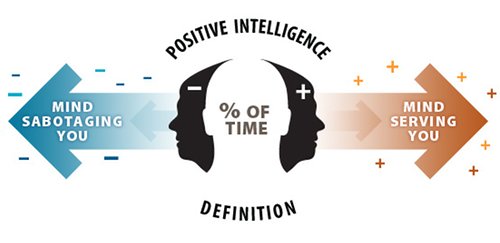
Chamine defines Positive Intelligence as “an indication of the control you have over your own mind and how well your mind acts in your best interest.” Basically, what kind of neighborhood is your mind.
PQ, your Positive Intelligence Quotient, is “the percentage of your time your mind is acting as your friend rather than your enemy.” It’s expressed on a scale of 0 to 100 and research shows that a PQ of 75 (meaning your mind is your friend, or a good neighborhood, 75% of the time) is a tipping point. “Above it, you are generally being uplifted by the internal dynamics of the mind, below it you are constantly being dragged down by those dynamics.” 80% of teams and individuals score below the tipping point.
How you can increase your PQ
People with high PQs use one or more of the following 3 strategies:
STRATEGY 1 – Weaken your Saboteurs:
Saboteurs, also called Inner Critics, are the voices, beliefs, and assumptions in your head that work against you.
There are 10 and every person has at least two actively chattering away
- Judge: The “Master” Saboteur in everyone’s head. It constantly finds faults in you, others, your circumstances, and anything else it can get its hands on.
- Avoider: Focuses on the positive and pleasant to avoid dealing with difficult and unpleasant tasks, conflicts, and people.
- Controller: Takes charge, seeking to bend people to its will because it believes that the only way to get the best outcomes from people and situations is to control them
- Hyper-Achiever: Relies on constant external rewards, recognition, and praise as a way to feel self-respect and self-validation
- Hyper-Rational: Focuses on logic and reason as the sole means through which to understand people and situations, often leading to impatience or outright dismissal of anything or person deemed not logical
- Hyper-Vigilant: Sees threats in every moment and is constantly on guard and preparing for the worst-case scenario
- Pleaser: Seeks to gain acceptance and affection by constantly helping, pleasing, rescuing, or flattering others
- Restless: Searches for the next adventure, new thing, or adrenaline rush and distracts from the relationships and work that really matter
- Stickler: Needs perfection, order, and organization to such an extent that it makes everyone anxious and uptight
- Victim: Gains attention and affection by focusing on internal feelings, especially negatives ones
To weaken your saboteurs, first identify which one is currently active, then recognize the story its telling you (often, the story will seem helpful so this part is tricky), and then either call it out (“oh, it’s you again, making up stories) or thank it (“thank you for trying to keep me safe. I’ve got this.”)
STRATEGY 2 – Strengthen your Sage:
The Sage perspective is essentially the opposite of the Judge. Whereas the Judge finds everything that is (or could be wrong), the Sage accepts every single thing as a gift or opportunity.
OK, I know this sounds like some new-age woo, especially in the midst of COVID-19 and its impact on every single thing in our lives. Chamine’s C-Suite clients are skeptical of this too, which is why he teaches them the Three Gifts technique – write down the horrible thing then write down 3 ways it could turn out to be a gift or opportunity at some point in the future.
You can strengthen your Sage by using one (or more) of its 5 powers:
- Empathize: When strong feelings are involved and emotional reserves are running low, picture yourself, or the person or situation causing problems, as a small child and interact with it
- Explore: When the situation is complex or you want more information before making a decision, pretend to be a fascinated anthropologist and seek out info by asking questions
- Innovate: When the usual answers aren’t working, adopt an innovator’s mentality greet ideas with “yes….and….”
- Navigate: When faced with multiple options, “flash forward” and imagine yourself at some point in the distant future after having taken each path and consider how you feel in that future place
- Activate: When your Saboteurs are in control, preempt them by writing down everything they could say and recognize, respond, and thank it.
STRATEGY 3 – Strengthen your PQ brain
Your PQ brain is comprised of the middle prefrontal cortex, the right brain, the mirror neuron system, the ACC, and the Insular Cortex (these last three areas control your empathy reaction).
Strengthening your PQ brain is as “simple” as focusing all of your attention on your physical body and/or the experience of at least one of your 5 senses, for at least 10 seconds 100 separate times per day for 21 straight days
Yes, 100 times per days sounds like a lot, so Chamine offers some tip:
- During Daily routines, for example when you’re brushing your teeth, focus on the feeling of the toothbrush against your gums
- While working out
- Before or when you’re eating
- As you listen to music
- When you’re playing sports (including e-sports)
- Being with friends and family
Bottom Line
The data proves that Positive Intelligence has a real and tangible impact on your performance at work, in your relationships, and in life. This book contains a variety of case stories to show the power of Positive Intelligence in action. Even better, it offers an easy to understand framework and totally do-able approach to make Positive Intelligence work for you.
***
To learn more about Positive Intelligence, visit Shirzad Chamine’s site here.
To buy the book, visit you can buy it from independent online bookstores Bookshop or IndieBound, or at Amazon or Barnes & Noble.