
Why Creative Confidence Beats Market Signals (And How Johnny Cash Used It to Resurrect His Career)

Why Creative Confidence Beats Market Signals (And How Johnny Cash Used It to Resurrect His Career)

The best business advice can destroy your business. Especially when you follow it perfectly.

Just ask Johnny Cash.

After bursting onto the scene in the mid-1950s with “Folsom Prison Blues”, Cash enjoyed twenty years of tremendous success.   By the 1970s, his authentic, minimalist approach had fallen out of favor.

Eager to sell records, he pivoted to songs backed by lush string arrangements, then to “country pop” to attract mainstream audiences and feed the relentless appetite of 900 radio stations programming country pop full-time.

By late 1992, Johnny Cash’s career was roadkill. Country radio had stopped playing his records, and Columbia Records, his home for 25 years, had shown him the door. At 60, he was marooned in faded casinos, playing to crowds preferring slot machines to songs.

Then he took the stage at Madison Square Garden for Bob Dylan’s 30th anniversary concert.

In the audience sat Rick Rubin, co-founder of Def Jam Recordings and uber producer behind Public Enemy, Run-DMC, and Slayer, amongst others. He watched in awe as Cash performed, seeing not a relic but raw power diluted by smart decisions.


The Stare-Down that Saved a Career

Four months later, Rubin attended Cash’s concert at The Rhythm Café in Santa Anna, California. According to Cash’s son, “When they sat down at the table, they said: ‘Hello.’ But then my dad and Rick just sat there and stared at each other for about two minutes without saying anything, as if they were sizing each other up.”

Eventually, Cash broke the silence, “What’re you gonna do with me that nobody else has done to sell records for me?”

What happened next resurrected his career.

Rubin didn’t promise record sales.  He promised something more valuable: creative control and a return to Cash’s roots.

Ten years later, Cash had a Grammy, his first gold record in thirty years, and CMA Single of the Year for his cover of Nine Inch Nails’ “Hurt,” and millions in record sales.

When Smart Decisions Become Fatal

Executives do exactly what Cash did.  You respond to market signals. You pivot your offering when customer preferences shift and invest in emerging technologies.

All logical. All defensible to your board. All potentially fatal.

Because you risk losing what made you unique and valuable. Just as Cash lost his minimalist authenticity and became a casualty of his effort to stay relevant, your business risks losing sight of its purpose and unique value proposition.


Three Beliefs at the Core of a Comeback

So how do you avoid Cash’s initial mistake while replicating his comeback? The difference lies in three beliefs that determine whether you’ll have the creative courage to double down on what makes you valuable instead of diluting it.

  1. Creative confidence: The belief we can think and act creatively in this moment.
  2. Perceived value of creativity: Our perceived value of thinking and acting in new ways.
  3. Creative risk-taking: The willingness to take the risks necessary for active change.

Cash wanted to sell records, and he:

  1. Believed that he was capable of creativity and change.
  2. Saw the financial and reputational value of change
  3. Was willing to partner with a producer who refused to guarantee record sales but promised creative control and a return to his roots.


Your Answers Determine Your Outcome

Like Cash, what you, your team, and your organization believe determines how you respond to change:

  1. Do I/we believe we can creatively solve this specific challenge we’re facing right now?
  2. Is finding a genuinely new approach to this situation worth the effort versus sticking with proven methods?
  3. Am I/we willing to accept the risks of pursuing a creative solution to our current challenge?”

Where there are “no’s,” there is resistance, even refusal, to change.  Acknowledge it.  Address it.  Do the hard work of turning the No into a Yes because it’s the only way change will happen.


The Comeback Question

Cash proved that authentic change—not frantic pivoting—resurrects careers and disrupts industries. His partnership with Rubin succeeded because he answered “yes” to all three creative beliefs when it mattered most. Where are your “no’s” blocking your comeback?

Three Ways Strategic Idleness Gives You an Edge in Driving Innovation and Growth

Three Ways Strategic Idleness Gives You an Edge in Driving Innovation and Growth

“What will you do on vacation?” a colleague asked.

“Nothing,” I replied.

The uncomfortable silence that followed spoke volumes. In boardrooms and during quarterly reviews, we celebrate constant motion and back-to-back calendars.  Yet, study after study shows that the most successful leaders embrace a counterintuitive edge: strategic idleness.

While your competitors exhaust themselves in perpetual busyness, research shows that deliberate mental downtime activates the brain networks responsible for strategic foresight, innovative solutions, and clear decision-making.


The Status Trap of Busy-ness

At one company I worked with, there was only one acceptable answer to “How are you doing?”  “Busy.”  The answer wasn’t a way to avoid an awkward hallway conversation. It was social currency. If you’re busy, you’re valuable.  If you’re fine, you’re expendable.

A 2017 study published in the Journal of Consumer Research confirmed what Columbia, Georgetown, and Harvard researchers discovered: being busy is now a status symbol, signaling “competence, ambition, and scarcity in the market.”

But here’s the uncomfortable truth: your packed schedule is undermining the very outcomes you’re accountable for delivering.


Your Brain’s Innovation Engine

Neuroscience has confirmed what innovators have long practiced: Strategic Idleness. While you consciously “do nothing,” your default mode network (DMN) engages, making unexpected connections across stored information and experiences.

Recent research published in the journal Brain demonstrates that the DMN is activated during creative thinking, with a specific pattern of neural activity occurring during the search for novel ideas. This network is essential for both spontaneous thought and divergent thinking, core elements of innovation.

So if you’ve always wondered why you get your best ideas in the shower, it’s because your DMN is powered all the way up.


Three Ways to Power-Up Your Engine

Here are three executive-grade approaches to strategic idleness without more showers or productivity sacrifices:

  1. Pause for 10 Minutes Before Making a Decision
    Before making high-stakes decisions, implement a mandatory 10-minute idleness period. No email, no conversation—just sitting. Research on cognitive recovery suggests that this brief reset activates your DMN, allowing for a more comprehensive consideration of variables and strategic implications.
  2. Take a Walking Meeting with Yourself
    Block 20 minutes in your calendar each week for a solo walking meeting (and then take the walk!). No other attendees, no agenda, just walking. Researchers at Stanford University found that walking increases creative output by an average of 60% compared to sitting. The combination of physical movement and mental space creates ideal conditions for your brain to generate solutions to problems you didn’t know you had.
  3. Schedule 3-5 minutes of Strategic Silence before key discussions
    Research on group dynamics shows that silent reflection before discussion can reduce groupthink and increase the quality of ideas by helping team members process information more deeply. Before you dive into a critical topic at your next leadership meeting, schedule 3-5 minutes of silence. Explain that this silence is for individual reflection and planning for the upcoming discussion, not for checking email or taking bathroom breaks. Acknowledge that it will feel awkward, but that it’s critical for the upcoming discussion and decision.
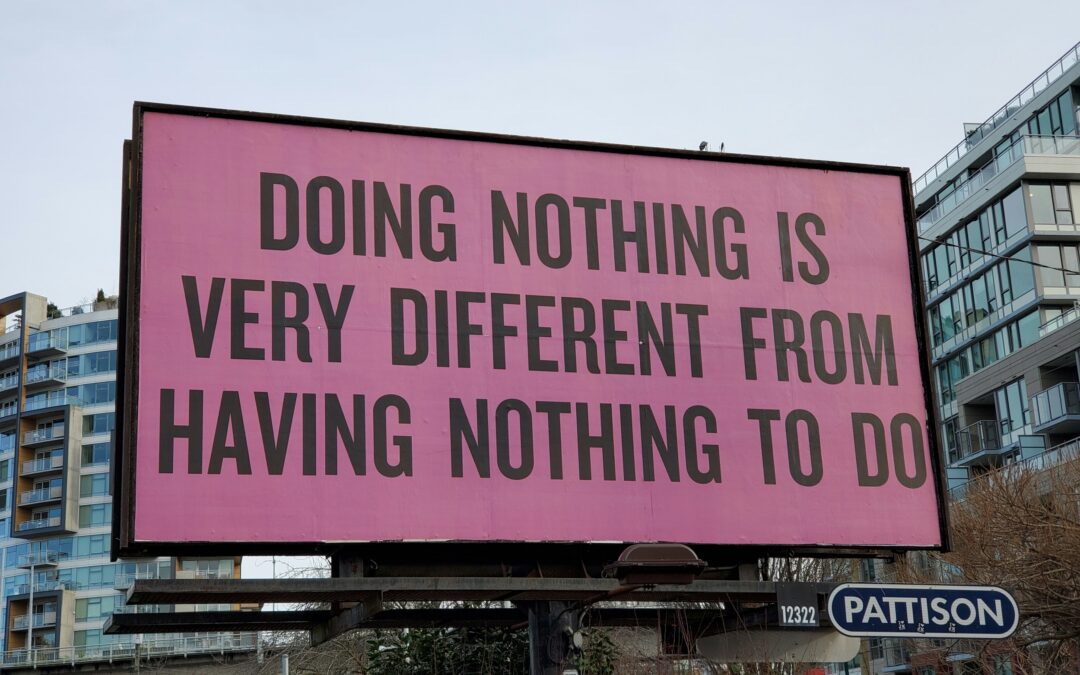
Remember, You’re Not Doing Nothing If You’re being Strategically Idle

The most valuable asset in your organization isn’t technology, capital, or even the products you sell.  It’s the quality of thinking that goes into critical decisions. Strategic idleness isn’t inaction; it’s the deliberate cultivation of conditions that foster innovation, clear judgment, and strategic foresight.

While your competitors remain trapped in perpetual busyness, by using executive advantage of strategic idleness, your next breakthrough will present itself.

This is an updated version of the June 9, 2019, post, “Do More Nothing.”

Who is More Creative – Men or Women? 753 Studies have the Answer

Who is More Creative – Men or Women? 753 Studies have the Answer

You were born creative. As an infant, you had to figure many things out—how to get fed or changed, get help or attention, and make a onesie covered in spit-up still look adorable.  As you grew older, your creativity grew, too.  You drew pictures, wrote stories, played dress-up, and acted out imaginary stories.

Then you went to school, and it was time to be serious.  Suddenly, creativity had a time and place.  It became an elective or a hobby.  Something you did just enough of to be “well-rounded” but not so much that you would be judged irresponsible or impractical.

When you entered the “real world,” your job determined whether you were creative.  Advertising, design, marketing, innovation?  Creative.  Business, medicine, law, engineering?  Not creative.

As if Job-title-a-determinant-of-creativity wasn’t silly enough, in 2022, a paper was published in the Journal of Applied Psychology that declared that, based on a meta-analysis of 259 studies (n=79,915), there is a “male advantage in creative performance.”

Somewhere, Don Draper, Pablo Picasso, and Norman Mailer high-fived.

But, as every good researcher (and innovator) knows, the headline is rarely the truth.  The truth is that it’s contextual and complicated, and everything from how the original studies collected data to how “creativity” was defined matters.

But that’s not what got reported.  It’s also not what people remember when they reference this study (and I have heard more than a few people invoke these findings in the three years since publication).

That is why I was happy to see Fortune report on a new study just published in the Journal of Applied Psychology. The study cites findings from a meta-analysis of 753 studies (n=265,762 individuals) that show men and women are equally creative. When “usefulness (of an idea) is explicitly incorporated in creativity assessment,” women’s creativity is “stronger.”

Somewhere, Mary Wells Lawrence, Frida Kahlo, and Virginia Woolf high-fived.

Of course, this finding is also contextual.

What makes someone “creative?”

Both studies defined creativity as “the generation of novel and useful ideas.”

However, while the first study focused on how context drives creativity, the second study looked deeper, focusing on two essential elements of creativity: risk-taking and empathy. The authors argued that risk-taking is critical to generating novel ideas, while empathy is essential to developing useful ideas.

Does gender influence creativity?

It can.  But even when it does, it doesn’t make one gender more or less creative than the other.

Given “contextual moderators” like country-level culture, industry gender composition, and role status, men tend to follow an “agentic pathway” (creativity via risk-taking), so they are more likely to generate novel ideas.

However, given the same contextual moderators, women follow a “communal pathway” (creativity via empathy), so they are more likely to generate useful ideas.

How you can use this to maximize creativity

Innovation and creativity go hand in hand. Both focus on creating something new (novel) and valuable (useful).  So, to maximize innovation within your team or organization, maximize creativity by:

  • Explicitly incorporate novelty and usefulness in assessment criteria.  If you focus only on usefulness, you’ll end up with extremely safe and incremental improvements.  If you focus only on novelty, you’ll end up with impractical and useless ideas.
  • Recruit for risk-taking and empathy.  While the manifestation of these two skills tends to fall along gender lines, don’t be sexist and assume that’s always the case.  When seeking people to join your team or your brainstorming session, find people who have demonstrated strong risk-taking or empathy-focused behaviors and invite them in.
  • Always consider the context.  Just as “contextual moderators” impact people’s creative pathways, so too does the environment you create.  If you want people to take risks, be vulnerable, and exhibit empathy, you must establish a psychologically safe environment first.  And that starts with making sure there aren’t any “tokens” (one of a “type”) in the group.

Which brings us back to the beginning.

You ARE creative.

How will you be creative today?

VTS with the Best: An Interview with Suzi Hamill

VTS with the Best: An Interview with Suzi Hamill

Last week, I wrote about Visual Thinking Strategies (VTS), a process of using art to teach visual literacy, thinking, and communication skills.

Typically, used in primary school classrooms, VTS has made its way into the corporate setting, helping individuals and teams to build and strengthen their problem solving and critical thinking skills, ability to communicate and collaborate, and effectiveness in delivering and receiving feedback.

While I did my best to capture the Why, What, and How of VTS in that post, there’s no substitute for learning from an expert.  That’s why I asked Suzi Hamill , former Head of Design Thinking at Fidelity and the woman who introduced me to VTS, to share her experience using the tool.


Hi Suzi.  Thanks for sharing your VTS wisdom and experience today.  I understand you’ve been doing a fair bit of VTS-ing lately.

Suzi: Yes!  Just a few months ago I was at Oxford University coaching 30 Chief Marketing Officers from large global corporations on how to apply Visual Thinking Strategies to their work and their teams.  And just last week, I led a session with a group of women on the West Coast of the US.

That’s one of the things I find so fascinating about VTS.  It was created to help people learn about art and was designed to be used in schools, but it can have such a powerful impact in a wide variety of businesses.

Suzi: Absolutely.  In a business context, there are massive systems and massive problems, and everyone has their own interpretation of what’s going on.  (imagine doctors deliberating over a diagnosis, investment analysts debating a company’s intrinsic value, retailers predicting the next fashion trend…) This creates conflict.  How do you pull together a range of people and ideas to forge the best path forward? VTS is a great, simple but rigorous method to help business groups look at big problems. VTS is a way to have open exploratory conversations with a diverse set of people

This is especially true in organizations that are very execution oriented. Often organizations haven’t developed the time, space or habit to work through ambiguity. VTS opens space for there to be ambiguity and dialogue.  It gives people permission to explore ideas, be wrong, and hear different points of view.

All of those behaviors are essential to making good business decisions.  I wonder, have you found that some people need “permission” more than others?

Suzi: I think everyone can benefit from the VTS experience and there are some circumstances where it can be transformational.

We are often taught not to question authority. But there is a delicate balance between challenging authority and understanding perspectives At Fidelity, our first experiment focused on using it as a way to prompt open conversation when there was a power imbalance in a room.  We rolled VTS out to our Design Team of about 100 people as a way to help junior designers to talk to the CEO or senior executives about their work and not get defensive.  We trained them to ask the VTS questions, especially “What do you see that makes you say that?”  We found that it was a great way for designers to learn how to get feedback on their designs.

Once we started having success with VTS, it was integrated into Fidelity’s 6-month long training program for the top 100 potential leaders.

That’s where we found the next circumstance – using VTS with leadership teams.  We found that VTS acts as a practical way to introduce the idea that you’re not just a do-er now, you’re a thinker and, as a result, you’re going to be faced with ambiguity.  Instead of shying away from it, you need to see that ambiguity is not only ok, but it is also fertile ground for us to grow our business.

That’s great but, as we both know, just because you learn something in training doesn’t mean you actually do it in real life.  Have you seen VTS make that jump?  Get people to move from knowing to doing?

 Suzi: I have.

At Fidelity, we would VTS customer research.  We would use the principle of VTS more than follow the strict methodology. We’d post our research on walls – sticky notes, photos of customers, flowcharts, everything, and we would bring in stakeholders and use the VTS process to tease out insights.  We give people time to LOOK and internalize what they were seeing before we told them what to think. By asking questions, we would discover what they were interpreting, identify unconscious biases, and learn what they already know or want to know about the customer.

At the event in Oxford, we VTS-ed the Business Model Canvas because most of the CMOs weren’t familiar with it.   Just by looking at it, they teased out its purpose, what was important and what wasn’t, what was confusing, and what wouldn’t work.  They walked away with a deeper internalization of its meaning

How is VTS able to do that?  To help people quickly internalize new insights or behaviors?

Suzi: The best way I can explain it is that VTS is like yoga.  When you teach someone yoga, with consistent practice they develop better posture and they walk and move fluidly and with strength.  So, when they’re going through their day, they become more aware of their posture and adjust but they don’t go into a whole vinyasa flow.

VTS is similar because when you use it with people, you’re teaching the mechanics of dialogue, of using evidence to progress, of managing ambiguity and conflict.

It takes time to tease out the power of the process but in the end, I’ve seen it help people realize that you don’t have to agree or disagree right away.  Instead, it gives them space to express an opinion and teaches them to ask questions and to ask for evidence in a way that is psychologically safe.

OK, but is it as simple as asking the 3 VTS questions?

Suzi: I wish.  You need somebody who is a skilled facilitator, who can keep the group moving forward and exploring ideas.

Leaders know they should stimulate conversation… solicit other people’s opinions, but they don’t know how. In meetings leaders will voice their own opinions, rely on the loudest voices, and steer the conversation. People will pick up on these signals. They will stop exploring and focus on giving the right answer.

Often, when people are running meetings they try to participate.  But that’s like trying to breathe underwater.  You can’t facilitate and participate.

What have you learned & applied?

Suzi: If you want to get people to engage in a great dialog, try giving them something to look at first. It can be a metaphor or real reflection. But give them something specific to point to anchor their thoughts.

Give people time to look and think before they speak or act. Silence is Golden. Silence is not the enemy. Give people time to silently observe something. Even 1 min can make a huge difference in how people respond.

You don’t need to compliment people on their thoughts to keep them engaged. Ask them for more… What do you see that makes you say that? What more can we find? People are not often asked for their opinions. That act alone is incredibly engaging.

As a leader it is just as important to get the obvious out on the table so that you can get to true insight.

TO LEARN MORE ABOUT VTS OR TO EXPERIENCE IT FOR YOURSELF…

How Looking at Art Can Make You a Better Thinker, Communicator, and Leader

How Looking at Art Can Make You a Better Thinker, Communicator, and Leader

“It was quite a sight!  A dozen senior executives from a big, conservative financial services firm, all sitting on the floor in front of a painting, talking about what it could mean and why they think that.”

On a typical dreary November day, and Suzi and I were sitting in the café inside Boston’s Museum of Fine Arts.  She had just left her job as Head of Design Thinking at Fidelity Investments and I was taking a sabbatical before deciding what would be next for my career.  Introduced by a mutual friend, we decided to swap stories over lunch and a walk through one of the museum’s special exhibitions.

She was describing a Visual Thinking (VTS) session she had recently facilitated and the nearly instant impact it had on the way executives expressed themselves and communicated with each other.  She saw them engage in a level of creative problem-solving and critical thinking that they hadn’t in the past.

Intrigued, I set off to learn more.  What I discovered was a powerful, proven, and gasp fun way to help my clients navigate the ambiguous early days of innovation and embrace their inner curiosity and creativity.


Why should you care about VTS?

Imagine someone says to you, “If you and your team spend 1-2 hours with me each month for 9 months, I guarantee an improvement in your abilities to:

  • Quickly gather and synthesize accurate and unique insights by listening deeply and re-phrasing what they heard ensure understanding
  • Think critically and creatively by examining information or an idea from all angles, rethinking it, and deciding whether to keep, revise, or discard it
  • Communicate more clearly, respectfully, and productively with a variety of people inside and outside the organization
  • Work cross-functionally because they can apply critical thinking skills confidently to topics outside of their expertise
  • Innovate and experiment because they have learned how to individually and as a team operate in uncertainty
  • Provide more effective feedback by phrasing criticisms as questions and engaging in collaborative discovery and problem-solving conversations

Would you make the time commitment?

Now, what if they said, “All you have to do each month is sit together in a conference room and take part in a conversation.  No travel.  No additional expenses.  Just turn off your email and your phone for one hour and have a conversation in a room you already pay rent on.”

Would you do it then?

Of course you would.

Because you’ve been to trainings that focus on only one of the items in the list above and those trainings are expensive, time-consuming, and not nearly as effective as they should be.


What is Visual Thinking Strategies (VTS)?

According to the book, Visual Thinking Strategies: Using Art to Deepen Learning Across School Disciplines, VTS “uses art to teach visual literacy, thinking, and communication skills – listening an expressing oneself.”

Philip Yenawine was the Director of Education at the Museum of Modern Art (MOMA) in New York from 1983 – 1993.  During that time, he noticed that despite the museum’s efforts to organize and craft detailed explanations and interpretations for each piece of art, visitors would still ask lots of “Why?” questions and would remember little, if anything, from their visit.

Frustrated but curious, he and his team began studying developmental research and theory and discovered that what MOMA visitors needed wasn’t explanations, details, and facts, it was “permission to be puzzled and to think.  Consent to use their powerful eyes and intelligent minds.  Time to noodle and figure things out.  The go-ahead to use what they already know to reflect on what they don’t; the first steps of learning.”

Philip and his team with MOMA partnered with cognitive psychologist Abigail Housen to develop and test a process now known as Visual Thinking Strategies (VTS).

In the 30 years since their initial experiments, Philip and Abigail’s work has been used in 28 countries and 58 museums, over 12,000 students have engaged in VTS discussions and 1,200 people have become trained facilitators.


How to do VTS

The secret to VTS’ effectiveness is in the facilitation so if you’re going to do this, invest in an expert facilitator.  An expert facilitator is the only way to get the results listed above.


Here’s how a VTS session works:

  • Facilitator shares a piece of art specially selected so that “the subjects are familiar… but they also contain elements of mystery.”
  • Attendees take one minute to silently focus on the art
  • Facilitator asks 3 questions over the hour:
    • What’s going on in this picture?
    • What do you see that makes you say that?
    • What more can you find?
  • As each individual answers a question, the Facilitator:
    • Points at what is being observed
    • Paraphrases what has been said
    • Links what has been said to what others have said
  • Facilitator wraps up the session by thanking everyone and sharing something s/he learned from listening. They do NOT give “the answer” because “this isn’t about right and wrong but about thinking and…that the students singly and together are capable of wonderful, grounded ideas.”

That’s it – 1 piece of art, 3 questions, and at least 5 major benefits if you commit to the process.


Seems like something worth sitting on an art gallery floor for, right?

To learn more, read Visual Thinking Strategies: Using Art to Deepen Learning Across School Disciplines by Philip Yenawine and visit the website Visual Thinking Strategies