
by Robyn Bolton | Jul 24, 2022 | Customer Centricity, Innovation, Leadership, Metrics, Stories & Examples, Strategy
Many years ago, Clay Christensen visited his firm where I was a partner and told us a story*.
“I imagine the day I die and present myself at the entrance to Heaven,” he said. “The Lord will show me around, and the beauty and majesty will overcome me. Eventually, I will notice that there are no numbers or data in Heaven, and I will ask the Lord why that is.”
“Data lies,” the Lord will respond. “Nothing that lies can be in Heaven. So, if people want data, I tell them to go to Hell.”
We all chuckled at the punchline and at the strength of the language Clay used (if you ever met him, you know that he was an incredibly gentle and soft-spoken man, so using the phrase “go to Hell” was the equivalent of your parents unleashing a five-minute long expletive-laden rant).
“If you want data, go to Hell.”
Clay’s statement seems absolutely blasphemous, especially in a society that views quantitative data as the ultimate source of truth:
- “In God we trust. All others bring data.” W. Edward Deming, founding Father of Total Quality Management (TQM)
- “Above all else, show the data.” – Edward R. Tufte, a pioneer in the field of data visualization
- “What gets measured gets managed” – Peter Drucker, father of modern management studies
But it’s not entirely wrong.
Quantitative Data’s blessing: A sense of safety
As humans, we crave certainty and safety. This was true millennia ago when we needed to know whether the rustling in the leaves was the wind or a hungry predator preparing to leap and tear us limb from lime. And it’s true today when we must make billion-dollar decisions about buying companies, launching products, and expanding into new geographies.
We rely on data about company valuation and cash flow, market size and growth, and competitor size and strategy to make big decisions, trusting that it is accurate and will continue to be true for the foreseeable future.
Quantitative Data’s curse: The past does not predict the future
As leaders navigating an increasingly VUCA world, we know we must prepare for multiple scenarios, operate with agility, and be willing to pivot when change happens.
Yet we rely on data that describes the past.
We can extrapolate it, build forecasts, and create models, but the data will never tell us with certainty what will happen in the future. It can’t even tell us the Why (drivers, causal mechanisms) behind the What it describes.
The Answer: And not Or
Quantitative data Is useful. It gives us the sense of safety we need to operate in a world of uncertainty and a starting point from which to imagine the future(s).
But, it is not enough to give the clarity or confidence we need to make decisions leading to future growth and lasting competitive advantage.
To make those decisions, we need quantitative data AND qualitative insights.
We need numbers and humans.
Qualitative Insight’s blessing: A view into the future
Humans are the source of data. Our beliefs, motivations, aspirations, and actions are tracked and measured, and turned into numbers that describe what we believed, wanted, and did in the past.
By understanding human beliefs, motivations, and aspirations (and capturing them as qualitative insights), we gain insight into why we believed, wanted, and did those things and, as a result, how those beliefs, motivations, aspirations, and actions could change and be changed. With these insights, we can develop strategies and plans to change or maintain beliefs and motivations and anticipate and prepare for events that could accelerate or hinder our goals. And yes, these insights can be quantified.
Qualitative Insight’s curse: We must be brave
When discussing the merit of pursuing or applying qualitative research, it’s not uncommon for someone to trot out the saying (erroneously attributed to Henry Ford), “If I asked people what they wanted, they would have said a horse that goes twice as fast and eats half as much.”
Pushing against that assertion requires you to be brave. To let go of your desire for certainty and safety, take a risk, and be intellectually brave.
Being brave is hard. Staying safe is easy. It’s rational. It’s what any reasonable person would do. But safe, rational, and reasonable people rarely change the world.
One more story
In 1980, McKinsey predicted that the worldwide market for cell phones would max out at 900,000 subscribers. They based this prediction on solid data, analyzed by some of the most intelligent people in business. The data and resulting recommendations made sense when presented to AT&T, McKinsey’s client.
Five years later, there were 340,213 subscribers, and McKinsey looked pretty smart. In 1990, there were 5.3 million subscribers, almost 6x McKinsey’s prediction. In 1994, there were 24.1M subscribers in the US alone (27x McKinsey’s global forecast), and AT&T was forced to pay $12.6B to acquire McCaw Cellular.
Should AT&T have told McKinsey to “go to Hell?” No.
Should AT&T have thanked McKinsey for going to (and through) Hell to get the data, then asked whether they swung by earth to talk to humans and understand their Jobs to be Done around communication? Yes.
Because, as Box founder Aaron Levie reminds us,
“Sizing the market for a disruptor based on an incumbent’s market is like sizing a car industry off how many horses there were in 1910.”
* Except for the last line, these probably (definitely) weren’t his exact words, but they are an accurate representation of what I remember him saying

by Robyn Bolton | Jul 20, 2022 | Leadership, Tips, Tricks, & Tools
All eyes are on you,
You have the data. You heard everyone’s opinions. Now it’s time to decide.
Which projects get funding?
How will headcount change?
What projects are “deprioritized?”
You know that making tough decisions is the essence of leadership, but you’re starting to wonder if maybe life wouldn’t be a whole lot easier if you just stood up, walked out, and moved to a hut on a remote island and ate mangos and fish the rest of your life.
You make 35,000 decisions each day, and some of those decisions are really tough.
They’re tough because you don’t have enough data to be 100% certain of the answer. Or because everyone has a different opinion on what the correct answer is. Or because the consequences, even if you’re right, are breathtakingly high.
But these aren’t the reasons people struggle, even resist, making decisions. After all, you worked hard to get to a position where you could make these decisions.
Decisions are tough because when you say “Yes” to one thing, you’re saying “No” to something else.
Say No to Loss Aversion
When you say “No,” your brain doesn’t focus on what you gained (clarity, resolution). It focuses on what you lost.
This is called Loss aversion, and it’s a common cognitive bias that leads people to do anything they possibly can to avoid losses. Because when your brain focuses on loss, the pain you feel is twice as intense as the pleasure you feel from what you gained.
That’s why when you choose between two equally strategic projects (because you don’t have the resources to launch both), each projected to generate $100M in revenue, you feel like you lost $200M instead of gaining $100M.
Say Yes to Easier Decisions
You can’t make tough decisions, like stopping projects, easy. But you can make them easier.
1. Communicate how you will decide BEFORE starting any work
“I’ll know it when I see it,” is lazy and selfish. It’s lazy because it shows that you haven’t thought through the issue or understand the implications. It’s selfish because you’re forcing your team into a guessing game in which they must do all the work, hoping that they collect the data you need.
If you know how you’ll make the decision, tell the team, saving them time and energy collecting the inputs you need.
If you think you know how you’ll decide but want to preserve the option to consider other inputs, tell your team, “I expect to make a decision based on x, y, and z, but I’m also open to other factors.”
If you don’t know how you’ll make the decision, maybe the decision doesn’t need to be made.
2. Understand if and how the decision can change
Some decisions are forever, and some can be changed. Getting a tattoo is a Forever Decision (yes, you can have it removed later, but it’s painful, expensive, and time-consuming). Getting a body piercing is a For Now Decision (pull out the stud, and you’re set).
What type of decision are you making? A Forever Decision or a For Now Decision? What would cause you to change your mind if it’s a For Now Decision?
Answering these questions helps everyone understand the stakes and avoid surprise and confusion if something changes. And it takes a bit of pressure off your shoulders, too.
3. Reflect and respect the deadline
If you rush into a decision, you’re more likely to make a superficial or short-sighted decision. If you take too long, you may miss an opportunity.
If you don’t have a deadline to make a decision, give yourself one and stick to it. Yes, the deadline may move back, giving you more time. But it may also move up, giving you less. Hope for the best (more time), plan for the worst (less time), and act with what you’ve got.
Then schedule at least a few days between receiving the needed information and making a decision. Doing so gives you time to reflect, ask questions, and follow up with people. It also gives your brain time to work its magic and produce A-Ha! moments.
One more decision
Some decisions are easy.
Some are incredibly tough.
226.7 decisions involve food.
Decide to make the tough ones easier.

by Robyn Bolton | Jul 12, 2022 | Innovation, Leadership, Tips, Tricks, & Tools
What are some of the things you know you should do, but you don’t?
- Eat five servings of vegetables each day
- Take a multivitamin
- Do 10 minutes of cardio daily
Why not?
- Vegetables don’t taste as good as pizza.
- Multivitamins don’t affect how you feel today (or tomorrow or next month)
- You don’t have time for the 45 minutes that 10 minutes of cardio actually takes (changing into workout clothes, doing cardio, showering after)
It’s ok. I get it. Heck, I say all the same things.
What about the other things you know you should do but don’t?
- Invest in innovation
- Invest regularly, not just when business is good
- Invest repeatedly because it’s a key driver of revenue growth and competitive advantage
Guess what, the reasons you’re not doing it are similar to why you’re not eating vegetables, taking a multivitamin, or sprinting through your neighborhood:
- Innovation is so much more uncertain and complex than running your day-to-day business
- Innovation doesn’t affect your bottom line this quarter (or this year or next)
- You don’t have time because you’re focused on putting out fires and operating today’s business
It’s ok. We all get it. Heck, I’m absolutely sure we all have the same reasons.
How to Turn Shoulds Into Dids
What can we do about all this? After all, the first step is acknowledging you have a problem (or, at least, aren’t doing something you know you should).
1. Start Small.
It’s not practical (or yummy) to go from zero servings of vegetables to five, so don’t. Try going from zero to one and find a one you like (not just tolerate).
Same thing with innovation. Don’t go from no investment to standing up an entirely new team in new fancy offices with massive budgets. Find a nagging problem that annoys everyone and, if it can be solved, will produce tangible and meaningful results. Tap a few people to work on it full-time, give them a small budget, and a short timeframe within which to make progress (not solve the entire problem), and check in weekly.
2. Piggyback on another habit
A multivitamin won’t change how you feel today, but it could change how you feel years from today. But trying to remember to take a multivitamin every day is mentally exhausting. So try to work your multivitamin into an already existing daily habit. Do you have prescriptions you take every day? Put the vitamin bottle next to those. Stare at the coffee maker waiting for it to finish? Put the vitamins next to it, so you take them while staring.
Same thing with innovation. You have teams in your organization consistently working to make your products and processes better, faster, and cheaper. Have them teach others how to do what they do. You have business leaders projecting ever-increasing revenue. Ask them to explain what needs to happen to make that growth possible and how it will occur. Then invest in the people, skills, and resources required.
3. Say what you mean (even if it’s super uncomfortable)
If it’s important, you make time. After all, research proves that “I don’t have time” means “it’s not a priority. If having great cardio was really important to me (it is), I would make time to run (I don’t). In other words, great cardio is important, but it’s not a priority (or not a higher priority than binging Stranger Things).
When an innovation team asks for time on your calendar, don’t tell them you don’t have time. Be honest and tell the team they’re not a priority or a lower priority than the other things you’re spending time on. Harsh? Yes. Helpful. Absolutely! This level of honesty gives the innovation team a clear sense of what they’re competing against for scarce resources, the bar they have to clear to rise up your priority list, and a starting point from which to work with you to get what they need in a way that works for you.
You can do it
Shoulds fill our lives. But they’re not all equal and won’t all become dids.
If a should is essential, we’ll find a way to make it happen. It won’t be easy, but it is possible. If a should isn’t essential or as important as other shoulds, it will stay a should.
Maybe that’s ok. Maybe it’s not. Maybe I’ll regret choosing fries over mixed veggies as a side.
We’ll know someday.

by Robyn Bolton | Jul 4, 2022 | Innovation, Leadership
As a leader, you champion innovation. You recognize its importance to your organization. Its role in creating new sources of revenue and competitive advantage, attracting and retaining talent, and ensuring long-term growth.
And because you believe in the importance of innovation, you advocate for it every chance you get. You talk to people throughout your organization. Heck, you even talk to innovators inside and outside your industry so that you can learn and share best practices and stay on the cutting edge.
But do you also talk to:
- Doubters tired of seeing innovation efforts come and go with no results?
- Naysayers questioning why money is spent on innovation that may or may not work when it’s needed somewhere that will generate returns?
- Blockers determined to save the company from the latest management trend?
Most of us don’t because it’s:
- Uncomfortable because you feel like you need to defend yourself and your work.
- Frustrating because you don’t feel heard.
- Infuriating because you’re punished for mistakes your predecessors made,
It’s so much easier to avoid them.
To talk to them only when you need something.
To grumble about them, their short-sightedness, and the day they will finally be forced to admit that you were right and they were wrong.
(ok, maybe the last one is just me because I do love a good “I told you so” fantasy)
It’s easier to preach to the choir.
Innovation is difficult for many reasons – the work requires people to embrace uncertainty in an environment designed to eliminate it, timelines often exceed organizational patience, and there’s no guarantee of ROI.
It’s also difficult because it requires us to be brave. And part of being brave is talking to the people who don’t believe in innovation the way you do and don’t support your efforts. (Yet.)
It’s important to preach to brick walls.
Talking to the doubters, naysayers, and blockers feels like running into a brick wall. You run into enough brick walls every day. Why bother seeking out more?
Because brick walls exist to protect things, to keep the bad out and the good in. They support things, enabling structures to grow, house, and help more people. Brick walls keep people comfortable and last for centuries.
And that’s precisely what the doubters, naysayers, and blockers believe they are doing.
But brick walls also have doors to allow people in and windows to enable people to see out.
So too do the doubters, naysayers, and blockers. You just need to knock.
Knock by asking about them as human beings and what motivates them as professionals.
Seek to understand why they do the things they do and say the things they say.
Bring gifts of empathy and inquiry, not demands of agreement and support.
Your goal as an innovation champion isn’t to break down brick walls.
It’s to find and open the door, learn what music the residents enjoy, and invite them to listen to the choir.
And, maybe one day, join it.

by Robyn Bolton | Jun 22, 2022 | Innovation, Leadership
“You’re right. It’s counter-intuitive but correct. Good job!”
I wish I could take back those words. Not just because they’re wrong, but because they were the beginning of the end of an innovation team with incredible talent and promise.
How it Began
It was year 2 for the business’ innovation strategy but the first year that a full-time team was in place. The first year team, a consulting firm, did great work building a foundation of deep stakeholder and market insights and identifying several potential areas for new businesses and business models.
Based on the strength of the work, the BU president invested in building a team of 3 full-time employees – one transferred from another part of the organization, the other two were new hires. With the team in place, the President gave them two objectives:
- Design, build, and test a new services business for one of the market opportunities
- Establish the process, governance, and metrics for the innovation team.
The team worked hard for six months. They focused mainly on building the new services business, and even took over another new business, still in the prototyping phase, that was floundering despite early promise. The Architecture work became an afterthought, squeezed out by other priorities.
That’s why the Director of Innovation asked for help. She didn’t have time, but it was still a priority.
About a month into our work, it was time to present the team’s progress to the BU president. The meeting had been on his calendar for several months and we had several conversations in which we previewed the content, and he expressed his eagerness to learn more.
Then he cancelled.
The Call
After the President called my client to cancel the update meeting, she called me. Our conversation went something like this.:
Client: Some things have come up in the core business and the quarter isn’t coming in as strong as expected. The core teams need more of his time so he asked if we could cancel this quarter’s meeting and just meet next quarter. He said he’s confident we’re doing the right things and we should just keep going and let him know if we need anything.
Me: Ok. Is next quarter’s meeting on the books or do we need to schedule it?
Client: It’s already scheduled. Honestly, I told him that he’s doing exactly the right thing. He needs to focus on the core business because if it’s not healthy we won’t have the resources to do what we need to do.
Me: You’re right. It’s counter-intuitive (to tell someone to ignore you) but correct. Good job!
What I did wrong
- I didn’t ask whether this cancellation as a one-off or a habit. If I had asked, I would have learned that he cancelled every meeting, citing an emergency in the core business. As a result, the only updates he received were quick progress update emails. And he never responded.
- I didn’t push for a meeting before next quarter. Things come up and meetings need to be postponed or cancelled. That’s reality. But executives always find time for priority efforts and are rarely comfortable going 3-4 months without a discussing key issues.
- I didn’t suggest a 1:1 to discuss, and likely change, strategy. “I don’t have time” means “it’s not a priority.” So, if the BU President really didn’t have 1 hour every 3 months to work with the innovation team, then innovation, as it was currently scoped, clearly wasn’t a priority.
What you can do right
- Expect engagement. Executives make time for things that are important (and that they’re measured on). Everything else is a “passion project.” If innovation is key to growing tomorrow’s business, then it’s as important as the activities that sustain today’s business. Be it clear that you’re willing to be flexible but, if your boss wants results, you need your boss to actively engage with innovation on a frequent and regular basis.
- Work together to figure out how to work together. In the beginning, it made sense to for the Innovation team and BU President to meet for half a day every quarter. As time went one, it became clear that wasn’t practical. So instead of holding tight to the original plan, we should have acknowledged that things weren’t working and agreed on a different approach that meets everyone’s needs (and worked with our schedules)
- Have the hard conversation. If, despite your best efforts, you still can’t get executives to engage, it’s time to ask the hard questions – “Is what we are working on a priority? Do we need to change our focus? Do we need to disband?” No one likes this conversation. You won’t like it because it could mean the end of the team and your role. The executive doesn’t like it because it means that their efforts and investments in innovation failed. But the same philosophy that applies to new ideas and businesses also applies to innovation teams and efforts – learn fast so you can kill things quickly and move on to the next big thing.
How it ended
The next quarter, a meeting did happen. The innovation team presented their work and the BU President approved funding to develop and test two new business ideas.
Six months later, the company re-organized and a new President took over.
Six months after that, the innovation team was disbanded. The two new hires left the company, the person who transferred in, transferred back out to another part of the organization.
It’s possible that this fate was inevitable, that no matter how much we engaged with the first president, that we still would have been shut down by the second president.
It’s also possible that one more question, one more conversation, one more pivot could have changed everything.
by Robyn Bolton | Jun 14, 2022 | Innovation, Leadership, Tips, Tricks, & Tools
“Can I offer you a bit of advice?”
As an innovator, this question should trigger your fight, flight, or freeze response.
It is often a genuine question asked by a good-hearted colleague who is motivated by a genuine desire to help.
It can also signal the beginning of the end.
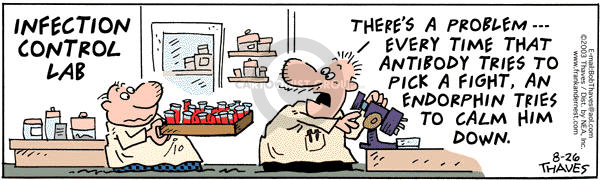
Beware Organizational Antibodies
Thanks to COVID-19, we’ve all (re)learned how our bodies’ immune systems work:
A foreign object (a pathogenic bacteria or virus) enters our bodies, and our immune system rallies a bunch of antibodies to identify the unwanted object and neutralize or destroy it.
Yea! Threat neutralized! We’re safe again!
Thank you, antibodies!
Companies work in much the same way (after all, “corporation” traces its roots back to “corpus,” the Latin word for body)
A foreign object (innovation) enters our company, and our immune system (culture, processes, structures) rallies a bunch of antibodies (rules, metrics, stories) to identify the new object and neutralize or destroy it.
Whether you thank the antibodies or curse them depends very much on your point of view. Either way, you can’t argue that the antibodies did precisely what they are designed to do – keep the company operating efficiently with minimum disruption or distraction.
How to spot Organizational Antibodies
Antibodies always appear in human form, usually as allies like colleagues or bosses, and express themselves in a single statement or question.
Here are the five most common:
1. “Can I offer you a bit of advice?” – The antibody is here to help. It wants to spare you the pain your predecessors endured by passing lessons learned and suggestions to make your innovation more acceptable to upper management. Following their advice will neutralize the innovation, transforming it from “something new that creates value” to “something familiar that feels safe.”
2. “Have you thought about…?” – This is a slightly more aggressive antibody than #1, but it operates similarly. Intending to help, this antibody offers an unsolicited and specific piece of advice. If you take the advice, you face the same risk of neutralization as with #1, but if you ignore it, you risk hearing a very public, “I told you so.”
3. “You should talk to (fill in the blank)” – This is another antibody that wants to help, but not enough to do it. It senses the foreignness of your project, so it doesn’t want to get too involved lest it fails. But it wants to do something, so it can claim involvement if your innovation succeeds. So, it sends you to someone it genuinely believes will be helpful. While it’s certainly important to talk to people throughout the company, beware the run-around that results in all talking and no doing.
4. “I don’t have time right now but let’s talk in a month” – This antibody knows that we’re all time-starved, so we won’t argue with this reason. But “I don’t have time” means “It’s not a priority.” If the project isn’t a priority now, it won’t be a priority in a month. And if the project isn’t a priority, it will be starved of resources and die a slow, agonizing death.
5. “Before I can approve this, I need to see (financials, documentation). I’m just holding you to the same standard I hold other projects to.” – When all other antibodies fail, this one is unleashed. Directly or indirectly, it kills every innovation in the organization. It ignores the fact that new things don’t have historical data. It dismisses analogous innovations as too different to be valid. Anything that can’t be proven to be 100% certain contains some amount of risk. And risk must be destroyed.
How to work with Organizational Antibodies
Antibodies mean well. They genuinely want to help. Even when they’re being tough, they believe they’re being fair. It’s essential to respond with an equal measure of kindness and fairness.
Remember, you can’t stop antibodies. You can only hope to contain them with one (or more) of these approaches:
1. Say “Thank you.” – Don’t try to justify, explain, or convince the antibody that they’re wrong. Simply acknowledge that you heard them and say thank you.
2. Ask if they’re open to discussing their suggestion. – Most antibodies have short memories. Once they give advice, they move on to other things and quickly forget about you. But some don’t. Some return to ask what you did or why you didn’t listen to them. As tempting as it is to launch into an explanation or defense, don’t. Ask them if they’re open to a discussion. If they say “yes,” they just agreed to listen to your explanation and (hopefully) engage in a productive conversation. If they say “no” (usually phrased as “not right now”), then you save everyone time and aggravation.
3. Keep a list of people and when you’ll talk to them – You don’t have to talk to everyone before you start. When you are referred to someone, pause to think about when they will be most helpful – at the start of the project, when you have a specific question, or towards the end when you’re working through operational consideration. Keeping a list of who to talk to and when reassures people that you’re collaborating and helps you manage expectations.
4. Before you start, align on priorities – Ultimately, your boss decides what the priorities are. So, no matter how important or urgent something feels to you, if it’s not important or urgent to her, you won’t get the time, attention, or resources you need. Save yourself time and heartache by understanding the important and urgent priorities and aligning your work to those.
5. Before you start, ask, “What do you need to see to say Yes?” – We live in a world of finite resources, which means that every person and dollar you receive is a person or dollar NOT going to another project. So, before you start, ask what the decision-maker needs to make decisions. Suppose the requests are unreasonable (like a 5-year NPV approved by Finance before you even have a proof of concept). In that case, you can try negotiating for more reasonable expectations or shift your focus.
Organizational Antibodies exist in every organization. It’s only a matter of time before they appear and even swarm. For the sake of your innovation efforts and your company’s long-term growth, stay vigilant and have a plan to work with them. It’s how you’ll keep innovation alive.