
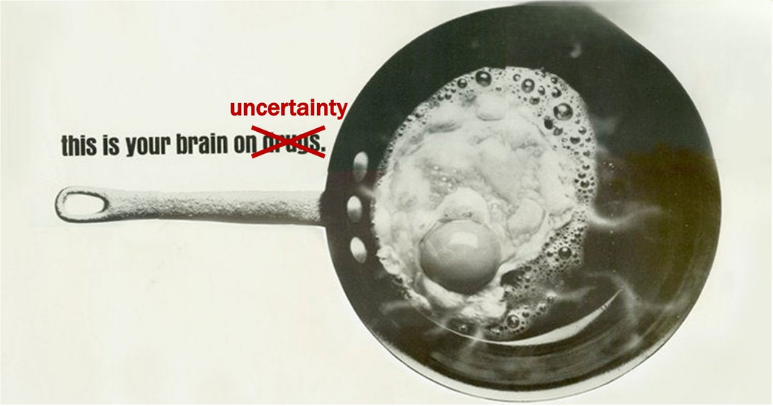
There’s a famous PSA from the 1980s in which a dad-like figure sighs with exhausted resignation, as he holds up an egg and explains it’s your brain, points to a frying pan and explains it’s drugs, then cracks the egg into the pan and, as it sizzles, states “this is your brain on drugs.”
It’s also your brain on uncertainty.
As you’ve probably heard, we’re living in a VUCA (volatile, uncertain, complex, and ambiguous) world. You’ve no doubt seen VUCA-ness play out in your workplace and your world and felt the impact of it.
And you’ve likely heard that you simply need to “embrace uncertainty.”
That’s terrible advice.
It’s like telling someone to hug a cactus. It hurts and no one benefits.
But you can try to understand it.
VUCA describes an external situation
The US Army War College popularized the acronym VUCA when it began using it in 1987 to describe “a more complex multilateral world perceived as resulting from the end of the Cold War.” Intended to be used as a framework to understand and articulate opportunities and challenges:
- V = Volatility: fast and frequent change
- U = Uncertainty: unpredictability of events’ size, timing, and impact
- C = Complexity: the existence of many interconnected parts
- A = Ambiguity: the existence of multiple interpretations and unknown odds
While Volatility and Complexity describe two different facets of a situation: speed and interconnectedness respectively, Uncertainty and Ambiguity both refer to the knowability of an answer.
And that’s where things get complicated.
Knowability exists on a 2×2 (because, of course)
We often use Uncertainty and Ambiguity as synonyms, but there’s an important difference between the two:
- Clarity of the question: Do I know what I am trying to figure out?
- Clarity of the answer: Do I know the outcomes or odds?
Put it together, and TA DA! you get a 2×2:
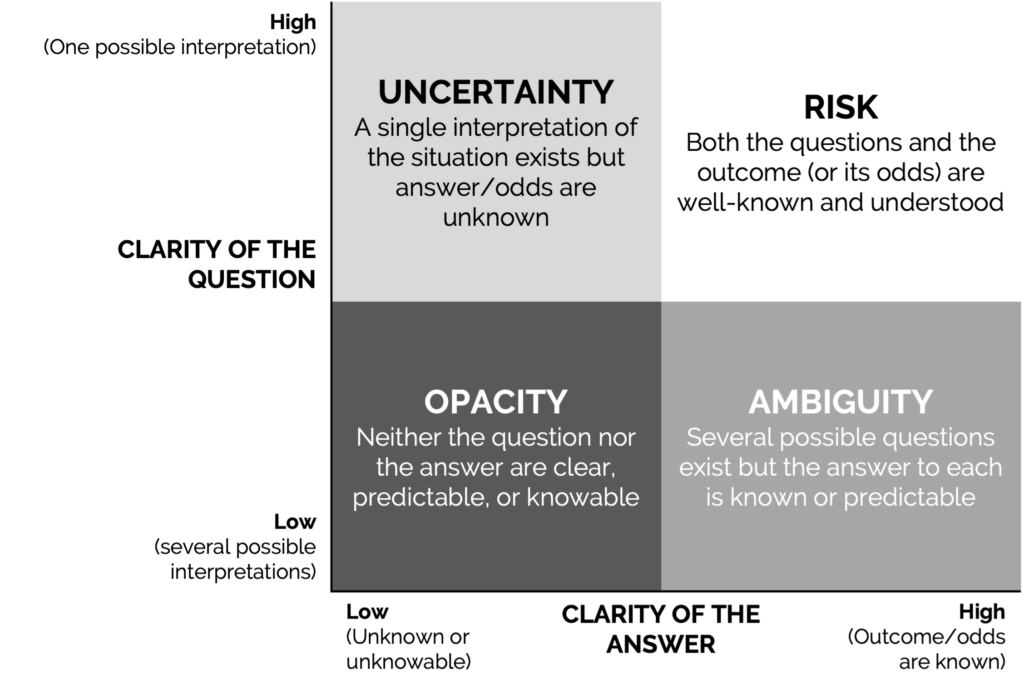
This 2×2 isn’t just a neat trick to renew my consulting license (not a real thing but, if it were, 2×2 usage would be a qualifying criterion). It’s essential to understanding how our brain reacts to a situation and our resulting feelings and behaviors.
(Not) Knowing > Feeling > Acting
Each of the four states of Knowing triggers chemical changes in our brains that drive certain behaviors:
| Situation | Brain and chemistry | Felt state it triggers | Resulting behavior |
| Risk
Question clear Answer known |
|
Minor sense of tension, anticipation or caution |
|
| Uncertainty
Question clear Answer unknown |
|
Suspense and mild unease, especially while the answer stays open |
|
| Ambiguity
Question unclear Answer clear once question is determined |
|
Doubt and unease, especially when you can’t decide on the question. |
|
| Opacity
Question unclear answer unknown |
|
Disorientation or overwhelm. |
|
Don’t embrace. Understand.
None of the feelings or behaviors above are awesome. That’s why “embracing uncertainty” feels like hugging a cactus.
Starting with your feelings and actions helps you understand the situation you’re in. Which is the first step to solving “uncertainty.”
FAQs
What is the difference between uncertainty and ambiguity?
Uncertainty means the question is clear but the answer isn’t. Ambiguity means the question itself isn’t clear. Uncertainty makes you want more information. Ambiguity makes you hesitate until you know what’s actually being asked.
How do I know if I'm facing uncertainty or ambiguity?
Ask two questions. Do I know what I’m trying to figure out? Do I know the possible outcomes? Clear question, unknown answer: uncertainty. Gather information and plan scenarios. Unclear question: ambiguity. Get clarity before you act.
Why does resistance to change happen, even when a decision is the right one?
Resistance to change often isn’t stubbornness. It’s brain chemistry. When the question is unclear (ambiguity), the amygdala fires, the brain’s reward system quiets, and behavior shifts to hesitating, avoiding, or grabbing a wrong-but-clear answer. When both question and answer are unclear (opacity), people freeze or withdraw. Naming which state you’re in rather than “embracing” it is the first step to moving past it.