

By now you (hopefully) know that uncertainty and ambiguity are different things caused by different combinations of knowns. But, as GI Joe taught every 80s kid, knowing is half the battle.
Doing is the other half.
Knowing about knowing
Whether it’s diagnosis, decision-making, or quantification, there are literally hundreds of different frameworks designed to manage uncertainty. With so many choices in breadth, depth, and application, choosing which one to use is an exercise in navigating uncertainty.
The Knowability Matrix (below) is rooted in the distinction that the US Army War College draws between uncertainty and ambiguity, specifically the knowability about the situation (question) and solution (answer). It’s further supported by neurological studies into the brain’s chemical reactions to different states of not-knowing.
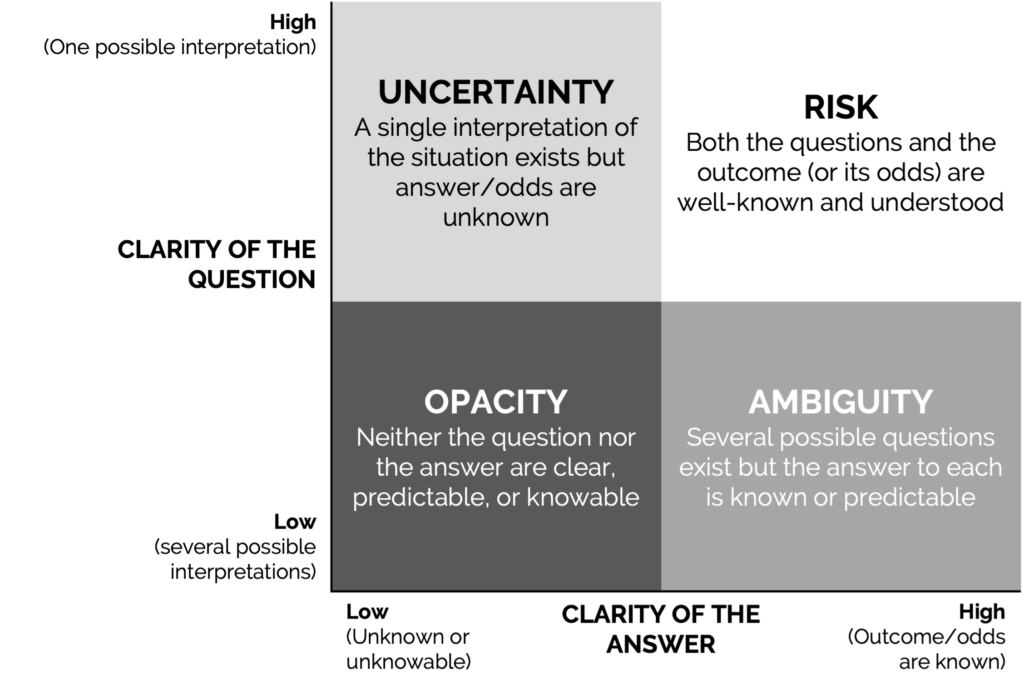
Diagnosing the state of not-knowing you’re in is a critically important first step to “solving” the situation. Often referred to as “name it to tame it,” decades of psychological research on the theory is increasingly backed up by neurological studies that show that by simply naming or labeling a negative emotion (even silently) significantly reduces activity in the amygdala (our brain’s fight or flight center).
But that doesn’t change the actual situation.
Doing because of your knowing
To change the situation, you need to do something. And what you need to do varies by situation.
Risk
- Knowing state: Question and answer are clear
- Felt state: Tension, anticipation, caution
- Tools for resolution: Expected value, probability and actuarial tables, Monte Carlo Simulation, Kelly Criterion, portfolio hedging and diversification, insurance, Value-at-Risk, Six Sigma
- You might be a RISK expert if you are a: Professional poker player, casino operator, actuary, insurance and reinsurance underwriter, credit-risk officer, reliability engineer
Uncertainty
- Knowing state: Question is clear, but answer is not
- Felt state: Suspense and unease
- Tools for resolution: Bayesian updating, scenario planning, portfolio/diversification of bets, experiments, calibrated forecasting, real options and hedging
- You might be an UNCERTAINTY expert if you are a: Research scientist, intelligence analyst, meteorologist, epidemiologist, venture capitalist, clinical-trial researcher, detective
Ambiguity
- Knowing state: Question is unclear, but answer becomes clear when question is determined
- Felt state: Doubt and unease (especially when trying to clarify the question)
- Tools for resolution: Problem framing (How might we?), abductive reasoning, prototyping-to-learn, Jobs to be Done, sensemaking,red team/devil’s advocate
- You might be an AMBIGUITY expert if you are a: Founder or entrepreneur, strategist or design researcher, judge or appellate lawyer, diplomat or negotiator, therapist, anthropologist
Opacity
- Knowing state: Both question and answer are unclear
- Felt state: Disorientation or overwhelm
- Tools for resolution: Impose structure (incident command, triage, checklists), shrink to the next move, OODA loop, act-sense-respond, rely on muscle memory/drilled pattern
- You might be an OPACITY expert if you are a: First responder, incident commander, ER professional in a mass casualty event, war correspondent, wildfire and disaster response pro
The difficulty of doing
As anyone who has ever struggled to lose weight, quit a bad habit, or start a healthy one knows, there’s a huge gap between knowing what you should do and actually doing it. This “Knowing-Doing Gap” isn’t just a reality individuals face when trying to change. It’s baked into how companies operate.
For centuries, businesses followed relatively predictable cycles. Sure, a war, depression, or radical technology popped up every now and then, but eventually everything settled back down.
As a result, companies got really good at managing Risk. They knew the questions and the answers so they could rely on actuarial and probability tables, Monte Carlo analyses, portfolios, hedging, and insurance to get them through uncertainty.
Now we live in an unpredictable world and risk management tools don’t work in Uncertainty, Ambiguity, and Opacity. But, because they’re the tools we know, they’re the tools that get used.
Until we have the courage to let go of the familiar but wrong tool and learn the right one, the call to “embrace uncertainty” will continue to be as productive as hugging a cactus.
FAQs
Is knowing which state of uncertainty you're in enough to move forward?
No. Diagnosis tells you which tool to use. It doesn’t guarantee the organization uses it. Even with the right tool in hand, growth decisions can still stall on reasonable-looking resistance: one more signoff, a handoff with no owner, a priority that quietly shifts.
Why do people use the wrong tools to solve problems?
Because those tools are what we know. For centuries, businesses built expertise in managing Risk (clear questions, clear answers) using tools like probability tables and hedging. Now most business problems are Uncertain, Ambiguous, or Opaque, where those same tools don’t work. But because they’re familiar, they still get used. Progress requires the courage to let go of the wrong-but-known tool for the right one.
Can a situation move from one state to another over time?
Yes. The four states aren’t fixed labels, they’re diagnoses of what’s still unknown right now. As problem framing, prototyping, or sensemaking clarify a fuzzy question, an Ambiguous situation often resolves into a clear Uncertainty or even a Risk problem. When that happens, the right toolkit changes with it. What worked for framing the question won’t work for hedging the answer.