by Robyn Bolton | Oct 19, 2025 | Leadership, Leading Through Uncertainty
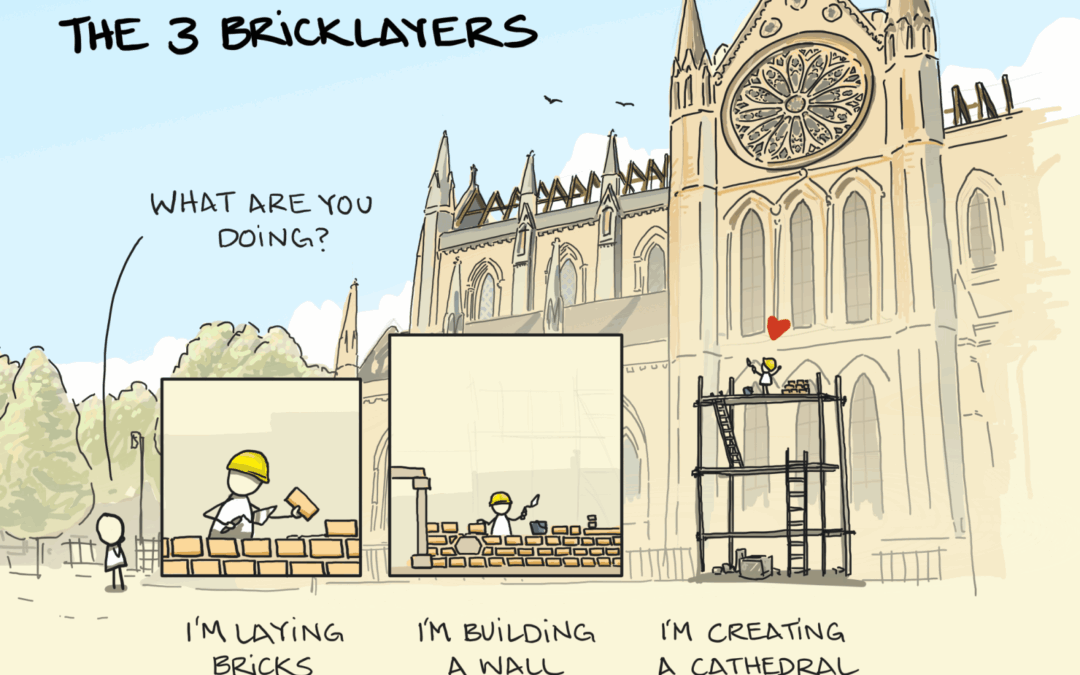
One day, an architect visited the building site of his latest project. There he saw three people all laying bricks. He asked each what they were doing. “I’m laying bricks,” the first responded. “I’m building a wall,” said the second. “I’m building a cathedral,” exclaimed the third.
The parable of the Three Bricklayers is a favorite amongst motivational speakers, urging their audiences to think beyond today’s tasks and this quarter’s goals to commit to a grandiose vision of eternal success and glory.
But there’s a problem.
The narrative changed
The person who had a vision of building a cathedral? They now believe they’re building ruins.
Is the C-Suite Quietly Quitting?
Recently published research found that three out of four executives believe that “without fundamental transformation* their organization will cease to exist” in ten years. That’s based on data from interviews with twenty-four “current or former CEOs who have led successful transformations” and 1,360 survey responses from C-Suite and next-generation leaders.
And, somehow, the news gets worse.
While 77% of C-suite executives report that they’re committed to their companies’ transformation efforts, but 57% believe their organization is taking the wrong approach to that transformation. But that’s still better than the 68% of Next-Gen executives who disagree with the approach.
So, it should come as no surprise that 71% of executives rate their companies’ transformation efforts as not at all to moderately successful. After all, it’s hard to lead people along a path you don’t agree with to a vision you don’t believe in.
Did they just realize that “change is hard in human systems?”
We all fall into the trap of believing that understanding something results in commitment and change.
But that’s not how humans work.
That’s definitely not how large groups of humans, known as organizations, work.
Companies’ operations are driven only loosely by the purpose, structures, and processes neatly outlined in HR documents. Instead, they are controlled by the power and influence afforded to individuals by virtue of the collective’s culture, beliefs, histories, myths, and informal ways of working.
And when these “opaque dimensions” are challenged, they don’t result in resistance,
They result in inertia.
“Organizational inertia kills transformations”
Organizations are “complex organisms” that evolve to do things better, faster, cheaper over time. They will continue doing so unless changed by an external force (yes, that’s Newton’s first law of motion).
That external force, the drive for transformation, must be strong enough to overcome:
- Insight Inertia stops organizations from getting started because there is a lack of awareness or acceptance amongst leaders that change is needed.
- Psychological Inertia emerges when change demands abandoning familiar success strategies. People embrace the idea of transformation but resist personal adaptation, defaulting to comfortable old behaviors.
- Action Inertia sets in and gains power as the long and hard work of transformation drags on. Over time, people grow tired. Exhausted by continuous change, teams progressively disengage, becoming less responsive and decisive.
But is that possible when 74% of executives are simply biding their time and waiting for failure?
“There’s a crack in everything, that’s how the light gets in.”
Did you see the crack in all the doom and gloom above?
- 43% of executives believe their organizations are taking the right approach to transformation.
- 29% believe that their organizations’ transformations have been successful.
- 26% believe their company will still be around in ten years.
The majority may not believe in transformation but only 33% of bricklayers believed they were building a cathedral, and the cathedral still got built.
Next week, we’ll explore how.
by Robyn Bolton | Sep 30, 2025 | Leading Through Uncertainty, Strategy, Tips, Tricks, & Tools
Just as we got used to VUCA (volatile, uncertain, complex, ambiguous) futurists now claim “the world is BANI now.” BANI (brittle, anxious, nonlinear, incomprehensible) is much worse than VUCA and reflects “the fractured, unpredictable state of the modern world.”
Not to get too Gen X on the futurists who coined and are spreading this term but…shut up.
Is the world fractured and unpredictable? Yes.
Does it feel brittle? Are we more anxious than ever? Are things changing at exponential speed, requiring nonlinear responses? Does the world feel incomprehensible? Yes, to all.
Naming a problem is the first step in solving it. The second step is falling in love with the problem so that we become laser focused on solving it. BANI does the first but fails at the second. It wallows in the problem without proposing a path forward. And as the sign says, “Ain’t nobody got time for this.”
(Re)Introducing the Cynefin Framework
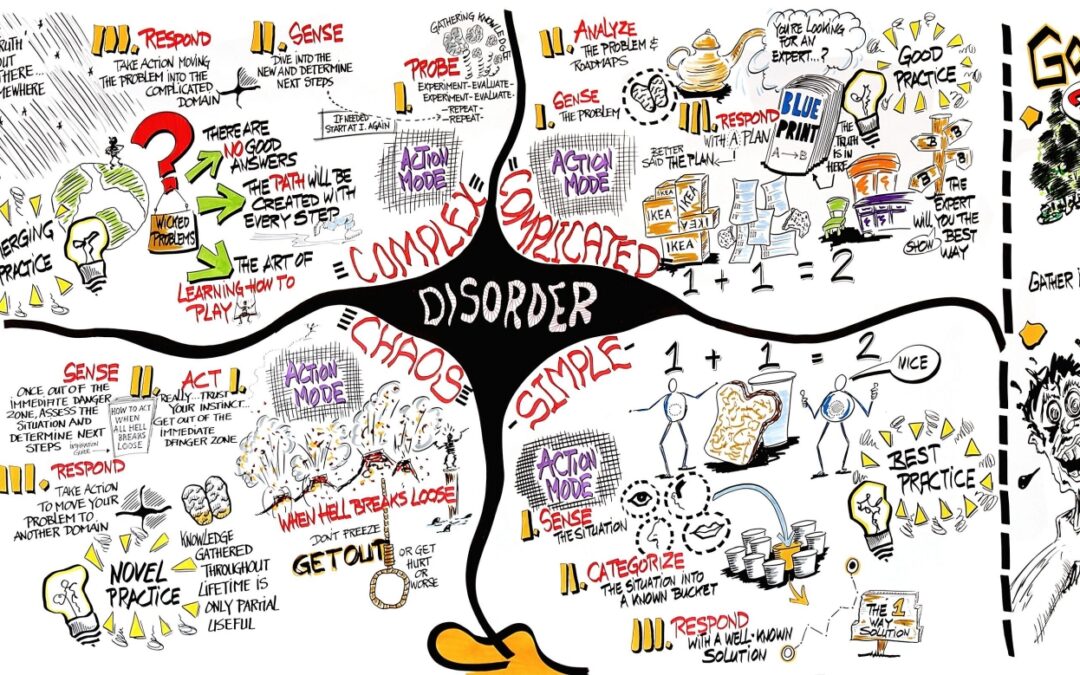
The Cynefin framework recognizes that leadership and problem-solving must be contextual to be effective. Using the Welsh word for “habitat,” the framework is a tool to understand and name the context of a situation and identify the approaches best suited for managing or solving the situation.
It’s grounded in the idea that every context – situation, challenge, problem, opportunity – exists somewhere on a spectrum between Ordered and Unordered. At the Ordered end of the spectrum, cause and affect are obvious and immediate and the path forward is based on objective, immutable facts. Unordered contexts, however, have no obvious or immediate relationship between cause and effect and moving forward requires people to recognize patterns as they emerge.
Both VUCA and BANI point out the obvious – we’re spending more time on the Unordered end of the spectrum than ever. Unlike the acronyms, Cynefin helps leaders decide and act.
5 Contexts. 5 Ways Forward
The Cynefin framework identifies five contexts, each with its own best practices for making decisions and progress.
On the Ordered end of the spectrum:
- Simple contexts are characterized by stability and obvious and undisputed right answers. Here, patterns repeat, and events are consistent. This is where leaders rely on best practices to inform decisions and delegation, and direct communication to move their teams forward.
- Complicated contexts have many possible right answers and the relationship between cause and effect isn’t known but can be discovered. Here, leaders need to rely on diverse expertise and be particularly attuned to conflicting advice and novel ideas to avoid making decisions based on outdated experience.
On the Unordered end of the spectrum:
- Complex contexts are filled with unknown unknowns, many competing ideas, and unpredictable cause and effects. The most effective leadership approach in this context is one that is deeply uncomfortable for most leaders but familiar to innovators – letting patterns emerge. Using small-scale experiments and high levels of collaboration, diversity, and dissent, leaders can accelerate pattern-recognition and place smart bets.
- Chaos are contexts fraught with tension. There are no right answers or clear cause and effect. There are too many decisions to make and not enough time. Here, leaders often freeze or make big bold decisions. Neither is wise. Instead, leaders need to think like emergency responders and rapidly response to re-establish order where possible to bring the situation into a Complex state, rather than trying to solve everything at once.
The final context is Disorder. Here leaders argue, multiple perspectives fight for dominance, and the organization is divided into fractions. Resolution requires breaking the context down into smaller parts that fit one of the four previous contexts and addressing them accordingly.
The Only Way Out is Through
Our VUCA/BANI world isn’t going to get any simpler or easier. And fighting it, freezing, or fleeing isn’t going to solve anything. Organizations need leaders with the courage to move forward and the wisdom and flexibility to do so in a way that is contextually appropriate. Cynefin is their map.

by Robyn Bolton | Aug 4, 2025 | Leadership, Leading Through Uncertainty, Stories & Examples, Strategy
The best business advice can destroy your business. Especially when you follow it perfectly.
Just ask Johnny Cash.
After bursting onto the scene in the mid-1950s with “Folsom Prison Blues”, Cash enjoyed twenty years of tremendous success. By the 1970s, his authentic, minimalist approach had fallen out of favor.
Eager to sell records, he pivoted to songs backed by lush string arrangements, then to “country pop” to attract mainstream audiences and feed the relentless appetite of 900 radio stations programming country pop full-time.
By late 1992, Johnny Cash’s career was roadkill. Country radio had stopped playing his records, and Columbia Records, his home for 25 years, had shown him the door. At 60, he was marooned in faded casinos, playing to crowds preferring slot machines to songs.
Then he took the stage at Madison Square Garden for Bob Dylan’s 30th anniversary concert.
In the audience sat Rick Rubin, co-founder of Def Jam Recordings and uber producer behind Public Enemy, Run-DMC, and Slayer, amongst others. He watched in awe as Cash performed, seeing not a relic but raw power diluted by smart decisions.
The Stare-Down that Saved a Career
Four months later, Rubin attended Cash’s concert at The Rhythm Café in Santa Anna, California. According to Cash’s son, “When they sat down at the table, they said: ‘Hello.’ But then my dad and Rick just sat there and stared at each other for about two minutes without saying anything, as if they were sizing each other up.”
Eventually, Cash broke the silence, “What’re you gonna do with me that nobody else has done to sell records for me?”
What happened next resurrected his career.
Rubin didn’t promise record sales. He promised something more valuable: creative control and a return to Cash’s roots.
Ten years later, Cash had a Grammy, his first gold record in thirty years, and CMA Single of the Year for his cover of Nine Inch Nails’ “Hurt,” and millions in record sales.
When Smart Decisions Become Fatal
Executives do exactly what Cash did. You respond to market signals. You pivot your offering when customer preferences shift and invest in emerging technologies.
All logical. All defensible to your board. All potentially fatal.
Because you risk losing what made you unique and valuable. Just as Cash lost his minimalist authenticity and became a casualty of his effort to stay relevant, your business risks losing sight of its purpose and unique value proposition.
Three Beliefs at the Core of a Comeback
So how do you avoid Cash’s initial mistake while replicating his comeback? The difference lies in three beliefs that determine whether you’ll have the creative courage to double down on what makes you valuable instead of diluting it.
- Creative confidence: The belief we can think and act creatively in this moment.
- Perceived value of creativity: Our perceived value of thinking and acting in new ways.
- Creative risk-taking: The willingness to take the risks necessary for active change.
Cash wanted to sell records, and he:
- Believed that he was capable of creativity and change.
- Saw the financial and reputational value of change
- Was willing to partner with a producer who refused to guarantee record sales but promised creative control and a return to his roots.
Your Answers Determine Your Outcome
Like Cash, what you, your team, and your organization believe determines how you respond to change:
- Do I/we believe we can creatively solve this specific challenge we’re facing right now?
- Is finding a genuinely new approach to this situation worth the effort versus sticking with proven methods?
- Am I/we willing to accept the risks of pursuing a creative solution to our current challenge?”
Where there are “no’s,” there is resistance, even refusal, to change. Acknowledge it. Address it. Do the hard work of turning the No into a Yes because it’s the only way change will happen.
The Comeback Question
Cash proved that authentic change—not frantic pivoting—resurrects careers and disrupts industries. His partnership with Rubin succeeded because he answered “yes” to all three creative beliefs when it mattered most. Where are your “no’s” blocking your comeback?

by Robyn Bolton | Jul 23, 2025 | Leadership, Leading Through Uncertainty, Stories & Examples
What does a lightning strike in a Spanish forest have to do with your next leadership meeting? More than you think.
On June 14, 2014, lightning struck a forest on Spain’s northeast coast, only 60 miles from Barcelona. Within hours, flames 16 to 33 feet high raced out of control toward populated areas, threatening 27,000 acres of forest, an area larger than the city of Boston.
Everything – data, instincts, decades of firefighting doctrine – prioritized saving the entire forest and protecting the coastal towns.
Instead, the fire commanders chose to deliberately let 2,057 acres, roughly the size of Manhattan’s Central Park, burn.
The result? They saved the other 25,000 acres (an area the size of San Francisco), protected the coastal communities, and created a natural firebreak that would protect the region for decades. By accepting some losses, they prevented catastrophic ones.
The Fear Trap That’s Strangling Your Business
The Tivissa fire’s triumph happened because firefighters found the courage to escape what researchers call the “fear trap” – the tendency to focus exclusively on defending against known, measurable risks.
Despite research proving that defending against predictable, measurable risks through defensive strategies consistently fails in uncertain and dynamic scenarios, firefighter “best practices” continue to advocate this approach.
Sound familiar? It should. Most executives today are trapped in exactly this pattern.
We’re in the fire right now. Financial markets are yo-yoing, AI threatens to disrupt everything, and consumer behaviors are shifting.
Most executives are falling into the Fear Trap by doubling down on protecting their existing business and pouring resources into defending against predictable risks. Yet the real threats, the ones you can’t measure or model, continue to pound the business.
While you’re protecting last quarter’s wins, tomorrow’s disruption is spreading unchecked.
Four Principles for Creative Decision-Making Under Fire
The decision to cede certain areas wasn’t hasty but based on four principles enabling leaders in any situation to successfully navigate uncertainty.
PRINCIPLE 1: A Predictable Situation is a Safe Situation. Stop trying to control the uncontrollable. Standard procedures work in predictable situations but fail in unprecedented challenges.
Put it in Practice: Instead of creating endless contingency plans, build flexibility and agility into operations and decision-making.
PRINCIPLE 2: Build Credibility Through Realistic Expectations. Reducing uncertainty requires realism about what can be achieved. Fire commanders mapped out precisely which areas around Tivissa would burn and which would be saved, then communicated these hard truths and the considered trade-offs to officials and communities before implementing their strategy, building trust and preventing panic as the selected areas burned.
Put it in practice: Stop promising to protect everything and set realistic expectations about what you can control. Then communicate priorities, expectations, and trade-offs frequently, transparently, and clearly with all key stakeholders.
PRINCIPLE 3: Include the future in your definition of success: Traditional firefighting protects immediate assets at risk. The Tivissa firefighters expanded this to include future resilience, recognizing that saving everything today could jeopardize the region tomorrow.
Put it in practice: Be transparent about how you define the Common Good in your organization, then reinforce it by making hard choices about where to compete and where to retreat. The goal isn’t to avoid all losses – it’s to maximize overall organizational health.
PRINCIPLE 4: Use uncertainty to build for tomorrow: Firefighters didn’t just accept that 2,057 acres would burn – they strategically chose which acres to let burn to create maximum future advantage, protecting the region for generations.
Put it in practice: Evaluate every response to uncertainty on whether it better positions you for future challenges. Leverage the disruption to build capabilities, market positions, and organizational structures that strengthen you for future uncertainty.
Your Next Move
When the wind shifted and the fire exploded, firefighters had to choose between defending everything (and likely losing it all) or accepting strategic losses to ensure overall wins.
You’re facing the same choice right now.
Like the firefighters, your breakthrough might come not from fighting harder against uncertainty, but from learning to work with it strategically.
What are you willing to let burn to save what matters most?

by Robyn Bolton | Jul 16, 2025 | Leadership, Strategic Foresight
You’ve done everything to set Strategic Foresight efforts up for success. Executive authority? Check. Challenging inputs? Check. Process integration? Check. Now you just need to flip the switch and you’re off to the races.
Not so fast.
While the wrong set-up is guaranteed to cause failure, the right set-up doesn’t guarantee success. Research shows that strategic foresight initiatives with the right set-up fail because of “organizational pathologies” that sabotage even well-designed efforts.
If you aren’t leading the right people to do the right things in the right way, you’re not going to get the impact you need.
Here’s what to watch out for (and what to do when it happens).
Your Teams Misunderstand Foresight’s Purpose
People naturally assume that strategic foresight predicts the future. When it doesn’t, they abandon it faster than last year’s digital transformation initiative.
Shell learned this the hard way. In 1965, they built the Unified Planning Machinery, a computerized forecasting tool designed to predict cash flow based on trends. It was abandoned because executives feared “it would suppress discussion rather than encourage debate on differing perspectives.”
When they shifted from prediction to preparation, specifically to “modify the mental model of decision-makers faced with an uncertain future,” strategic foresight became an invaluable decision-making tool.
Help your team approach strategic foresight as preparation, not prediction, by measuring success by the improvement in discussion and decision-making, not scenario accuracy. When teams build mental flexibility rather than make predictions, wrong scenarios stop being failed scenarios.
People are Paralyzed by Fear of Being Wrong
Even when your teams understand foresight’s purpose, managers are often unwilling “to use foresight to plan beyond a few quarters, fearing that any decisions today could be wrong tomorrow.”
This is profoundly human. As Webb wrote, “When faced with uncertainty, we become inflexible. We revert to historical patterns, we stick to a predetermined plan, or we simply refuse to adopt a new mental model.” We nod along in scenario sessions, then make decisions exactly like we always have.
Shell’s scenario planning efforts succeeded because it made being wrong acceptable. Even though executives initially scoffed at the idea of oil prices quadrupling, they prepared for the scenario and took near-term “no regrets” decisions to restructure their portfolio.
To help people get past their fear, reward them for making foresight-informed decisions. For example, establish incentives and promotion criteria where exploring “wrong” scenarios leads to career advancement.
Your Culture Confuses Activity with Achievement
Between insight and action, the Tyranny of Now reigns. In even the most committed organizations, the very real and immediate needs of the business call us away from our planning efforts and consume our time and energy, meaning strategic foresight is embraced only when it doesn’t interfere with their “real” jobs.
Disney’s approach made strategic foresight a required element of people’s “real jobs” by integrating foresight activities and insights directly into performance management and strategic planning. When foresight teams identified that traditional media consumption was fracturing in 2012, Disney began preparing for that future by actively exploring and investing in new potential solutions.
Resist the Tyranny of Now’s pull by making strategic foresight activities just as tyrannical – require decisions based on foresight insights to occur in 90 days or less. These decisions should trigger resource allocation reviews, even if the resources are relatively small (e.g., one or a few people, tens or hundreds of thousands of dollars). If strategic foresight doesn’t force hard choices about investments and priorities, it’s activity without achievement.
How You Lead and What People Do Determine Strategic Foresight’s Success
Executive authority, challenging inputs, and process integration are necessary but not sufficient. Success requires conquering the deeper organizational and human behaviors that determine whether strategic foresight is a corporate ritual or a competitive advantage.