VTS with the Best: An Interview with Suzi Hamill

VTS with the Best: An Interview with Suzi Hamill

Last week, I wrote about Visual Thinking Strategies (VTS), a process of using art to teach visual literacy, thinking, and communication skills.

Typically, used in primary school classrooms, VTS has made its way into the corporate setting, helping individuals and teams to build and strengthen their problem solving and critical thinking skills, ability to communicate and collaborate, and effectiveness in delivering and receiving feedback.

While I did my best to capture the Why, What, and How of VTS in that post, there’s no substitute for learning from an expert.  That’s why I asked Suzi Hamill , former Head of Design Thinking at Fidelity and the woman who introduced me to VTS, to share her experience using the tool.


Hi Suzi.  Thanks for sharing your VTS wisdom and experience today.  I understand you’ve been doing a fair bit of VTS-ing lately.

Suzi: Yes!  Just a few months ago I was at Oxford University coaching 30 Chief Marketing Officers from large global corporations on how to apply Visual Thinking Strategies to their work and their teams.  And just last week, I led a session with a group of women on the West Coast of the US.

That’s one of the things I find so fascinating about VTS.  It was created to help people learn about art and was designed to be used in schools, but it can have such a powerful impact in a wide variety of businesses.

Suzi: Absolutely.  In a business context, there are massive systems and massive problems, and everyone has their own interpretation of what’s going on.  (imagine doctors deliberating over a diagnosis, investment analysts debating a company’s intrinsic value, retailers predicting the next fashion trend…) This creates conflict.  How do you pull together a range of people and ideas to forge the best path forward? VTS is a great, simple but rigorous method to help business groups look at big problems. VTS is a way to have open exploratory conversations with a diverse set of people

This is especially true in organizations that are very execution oriented. Often organizations haven’t developed the time, space or habit to work through ambiguity. VTS opens space for there to be ambiguity and dialogue.  It gives people permission to explore ideas, be wrong, and hear different points of view.

All of those behaviors are essential to making good business decisions.  I wonder, have you found that some people need “permission” more than others?

Suzi: I think everyone can benefit from the VTS experience and there are some circumstances where it can be transformational.

We are often taught not to question authority. But there is a delicate balance between challenging authority and understanding perspectives At Fidelity, our first experiment focused on using it as a way to prompt open conversation when there was a power imbalance in a room.  We rolled VTS out to our Design Team of about 100 people as a way to help junior designers to talk to the CEO or senior executives about their work and not get defensive.  We trained them to ask the VTS questions, especially “What do you see that makes you say that?”  We found that it was a great way for designers to learn how to get feedback on their designs.

Once we started having success with VTS, it was integrated into Fidelity’s 6-month long training program for the top 100 potential leaders.

That’s where we found the next circumstance – using VTS with leadership teams.  We found that VTS acts as a practical way to introduce the idea that you’re not just a do-er now, you’re a thinker and, as a result, you’re going to be faced with ambiguity.  Instead of shying away from it, you need to see that ambiguity is not only ok, but it is also fertile ground for us to grow our business.

That’s great but, as we both know, just because you learn something in training doesn’t mean you actually do it in real life.  Have you seen VTS make that jump?  Get people to move from knowing to doing?

 Suzi: I have.

At Fidelity, we would VTS customer research.  We would use the principle of VTS more than follow the strict methodology. We’d post our research on walls – sticky notes, photos of customers, flowcharts, everything, and we would bring in stakeholders and use the VTS process to tease out insights.  We give people time to LOOK and internalize what they were seeing before we told them what to think. By asking questions, we would discover what they were interpreting, identify unconscious biases, and learn what they already know or want to know about the customer.

At the event in Oxford, we VTS-ed the Business Model Canvas because most of the CMOs weren’t familiar with it.   Just by looking at it, they teased out its purpose, what was important and what wasn’t, what was confusing, and what wouldn’t work.  They walked away with a deeper internalization of its meaning

How is VTS able to do that?  To help people quickly internalize new insights or behaviors?

Suzi: The best way I can explain it is that VTS is like yoga.  When you teach someone yoga, with consistent practice they develop better posture and they walk and move fluidly and with strength.  So, when they’re going through their day, they become more aware of their posture and adjust but they don’t go into a whole vinyasa flow.

VTS is similar because when you use it with people, you’re teaching the mechanics of dialogue, of using evidence to progress, of managing ambiguity and conflict.

It takes time to tease out the power of the process but in the end, I’ve seen it help people realize that you don’t have to agree or disagree right away.  Instead, it gives them space to express an opinion and teaches them to ask questions and to ask for evidence in a way that is psychologically safe.

OK, but is it as simple as asking the 3 VTS questions?

Suzi: I wish.  You need somebody who is a skilled facilitator, who can keep the group moving forward and exploring ideas.

Leaders know they should stimulate conversation… solicit other people’s opinions, but they don’t know how. In meetings leaders will voice their own opinions, rely on the loudest voices, and steer the conversation. People will pick up on these signals. They will stop exploring and focus on giving the right answer.

Often, when people are running meetings they try to participate.  But that’s like trying to breathe underwater.  You can’t facilitate and participate.

What have you learned & applied?

Suzi: If you want to get people to engage in a great dialog, try giving them something to look at first. It can be a metaphor or real reflection. But give them something specific to point to anchor their thoughts.

Give people time to look and think before they speak or act. Silence is Golden. Silence is not the enemy. Give people time to silently observe something. Even 1 min can make a huge difference in how people respond.

You don’t need to compliment people on their thoughts to keep them engaged. Ask them for more… What do you see that makes you say that? What more can we find? People are not often asked for their opinions. That act alone is incredibly engaging.

As a leader it is just as important to get the obvious out on the table so that you can get to true insight.

TO LEARN MORE ABOUT VTS OR TO EXPERIENCE IT FOR YOURSELF…
How Looking at Art Can Make You a Better Thinker, Communicator, and Leader

How Looking at Art Can Make You a Better Thinker, Communicator, and Leader

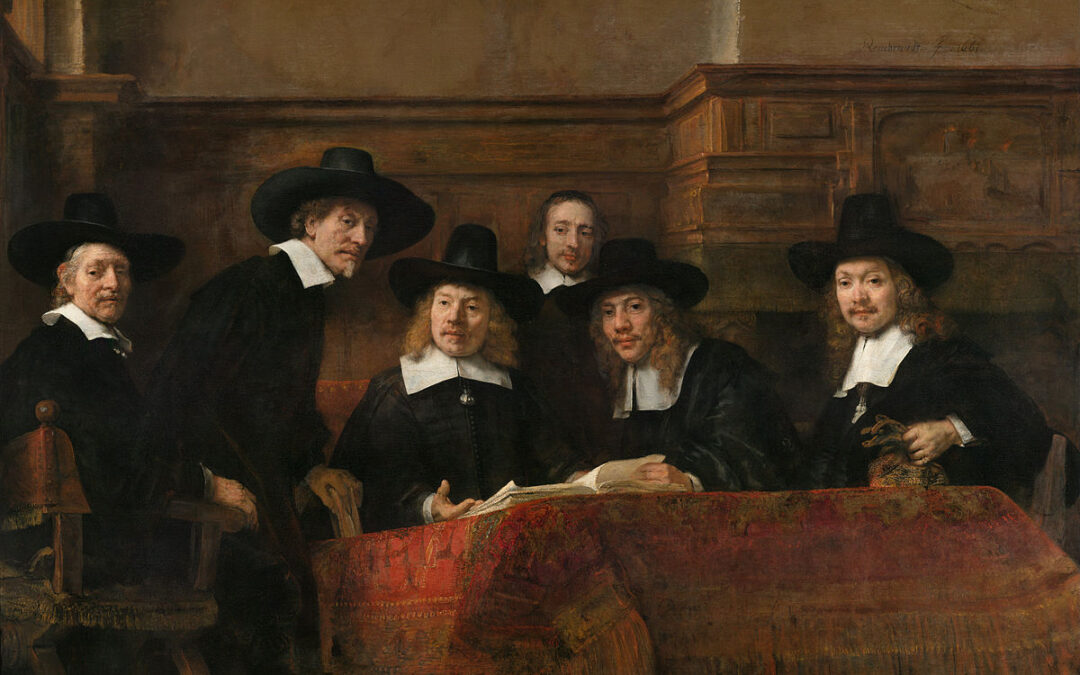
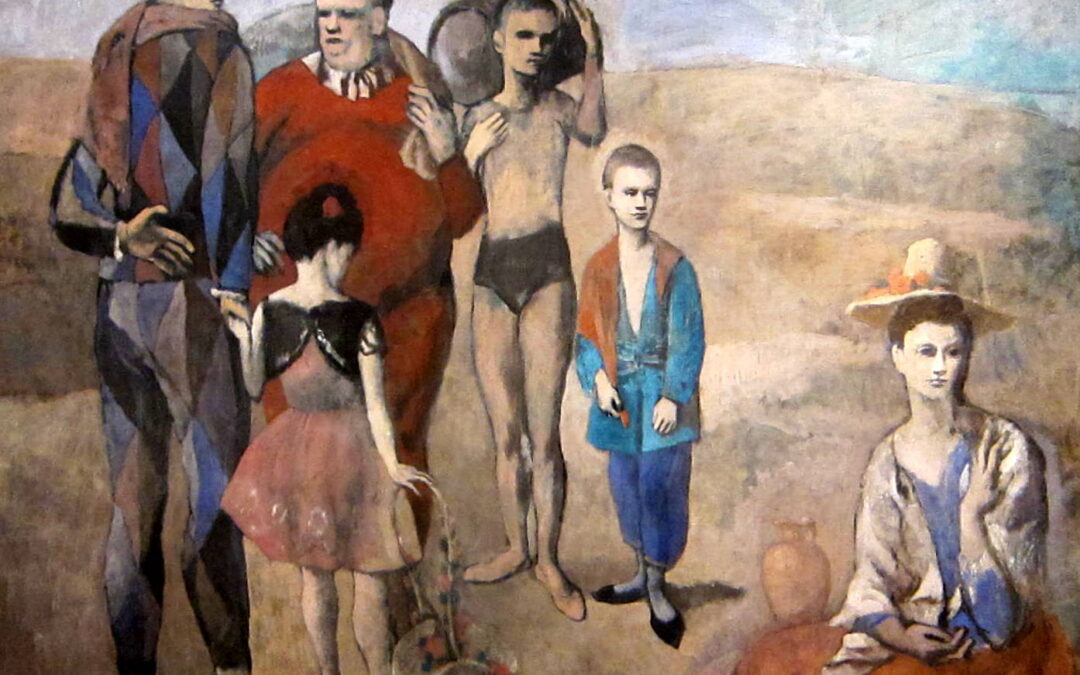
“It was quite a sight!  A dozen senior executives from a big, conservative financial services firm, all sitting on the floor in front of a painting, talking about what it could mean and why they think that.”

On a typical dreary November day, and Suzi and I were sitting in the café inside Boston’s Museum of Fine Arts.  She had just left her job as Head of Design Thinking at Fidelity Investments and I was taking a sabbatical before deciding what would be next for my career.  Introduced by a mutual friend, we decided to swap stories over lunch and a walk through one of the museum’s special exhibitions.

She was describing a Visual Thinking (VTS) session she had recently facilitated and the nearly instant impact it had on the way executives expressed themselves and communicated with each other.  She saw them engage in a level of creative problem-solving and critical thinking that they hadn’t in the past.

Intrigued, I set off to learn more.  What I discovered was a powerful, proven, and gasp fun way to help my clients navigate the ambiguous early days of innovation and embrace their inner curiosity and creativity.


Why should you care about VTS?

Imagine someone says to you, “If you and your team spend 1-2 hours with me each month for 9 months, I guarantee an improvement in your abilities to:

  • Quickly gather and synthesize accurate and unique insights by listening deeply and re-phrasing what they heard ensure understanding
  • Think critically and creatively by examining information or an idea from all angles, rethinking it, and deciding whether to keep, revise, or discard it
  • Communicate more clearly, respectfully, and productively with a variety of people inside and outside the organization
  • Work cross-functionally because they can apply critical thinking skills confidently to topics outside of their expertise
  • Innovate and experiment because they have learned how to individually and as a team operate in uncertainty
  • Provide more effective feedback by phrasing criticisms as questions and engaging in collaborative discovery and problem-solving conversations

Would you make the time commitment?

Now, what if they said, “All you have to do each month is sit together in a conference room and take part in a conversation.  No travel.  No additional expenses.  Just turn off your email and your phone for one hour and have a conversation in a room you already pay rent on.”

Would you do it then?

Of course you would.

Because you’ve been to trainings that focus on only one of the items in the list above and those trainings are expensive, time-consuming, and not nearly as effective as they should be.


What is Visual Thinking Strategies (VTS)?

According to the book, Visual Thinking Strategies: Using Art to Deepen Learning Across School Disciplines, VTS “uses art to teach visual literacy, thinking, and communication skills – listening an expressing oneself.”

Philip Yenawine was the Director of Education at the Museum of Modern Art (MOMA) in New York from 1983 – 1993.  During that time, he noticed that despite the museum’s efforts to organize and craft detailed explanations and interpretations for each piece of art, visitors would still ask lots of “Why?” questions and would remember little, if anything, from their visit.

Frustrated but curious, he and his team began studying developmental research and theory and discovered that what MOMA visitors needed wasn’t explanations, details, and facts, it was “permission to be puzzled and to think.  Consent to use their powerful eyes and intelligent minds.  Time to noodle and figure things out.  The go-ahead to use what they already know to reflect on what they don’t; the first steps of learning.”

Philip and his team with MOMA partnered with cognitive psychologist Abigail Housen to develop and test a process now known as Visual Thinking Strategies (VTS).

In the 30 years since their initial experiments, Philip and Abigail’s work has been used in 28 countries and 58 museums, over 12,000 students have engaged in VTS discussions and 1,200 people have become trained facilitators.


How to do VTS

The secret to VTS’ effectiveness is in the facilitation so if you’re going to do this, invest in an expert facilitator.  An expert facilitator is the only way to get the results listed above.


Here’s how a VTS session works:

  • Facilitator shares a piece of art specially selected so that “the subjects are familiar… but they also contain elements of mystery.”
  • Attendees take one minute to silently focus on the art
  • Facilitator asks 3 questions over the hour:
    • What’s going on in this picture?
    • What do you see that makes you say that?
    • What more can you find?
  • As each individual answers a question, the Facilitator:
    • Points at what is being observed
    • Paraphrases what has been said
    • Links what has been said to what others have said
  • Facilitator wraps up the session by thanking everyone and sharing something s/he learned from listening. They do NOT give “the answer” because “this isn’t about right and wrong but about thinking and…that the students singly and together are capable of wonderful, grounded ideas.”

That’s it – 1 piece of art, 3 questions, and at least 5 major benefits if you commit to the process.


Seems like something worth sitting on an art gallery floor for, right?

To learn more, read Visual Thinking Strategies: Using Art to Deepen Learning Across School Disciplines by Philip Yenawine and visit the website Visual Thinking Strategies

Back to Basics: What is Design Thinking?

Back to Basics: What is Design Thinking?

Last week, I published a post with a very simple goal – define innovation so we can stop debating what it means and start doing it.

The response was amazing.  So, I figured that this week I would tackle another buzzword – Design thinking.

We’ve all heard it and we’ve probably all said it but, like “innovation’ we probably all have a different definition for it.  In fact, in the last few months alone I’ve heard it used as a synonym for brainstorming, for customer interviews, and for sketching while talking.  Those things are all part of Design thinking but they aren’t the entirety of Design thinking.


What I tell my clients

When a client asks if we’re “doing Design thinking,” here’s what I say;

“Yes, because Design thinking is a way of solving problems that puts customers and stakeholders, not your organization, at the center of the process and seeks to produce solutions that create, capture, and deliver value to your customers, stakeholders, and your company.”


The Basics
  • What: One could consider the official definition of Design thinking to come from Tim Brown, Executive Char of IDEO, who stated that “Design Thinking is a human-centered approach to innovation that draws from the designer’s toolkit to integrate the needs of people, the possibilities of technology, and the requirements for business success”
  • Why: Useful in solving “wicked problems,” problems that are ill-defined or tricky and for which pre-existing rules and domain knowledge will be of limited or no help (or potentially detrimental)
  • How:
    • Inspiration: Understand the problem by building empathy with stakeholders (deeply understand their functional, emotional, and social Jobs to be Done) and document that understanding in a brief that outlines goals (ideal end state), bounds (elements to be avoided), and benchmarks against which progress can be measured
    • Ideation: Generate ideas using brainstorming to develop a vast quantity of ideas (divergent thinking) and then home in on the ideas at the intersection of desirability, feasibility, and viability that best fit the brief (convergent thinking)
    • Implementation: Prototype ideas so that they can be tested, evaluated, iterated, and refined in partnership with customers and stakeholders, ensuring that humans remain at the center of the process.
  • When: At the start of any R&D or development process
    • Traditionally, design was involved only in the late stages of development work, primarily to improve a solution’s functionality or aesthetic. Design Thinking’s ability to pull the designer mindset into the earliest phases of development is, perhaps, one of the biggest impacts it has made on business and technical fields
  • Where: Can be done anywhere BUT, because it is a human-centered approach, it must involve multiple human beings through the process
  • Who: Anyone who is willing to adopt a “beginner’s mind,” an attitude of openness to new possibilities, curiosity about the problem and the people with it, and humility to be surprised and even wrong


Important Points & Fun Facts
  • Design Thinking IS a human-centered design approach. This means that it seeks to develop solutions to problems by involving the human perspective at every single step of the process
  • Design thinking is NOT synonymous with user-centered design though user-centered design could be considered a subset of Design Thinking because it gives attention to usability goals and the user experience


  • Design Thinking was NOT invented by IDEO, but I would argue that they have done more to popularize it and bring it into the mainstream, especially into business management practices, than any other person or firm.
  • Design Thinking IS the product of 50+ years of academic and practical study and application. Here’s some fun facts:
    • 1935: The practice of Design thinking was first established by John Dewey as the melding of aesthetics and engineering principles
    • 1959: The term “Design thinking” was coined by John E. Arnold in his book Creative Engineering
    • 1991: the first symposium on Design Thinking was held at Delft University in the Netherlands
    • 2000s: Design thinking is widely adopted as an innovation approach thanks to books by Richard Florida (2002), Daniel Pink (2006), Roger Martin (2007), Tim Brown (2009), and Thomas Lockwood (2010)
    • 2005: Stanford’s d.school begins teaching Design thinking as a general approach to innovation


  • Design Thinking is NOT just for radical/breakthrough/disruptive innovation
  • Design Thinking IS useful for all types of innovation (something different that creates value) resulting from wicked problems. In fact, as far back as 1959, John E. Arnold identified four types of innovation that could benefit from a Design thinking approach:
    1. Novel functionality, i.e. solutions that satisfy a novel need or solutions that satisfy an old need in an entirely new way
    2. Higher performance levels of a solution
    3. Lower production costs
    4. Increased salability


If you want to learn more…

As noted above, there are lots of resources available to those who are deeply curious about Design thinking.  I recommend starting with Tim Brown’s 2008 HBR article, Design Thinking, and then diving into IDEO’s extremely helpful and beautifully designed website dedicated entirely to Design thinking.


Here’s what I’d like to learn…
  • Was this helpful in clarifying what Design Thinking is?
  • What, if anything, surprised you?
  • What else would you like to know?


Drop your thoughts in the comments or shoot me an email at robyn@milezero.io

Creative or Reactive: Which One Are You Right Now?

Creative or Reactive: Which One Are You Right Now?

Creative and Reactive

Same letters.

Different order.

Very different results.

These are strange times.

A relentless stream of news and updates are coming at us, warning us about COVID-19, a declining stock market, rising unemployment, and the financial crunch facing millions and millions of individuals and families.

On the other hand, we’re also getting daily notifications from companies about what they’re doing in the face of all of this news, tips for working from home and maintaining our mental health, and encouragement to support our friends, families, neighbors, and strangers in new ways.

Should we be scared or stoic? Isolated or connected? Hoarding or sharing?

Whatever you choose (and it is your choice), I encourage you to also be creative.

I’m not talking about being creative in the capital C way and take up painting, sculpting, composing, or any of the other activities we typically associate with the fine arts.

I’m talking about calmly assessing your situation, clearly acknowledging the constraints that are requiring change, and then exploring the “new normal” you can create.

This is what innovators do and you, yes YOU, are an innovator.

Innovators know that creativity thrives within constraints. If anything is possible and everything is permissible, you can do whatever you want! But that’s not how the world is. Not now and not before COVID-19.

We, people and businesses, have always faced constraints because we’ve never had infinite resources, money, or time. But we acknowledged the constraints and created within them. That’s what we have to do now.

Here’s some inspiration:

Businesses

Devil’s Food Catering: From event caterer to consortium offering takeout meals

Caterers have to order food well before events take place so when events are cancelled, caterers are left with a lot of food that they’ve already paid for and without the event income that was going to cover their costs.

Devil’s Food Catering in Portland OR faced exactly this situation. Instead of letting the food go to waste or trying to become a take-out shop on their own, they created Handbasket by teaming with other with other Portland area restaurants, breweries, distilleries, bakeries, and other providers to create “handmade menus for quality in-home dining experiences during this of social distancing.”

Gyms, Fitness Studios, and Personal Trainers: From in-person to on-line communities

Some people are gifted with the motivation to workout and some of us, well…aren’t.

In-person classes and personal training are often the solutions we rely on because we feel a sense of connection with our instructors, trainers, and classmates. As gyms close and social distancing becomes a way of life, the loss of live workouts can deepen our sense of isolation.

Recognizing this, local gyms, studios, and personal trainers in cities across the country are offering livestream classes so that we can continue to feel connected AND healthy AND active from the comfort of our own homes.

p.s. the link above is for the Boston area but I found similar articles for Philly, Washington, Houston, and even Wyoming

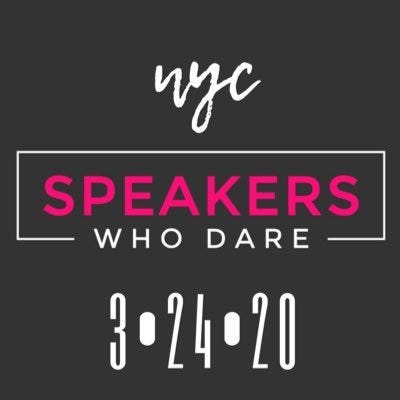
Speakers Who Dare: From Broadway event to Livestream to Movie

Spears Who Dare bills itself as TED meets Broadway, “a groundbreaking speaker series produced like a Broadway show, featuring speakers from around the world who want to ignite change and inspire new ways of thinking.”

Scheduled to take place on March 24, the organizers recognized that, like many other live events, their original plans for a live Broadway event needed to change. Last week, they shifted from live to livestream, planning a 6-camera shoot of each speaker and performer sharing their messages and art in an empty theater.

Then NYC closed the theaters. Within hours the organizers shifted again and asked each speaker to record a “mini-movie” that could be edited together to create “a full-blown Speakers Who Dare Film” to be shared with a global audience, viewing together on the original event date.

People

Seeing your coworkers when you can’t (or don’t want to) videoconference

Homemade games for when you’ve already played all the games you bought

More homemade games for when you really need to interact with people outside your own home

How and what will YOU create today?

Just in case you need a nudge…find the perfect gif starring the perfect celebrity expressing the perfect emotion and send it to someone who needs it


h/t to Kate Dixon and Megan Shea for sending their suggestions

10 Moments of Innovation Zen

10 Moments of Innovation Zen

I don’t know about you, but I’m rather tired of the non-stop hysteria that seems to be occurring these days. Between COVID-19, politics, the economy, and the state of Tom Brady’s contract (sorry, I live in Boston), it seems that the world is having a panic attack.

Namaste, people. Namaste.

In an effort to not contribute to the panic, instead of writing something topical and relating it to innovation, I’m simply going to share images of something that makes me extremely happy and peaceful and relate them to innovation.

Books.

I love books. I love reading them, looking at them, talking about them, and just being amongst them. In the days before Amazon, I would go to bookstores and simply sit in the aisle because it was the most calming and energizing thing I could think of. Don’t even get me started on the sheer joy of going into The Stacks in a library.

But as Amazon grew and the big chain bookstores shrank or went out of business, my opportunities for moments of book-filled zen became fewer and far between.

That’s why I love what independent bookstores are doing. They are innovating too, by changing the business they’re in. They’re no longer in the book-selling business (Amazon won that battle), they’re in the book experience business.

The Book Experience business is everything that Amazon.com can’t offer — discovery, community, an environment that stimulates all your 5 senses. Don’t believe me? Why do you think Amazon is opening physical book stores?

Yes, it takes time, money, risk, and resources to re-define the business you’re in but it’s worth it because it not only keeps you in business, it creates a competitive advantage that lasts.

And may even create moments of zen.

An interior view of the Zhongshuge bookstore in Chongqing, Oct. 22, 2019. VCG

People browse for books at a new store with wraparound shelving units in Hohhot, Inner Mongolia Autonomous Region, April 21, 2019. IC

An interior view of the Sanlian Taofen bookstore in Ningbo, Zhejiang province. From @设计美学志 on Weibo

An interior view of the Zhongshuge bookstore in Beijing, June 26, 2019. VCG

Libreria Acqua Alta, Venice

Livraria Lello, Porto

Shakespeare & Co, Paris

The Last Bookstore, Los Angeles, United States

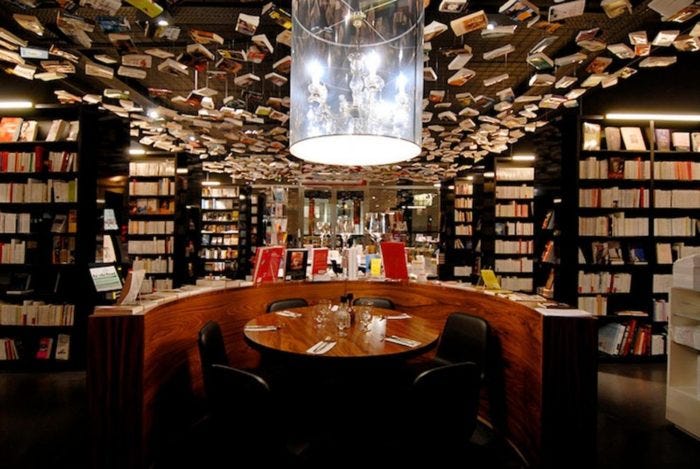
Cook & Book, Brussels Belgium

Saraiva, Rio de Janeiro