
by Robyn Bolton | Aug 4, 2025 | Leadership, Leading Through Uncertainty, Stories & Examples, Strategy
The best business advice can destroy your business. Especially when you follow it perfectly.
Just ask Johnny Cash.
After bursting onto the scene in the mid-1950s with “Folsom Prison Blues”, Cash enjoyed twenty years of tremendous success. By the 1970s, his authentic, minimalist approach had fallen out of favor.
Eager to sell records, he pivoted to songs backed by lush string arrangements, then to “country pop” to attract mainstream audiences and feed the relentless appetite of 900 radio stations programming country pop full-time.
By late 1992, Johnny Cash’s career was roadkill. Country radio had stopped playing his records, and Columbia Records, his home for 25 years, had shown him the door. At 60, he was marooned in faded casinos, playing to crowds preferring slot machines to songs.
Then he took the stage at Madison Square Garden for Bob Dylan’s 30th anniversary concert.
In the audience sat Rick Rubin, co-founder of Def Jam Recordings and uber producer behind Public Enemy, Run-DMC, and Slayer, amongst others. He watched in awe as Cash performed, seeing not a relic but raw power diluted by smart decisions.
The Stare-Down that Saved a Career
Four months later, Rubin attended Cash’s concert at The Rhythm Café in Santa Anna, California. According to Cash’s son, “When they sat down at the table, they said: ‘Hello.’ But then my dad and Rick just sat there and stared at each other for about two minutes without saying anything, as if they were sizing each other up.”
Eventually, Cash broke the silence, “What’re you gonna do with me that nobody else has done to sell records for me?”
What happened next resurrected his career.
Rubin didn’t promise record sales. He promised something more valuable: creative control and a return to Cash’s roots.
Ten years later, Cash had a Grammy, his first gold record in thirty years, and CMA Single of the Year for his cover of Nine Inch Nails’ “Hurt,” and millions in record sales.
When Smart Decisions Become Fatal
Executives do exactly what Cash did. You respond to market signals. You pivot your offering when customer preferences shift and invest in emerging technologies.
All logical. All defensible to your board. All potentially fatal.
Because you risk losing what made you unique and valuable. Just as Cash lost his minimalist authenticity and became a casualty of his effort to stay relevant, your business risks losing sight of its purpose and unique value proposition.
Three Beliefs at the Core of a Comeback
So how do you avoid Cash’s initial mistake while replicating his comeback? The difference lies in three beliefs that determine whether you’ll have the creative courage to double down on what makes you valuable instead of diluting it.
- Creative confidence: The belief we can think and act creatively in this moment.
- Perceived value of creativity: Our perceived value of thinking and acting in new ways.
- Creative risk-taking: The willingness to take the risks necessary for active change.
Cash wanted to sell records, and he:
- Believed that he was capable of creativity and change.
- Saw the financial and reputational value of change
- Was willing to partner with a producer who refused to guarantee record sales but promised creative control and a return to his roots.
Your Answers Determine Your Outcome
Like Cash, what you, your team, and your organization believe determines how you respond to change:
- Do I/we believe we can creatively solve this specific challenge we’re facing right now?
- Is finding a genuinely new approach to this situation worth the effort versus sticking with proven methods?
- Am I/we willing to accept the risks of pursuing a creative solution to our current challenge?”
Where there are “no’s,” there is resistance, even refusal, to change. Acknowledge it. Address it. Do the hard work of turning the No into a Yes because it’s the only way change will happen.
The Comeback Question
Cash proved that authentic change—not frantic pivoting—resurrects careers and disrupts industries. His partnership with Rubin succeeded because he answered “yes” to all three creative beliefs when it mattered most. Where are your “no’s” blocking your comeback?

by Robyn Bolton | Jul 23, 2025 | Leadership, Leading Through Uncertainty, Stories & Examples
What does a lightning strike in a Spanish forest have to do with your next leadership meeting? More than you think.
On June 14, 2014, lightning struck a forest on Spain’s northeast coast, only 60 miles from Barcelona. Within hours, flames 16 to 33 feet high raced out of control toward populated areas, threatening 27,000 acres of forest, an area larger than the city of Boston.
Everything – data, instincts, decades of firefighting doctrine – prioritized saving the entire forest and protecting the coastal towns.
Instead, the fire commanders chose to deliberately let 2,057 acres, roughly the size of Manhattan’s Central Park, burn.
The result? They saved the other 25,000 acres (an area the size of San Francisco), protected the coastal communities, and created a natural firebreak that would protect the region for decades. By accepting some losses, they prevented catastrophic ones.
The Fear Trap That’s Strangling Your Business
The Tivissa fire’s triumph happened because firefighters found the courage to escape what researchers call the “fear trap” – the tendency to focus exclusively on defending against known, measurable risks.
Despite research proving that defending against predictable, measurable risks through defensive strategies consistently fails in uncertain and dynamic scenarios, firefighter “best practices” continue to advocate this approach.
Sound familiar? It should. Most executives today are trapped in exactly this pattern.
We’re in the fire right now. Financial markets are yo-yoing, AI threatens to disrupt everything, and consumer behaviors are shifting.
Most executives are falling into the Fear Trap by doubling down on protecting their existing business and pouring resources into defending against predictable risks. Yet the real threats, the ones you can’t measure or model, continue to pound the business.
While you’re protecting last quarter’s wins, tomorrow’s disruption is spreading unchecked.
Four Principles for Creative Decision-Making Under Fire
The decision to cede certain areas wasn’t hasty but based on four principles enabling leaders in any situation to successfully navigate uncertainty.
PRINCIPLE 1: A Predictable Situation is a Safe Situation. Stop trying to control the uncontrollable. Standard procedures work in predictable situations but fail in unprecedented challenges.
Put it in Practice: Instead of creating endless contingency plans, build flexibility and agility into operations and decision-making.
PRINCIPLE 2: Build Credibility Through Realistic Expectations. Reducing uncertainty requires realism about what can be achieved. Fire commanders mapped out precisely which areas around Tivissa would burn and which would be saved, then communicated these hard truths and the considered trade-offs to officials and communities before implementing their strategy, building trust and preventing panic as the selected areas burned.
Put it in practice: Stop promising to protect everything and set realistic expectations about what you can control. Then communicate priorities, expectations, and trade-offs frequently, transparently, and clearly with all key stakeholders.
PRINCIPLE 3: Include the future in your definition of success: Traditional firefighting protects immediate assets at risk. The Tivissa firefighters expanded this to include future resilience, recognizing that saving everything today could jeopardize the region tomorrow.
Put it in practice: Be transparent about how you define the Common Good in your organization, then reinforce it by making hard choices about where to compete and where to retreat. The goal isn’t to avoid all losses – it’s to maximize overall organizational health.
PRINCIPLE 4: Use uncertainty to build for tomorrow: Firefighters didn’t just accept that 2,057 acres would burn – they strategically chose which acres to let burn to create maximum future advantage, protecting the region for generations.
Put it in practice: Evaluate every response to uncertainty on whether it better positions you for future challenges. Leverage the disruption to build capabilities, market positions, and organizational structures that strengthen you for future uncertainty.
Your Next Move
When the wind shifted and the fire exploded, firefighters had to choose between defending everything (and likely losing it all) or accepting strategic losses to ensure overall wins.
You’re facing the same choice right now.
Like the firefighters, your breakthrough might come not from fighting harder against uncertainty, but from learning to work with it strategically.
What are you willing to let burn to save what matters most?

by Robyn Bolton | Jun 25, 2025 | Leadership, Stories & Examples, Strategy
Convinced that Strategic Foresight shows you a path through uncertainty? Great! Just don’t rush off, hire futurists, run some workshops, and start churning out glossy reports.
Activity is not achievement.
Learning from those who have achieved, however, is an excellent first activity. Following are the stories of two very different companies from different industries and eras that pursued Strategic Foresight differently yet succeeded because they tied foresight to the P&L.
Shell: From Laggard to Leader, One Decision at a Time
It’s hard to imagine Shell wasn’t always dominant, but back in the 1960s, it struggled to compete. Tired of being blindsided by competitors and external events, they sought an edge.
It took multiple attempts and more than 10 years to find it.
In 1959, Shell set up their Group Planning department, but its reliance on simple extrapolations of past trends to predict the future only perpetuated the status quo.
In 1965, Shell introduced the Unified Planning Machinery, a computerized forecasting tool to predict cash flow based on current results and forecasted changes in oil consumption. But this approach was abandoned because executives feared “that it would suppress discussion rather than encourage debate on differing perspectives.”
Then, in 1967, in a small 18th-floor office in London, a new approach to ongoing planning began. Unlike past attempts, the goal was not to predict the future. It was to “modify the mental model of decision-makers faced with an uncertain future.”
Within a few years, their success was obvious. Shell executives stopped treating scenarios as interesting intellectual exercises and started using them to stress-test actual capital allocation decisions.
This doesn’t mean they wholeheartedly embraced or even believed the scenarios. In fact, when scenarios suggested that oil prices could spike dramatically, most executives thought it was far-fetched. Yet Shell leadership used those scenarios to restructure their entire portfolio around different types of oil and to develop new capabilities.
The result? When the 1973 oil crisis hit and oil prices quadrupled from $2.90 to $11.65 per barrel, Shell was the only major oil company ready. While competitors scrambled and lost billions, Shell turned the crisis into “big profits.”
Disney: From Missed Growth Goals to Unprecedented Growth
In 2012, Walt Disney International’s (WDI) aggressive growth targets collided with a challenging global labor market, and traditional HR approaches weren’t cutting it.
Andy Bird, Chairman of Walt Disney International, emphasized the criticality of the situation when he said, “The actions we make today are going to make an impact 10 to 20 years down the road.”
So, faced with an unprecedented challenge, the team pursued an unprecedented solution: they built a Strategic Foresight capability.
WDI trained over 500 leaders across 45 countries, representing five percent of its workforce, in Strategic Foresight. More importantly, Disney integrated strategic foresight directly into their strategic planning and performance management processes, ensuring insights drove business decisions rather than gathering dust in reports.
For example, foresight teams identified that traditional media consumption was fracturing (remember, this was 2012) and that consumers wanted more control over when and how they consumed content. This insight directly shaped Disney+’s development.
The results speak volumes. While traditional media companies struggled with streaming disruption, Disney+ reached 100 million subscribers in just 16 months.
Two Paths. One Result.
Shell and Disney integrated Strategic Foresight differently – the former as a tool to make high-stakes individual decisions, the latter as an organizational capability to affect daily decisions and culture.
What they have in common is that they made tomorrow’s possibilities accountable to today’s decisions. They did this not by treating strategic foresight as prediction, but as preparation for competitive advantage.
Ready to turn these insights into action? Next week, we’ll dive into the tools in the Strategic Foresight toolbox and how you and your team can use them to develop strategic foresight that drives informed decisions.

by Robyn Bolton | May 30, 2025 | Leadership, Strategy
Conventional wisdom tells us that transformation flows from the C-suite down because real change requires executive mandates and company-wide rollouts. But what if our focus on building transformation momentum is exactly backward?
Ever since reading Multipliers, where Liz Wiseman revealed how the best leaders amplify their people rather than diminish them, I’ve wondered if, like innovation, organizational transformation and change also require us to do the opposite of our instincts.
I recently had the opportunity to dig deeper into this topic with her, and I couldn’t resist exploring how change really happens in large organizations.
What emerged wasn’t another framework—it was something more brilliant and subversive: how middle managers quietly become change agents, why sustainable transformation looks nothing like a launch event, and the liberating truth that leaders don’t need to be perfect.
Robyn Bolton: What’s the one piece of conventional wisdom about leading change that you believe organizations need to unlearn?
Lize Wiseman: I don’t believe that change needs to start, or even be sponsored, at the top of the organization. I’ve seen so much change led from the middle management ranks. When middle managers experiment with new mindsets and practices inside their organizations, they produce pockets of success—anomalies that catch the attention of senior executives and corporate staffers who are highly adept at detecting variances (both negative and positive). When senior executives notice positive outcomes, they are quick to elevate and endorse the new practices, in turn spreading the practices to other parts of the organization. In other words, most senior executives are adept at spotting a parade and getting in front of it! (Incidentally, this is one of several executive skills you won’t find documented on any official leadership competency model.) If you don’t yet have the political capital to lead a company-wide initiative, run a pilot with a few rising middle managers. Shine a spotlight on their success and let the practices spread to their peers. Expose their good work to the executive team and make yourself available to turn the parade into a movement.
RB: In your research and work, what’s the most surprising pattern you’ve observed about successful organizational transformation?”
LW: As mentioned above, I believe the starting point for transformation is less important than how you will sustain the momentum you’ve generated. Unfortunately, most new initiatives—be they corporate change initiatives or personal improvement plans—begin with a bang but fizzle out in what I call “the failure to launch” cycle. Transformation that is sustained over time usually starts small and builds a series of successive wins. Each win provides the energy needed to carry the work into the next phase. These series of wins generate the energy and collective will needed to complete the cycle of success. As that cycle spins, nascent beliefs become more deeply entrenched and old survival strategies get supplanted by new methods to not just survive but thrive inside the organization.
Each little success requires careful support and an evidence-backed PR campaign to build awareness and broad support for the new direction. Nascent behavior and beliefs are fragile and will be overpowered by older assumptions until they are strengthened by supporting evidence. The supporting evidence forms a buttress around the budding mindset or practices, much like a brace around a sapling provides stability until the tree is strong enough to stand on its own.
RB: How has your thinking about what makes an effective leader evolved over the course of your career?
LW: When I began researching good leadership, most diminishing leaders appeared to be tyrannical, narcissistic bullies. But as I further studied the problem, I’ve come to see that the vast majority of the diminishing happening inside our workplaces is done with the best of intentions, by what I call the Accidental Diminisher—good people trying to be good managers. I’ve become less interested in knowing who is a Diminisher and much more interested in understanding what provokes the Diminisher tendencies that lurk inside each of us.
RB: When you consider all the organizations you’ve studied, what’s the most powerful lesson about driving meaningful change that most leaders overlook?
LW: One of the dangers of trying to lead change from the top is that most leaders have a hard time being a constant role model for the changes they advocate for. Even the best leaders can’t always display the positive behaviors they espouse and ask their organizations to embody. It’s human to slip up. But when behavior change is led primarily from the top, these all-too-natural slip-ups can become major setbacks for the whole organization because they provide visible evidence that the new behavior isn’t required or feasible, and followers can easily give up. Wise leaders understand this dynamic and build a hypocrisy factor into their change plans–meaning, they acknowledge upfront that they aspire to the new behavior but don’t always fully embody it, yet. They set the expectation that there will be setbacks and invite people to help them be better leaders as well. They acknowledge that the route to new behavior typically looks like the acclimation process used by high-elevation climbers. These climbers spend some of their days in ascent, but once they reach new elevations, often have to descend to lower camps to acclimate. It’s the proverbial two-steps-forward, one-step-back process. When leaders acknowledge their shortcomings and the likelihood of their future missteps, they not only minimize the chance that others give up when they see hypocrisy above them, but they create space for others to make and recover from their own mistakes.
RB: Looking ahead, what do you believe is the most important capability leaders need to develop to help their organizations thrive?
LW: Leading in uncertainty, specifically the ability to lead people to destinations that they themselves have never been.
I love that Liz’s insights flip the script, calling on people outside the C-Suite to stop waiting for permission and start running quiet experiments, building proof points, and letting success do the selling.
The next time you want a change or have change thrust upon you, don’t look for a parade to lead. Look for one person willing to try something different and get to work.
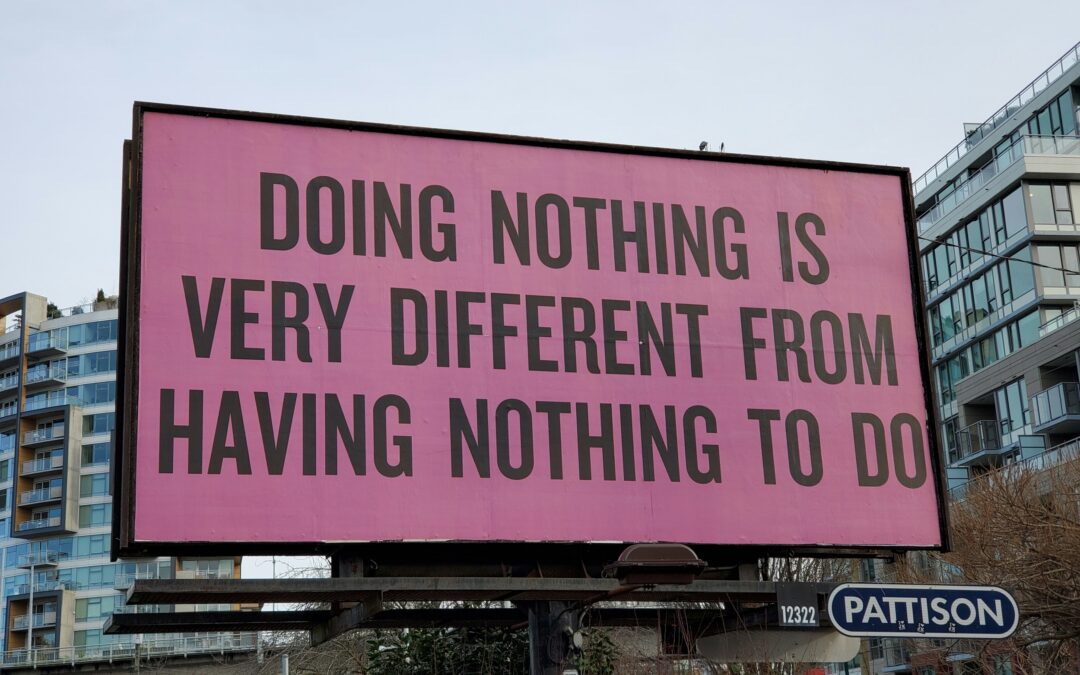
by Robyn Bolton | May 21, 2025 | Innovation, Leadership, Tips, Tricks, & Tools
“What will you do on vacation?” a colleague asked.
“Nothing,” I replied.
The uncomfortable silence that followed spoke volumes. In boardrooms and during quarterly reviews, we celebrate constant motion and back-to-back calendars. Yet, study after study shows that the most successful leaders embrace a counterintuitive edge: strategic idleness.
While your competitors exhaust themselves in perpetual busyness, research shows that deliberate mental downtime activates the brain networks responsible for strategic foresight, innovative solutions, and clear decision-making.
The Status Trap of Busy-ness
At one company I worked with, there was only one acceptable answer to “How are you doing?” “Busy.” The answer wasn’t a way to avoid an awkward hallway conversation. It was social currency. If you’re busy, you’re valuable. If you’re fine, you’re expendable.
A 2017 study published in the Journal of Consumer Research confirmed what Columbia, Georgetown, and Harvard researchers discovered: being busy is now a status symbol, signaling “competence, ambition, and scarcity in the market.”
But here’s the uncomfortable truth: your packed schedule is undermining the very outcomes you’re accountable for delivering.
Your Brain’s Innovation Engine
Neuroscience has confirmed what innovators have long practiced: Strategic Idleness. While you consciously “do nothing,” your default mode network (DMN) engages, making unexpected connections across stored information and experiences.
Recent research published in the journal Brain demonstrates that the DMN is activated during creative thinking, with a specific pattern of neural activity occurring during the search for novel ideas. This network is essential for both spontaneous thought and divergent thinking, core elements of innovation.
So if you’ve always wondered why you get your best ideas in the shower, it’s because your DMN is powered all the way up.
Three Ways to Power-Up Your Engine
Here are three executive-grade approaches to strategic idleness without more showers or productivity sacrifices:
- Pause for 10 Minutes Before Making a Decision
Before making high-stakes decisions, implement a mandatory 10-minute idleness period. No email, no conversation—just sitting. Research on cognitive recovery suggests that this brief reset activates your DMN, allowing for a more comprehensive consideration of variables and strategic implications.
- Take a Walking Meeting with Yourself
Block 20 minutes in your calendar each week for a solo walking meeting (and then take the walk!). No other attendees, no agenda, just walking. Researchers at Stanford University found that walking increases creative output by an average of 60% compared to sitting. The combination of physical movement and mental space creates ideal conditions for your brain to generate solutions to problems you didn’t know you had.
- Schedule 3-5 minutes of Strategic Silence before key discussions
Research on group dynamics shows that silent reflection before discussion can reduce groupthink and increase the quality of ideas by helping team members process information more deeply. Before you dive into a critical topic at your next leadership meeting, schedule 3-5 minutes of silence. Explain that this silence is for individual reflection and planning for the upcoming discussion, not for checking email or taking bathroom breaks. Acknowledge that it will feel awkward, but that it’s critical for the upcoming discussion and decision.
Remember, You’re Not Doing Nothing If You’re being Strategically Idle
The most valuable asset in your organization isn’t technology, capital, or even the products you sell. It’s the quality of thinking that goes into critical decisions. Strategic idleness isn’t inaction; it’s the deliberate cultivation of conditions that foster innovation, clear judgment, and strategic foresight.
While your competitors remain trapped in perpetual busyness, by using executive advantage of strategic idleness, your next breakthrough will present itself.
This is an updated version of the June 9, 2019, post, “Do More Nothing.”