by Robyn Bolton | Apr 15, 2026 | Customer Centricity, Innovation, Leadership
In October, at InnoLead’s annual conference in Boston MA, everything was AI. When the facilitator of a LEGO Serious Play workshop announced we would not talk about AI, the room erupted in applause.
In April, at Inside Outside Innovation’s biannual conference in Lincoln NE, everything was human. By day’s end, speakers and attendees alike were celebrating the sweet relief of a human-led, AI-supported future.
Why the difference? AI hasn’t fallen out of the news cycle, nor have AI-driven layoffs ceased.
Perspective.
InnoLead’s conference featured practitioners living the day-to-day reality of change and innovation. IO 2026 spotlighted thought leaders like Eric Ries, David Bland, and Erin Stadler, advisors able to see across organizations and invited into the C-Suite’s inner sanctum.
One conference talks about what is. One about what will be.
So, if you want to know what your C-Suite will task you with in six months, look to Nebraska.
To move forward, we must face hard truths
Eric Ries, the creator of Lean Startup and author of the forthcoming Incorruptible, exposed the myth that free markets reward value creation. They reward value extraction. Companies focused on extraction forget their purpose, serve themselves over their customers, and ultimately fail.
Elliott Parker, CEO of Alloy Partners and author of The Illusion of Innovation, declared corporate innovation to be alchemy. Isaac Netwon spent his life pursuing alchemy (creating calculus was just a side quest) but failed because the basic building block of matter, the atom, is immutable. The same is true of big company executives pursuing innovation. The atomic elements of corporations (efficiency) and entrepreneurship (autonomy, passion, urgency, skin in the game, and freedom) are immutable and incompatible. Just as lead cannot become gold, companies can’t create like startups.
To do better, we must focus on people
Erin Stadler, founder of Design Culture and author of one of my all-time favorite articles on innovation, shared a forgotten truth: “When we lead with people, the human element, the science, the innovation comes with it.” To do this requires leaders and organizations to find and state their purpose, to build principles and values, and to act on them every day
Dan Hassenplug, VP of Design at sport tech company Hudl, boldly declared that customer obsession is the “real AI strategy.” After all, getting 10x faster at something doesn’t matter if it’s on something that doesn’t matter. And what matters are your customers. Living with them, talking to them, listening to them. You’ll get radical and game changing insights that no competitor, survey, or synthetic persona can.
David Bland, founder of Precoil and author of Testing Business Ideas, implored the audience to flip the 80/20 ratio of feasibility experiments to desirability experiments. Why? “We can make anything these days. It doesn’t matter if you can make it if no one wants it.”
To focus on people, we must serve them
Ted Ullrich, co-founder of Tomorrow Lab, reminded us that “simplicity is earned,” not a starting point. We start by trying to do all the thingsfor customers, but that’s overwhelmng and unnecessary. Only by listening to humans and staying humble can we create the simple solutions that create value.
Julie Ann Crommet, founder of Collective Moxie and former VP at Disney, dazzled us with the simple fact that “the more specific the story, the more universal.” She backed this up with data that films with Authentically Inclusive Representation perform nearly 3x better at the box office and the story behind how Coco became Pixar’s highest grossing movie in China, despite content that is typically banned.
The future is wonderfully human
AI isn’t going away and it will change almost all aspects of life and work. But if the thought leaders, advisors, and designers in Nebraska are right (and I think they are), the future will be far more human than machine.
by Robyn Bolton | Mar 30, 2026 | Just for Fun, Leading Through Uncertainty
We survived the first quarter of the year. Congratulations everyone, job well done.
Did we hope for more than just survival? Of course we did! But hey, sometimes just living to fight another day is a victory and we still have nine more months to hit our KPIs, deliver our OKRs, and nail this fiscal’s BHAG.
So, let’s take a moment to focus on what really matters: Baseball is back!
Along with the hope of the new season, and the warm weather that comes with it, comes an excuse to revisit the wisdom of classic baseball moves. In 2021, I wrote about Moneyball’s lessons in innovation and it continues to be one of the top read posts on my blog.
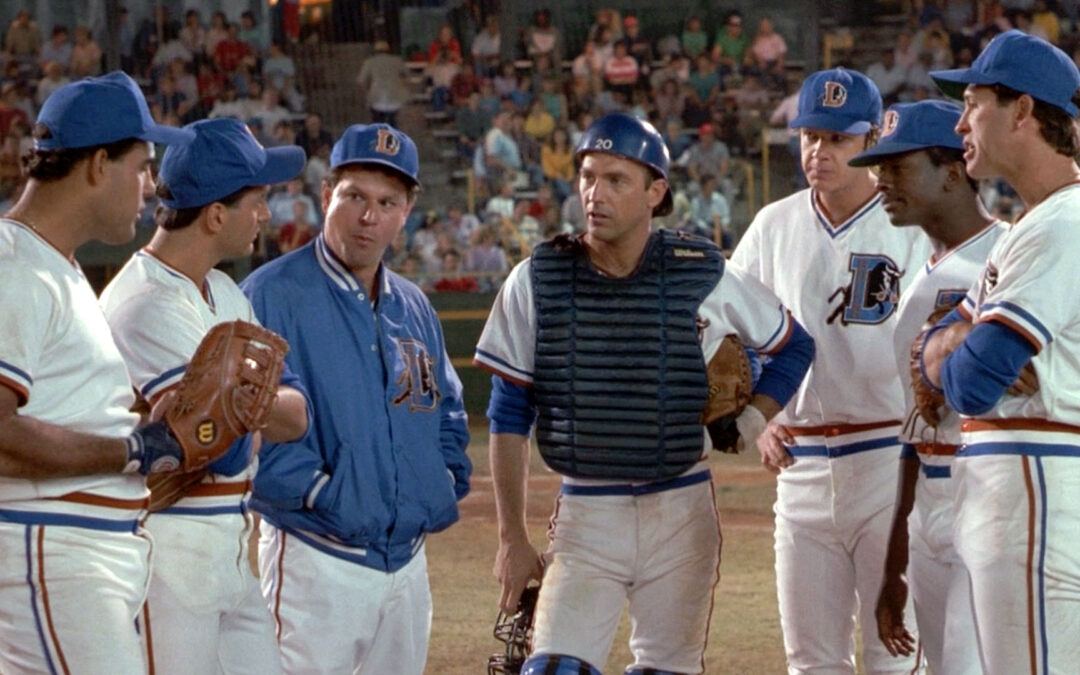
If you feel overwhelmed by Q1, fear not! There’s no greater source of advice on finding simplicity, solving problems, and leading people than Bull Durham.
When you’re overwhelmed, go back to the basics.
Skip: This… is a simple game. You throw the ball. You hit the ball. You catch the ball.
The Durham Bulls are 8-16 and Skip (the manager) has had enough. He’s tried every tool in his coaching toolkit and the team continues to perform poorly, display a poor attitude, and deliver a halfhearted performance. Overwhelmed and frustrated, he turns to veteran player Crash Davis for advice. “Scare ‘em,” Crash offers and what comes next is one of the greatest tirades on film.
But the greatest lesson here is what comes towards the end of the tirade: a description of the utter simplicity of baseball. There’s no strategy, no competitor analysis, no number-crunching, just a simple explanation of the most basic elements of the job. Throw. Hit. Catch.
It’s easy to get overwhelmed by news, technology, corporate politics, the list goes on. That overwhelm causes us to worry, lollygag, and obsess about what could happen. But when we cut through all that to find the essence of what we do and why we do it, things become remarkably clear and the next steps feel obvious.
Fall in love with the problem. Not the solution.
Zeke: We need a night off just to stop our losing streak. We need a rainout.
Crash: I can get us a rainout.
The Bulls are on another losing streak but this time on the road. As the team bus pulls into another motel and the players gather their bags, they complain about their problem (losing streak), propose an approach (night off) and propose a specific solution (rainout).
When Crash promises a rainout, it’s not because he knows something about the forecast the others don’t. It’s because he understands that there’s more than one way to get a night off. Like breaking into the ballpark, turning on the sprinklers, and flooding the field.
When we fall in love with a solution (rainout) we get stuck. We focus on making one thing happen, when critical dependencies are beyond our control. But when we fall in love with the problem (need a night off to stop a losing streak), we’re able to see less obvious but more likely and effective solutions.
People first. Problem solving second
Larry: [Jogs out to the mound to break up a players’ conference] Excuse me, but what the hell’s going on out here?
Crash Davis: Well, Nuke’s scared because his eyelids are jammed and his old man’s here. We need a live rooster to take the curse off Jose’s glove and nobody seems to know what to get Millie or Jimmy for their wedding present. We’re dealing with a lot of sh*t.
Larry: Okay, well, uh… candlesticks always make a nice gift, and uh, maybe you could find out where she’s registered and maybe a place-setting or maybe a silverware pattern. Okay, let’s get two! Go get ’em.
The Bulls are finally on a winning streak, but off-the-field issue are affecting on-the-filed play and things aren’t looking good. As the players gather on the mound, the team’s Assistant Manager trots out to figure out what’s going on and get the game going again.
After Crash sums up the personal issues, instead of telling the players to be professional, leave their problems at home, and get on with things, Larry focuses on solving the single issue affecting the most people first. It’s only when the players start nodding that he shifts everyone back into work-mode.
Only on Severance can we separate ourselves into work and life modes. Pretending that isn’t the case is counterproductive and toxic. But we can’t let one consume the other because it will ultimately degrade both our professional and personal lives.
As leaders, we need to find the balance between helping the humans grapple with real and personal issues and getting the team (back) on track and doing great work.
Ready to keep playing?
Baseball is a game of survival. A foul tip keeps the at bat alive. A walk keeps the inning alive. A bloop single to score a runner send the game into extra innings.
Winning takes patience and perseverance because the game is rarely won or lost in a single at-bat or inning. Just like you don’t win or lose your KPIs, OKRs, or BHAGs in a quarter.
As we start a new quarter, let’s keep it simple, focus on solving problems, and put people first.
Go get ‘em.
by Robyn Bolton | Mar 18, 2026 | AI, Customer Centricity, Leadership, Leading Through Uncertainty, Strategy
If you’re uncertain, you’re not alone. According to data from FactSet, 87% of Fortune 500 companies cited “uncertainty” during their 2025 Q1 earnings calls. And while things are definitely a tad chaotic in the world, I’ve started asking my clients, “What would you do if you were certain?”
It’s not an academic thought experiment. It’s a very practical exercise that radically shifts the way the think about and lead their businesses.
An Example That Proves the Rule
Most leaders facing disruption do one of two things: freeze and hope that “this too shall pass” or follow and hope that there is safety in numbers.
Neither is a strategy. Both are knee jerk reactions rooted in fear and communicated in the language and buzzwords of business.
This behavior didn’t start with AI. It happens every time a disruptive technology or philosophy bursts onto the scene. The printing press. The industrial revolution. Microchips. Each time, a new leader and paradigm emerges. How do they do it?
They’re certain.
Not because they’re omniscient. But because they know the answers to three questions
Question 1: Who Are You?
When photography made academic realism obsolete, Picasso didn’t freeze. He didn’t pick up a camera. He created something entirely new. Why? Because he knew exactly who he was. “I don’t seek,” he said. “I find.”
Today’s business icons are no different. Richard Branson describes himself as curious and someone who challenges the status quo. Lou Gerstner, when he arrived at a floundering IBM, declared himself a results man, not a visionary.
These self-definitions aren’t marketing. They’re decisions filters that define what you are and aren’t willing to do, agnostic of events, technologies, and capabilities.
Question 2: What Does Your Organization Actually Do?
Not what you make. Not what you sell. What Job to be Done do customers hire you to do?
Nintendo’s answer has been consistent across 130 years of radical product change: help me have fun with friends and family. From playing cards to the Game Boy, Wii, and Switch, their products changed completely. The Job didn’t.
IBM has done the same. From punch card tabulators to consulting and AI, the Job of helping customers make sense of complex information to run better never change. Amex moved from freight forwarding to credit and debit cards, but it’s commitment to move value securely when direct exchange isn’t an option never wavered.
When you know the Job you do, you stop chasing trends and start making choices.
Question 3: How Do You Move Forward?
You can’t answer this question without answering the first two. When you try, you get caught in the same freeze/follow trap as everyone else.
But when you answer the first two questions, the answer to this one becomes clear. For Picasso and Branson, they create. For Gerstner, he optimized the status quo. For most businesses, the answer is “And, not Or.” They must stabilize today’s business, step into (even follow) the next wave, and invest in creating the new.
Satya Nadella’s transformation of Microsoft is a perfect example. He defined himself as a learner, not a knower. He defined Microsoft’s job as helping people make a difference in their roles. From those two answers, every major move followed logically: maintain Office 365, step into cloud, create quantum computing technology.
None of it was reactive. All of it felt certain.
Your Moment Is Now
Yes, the world is uncertain. You don’t have to be.
Before you close this tab and tell yourself you’ll think about it later, answer the first two questions. You can change your answers later, but you need to start now.
The leaders who navigate this moment won’t be the ones who wait and see or follow the crowd. They’ll be the ones who know themselves and their organizations well enough to be certain.

by Robyn Bolton | Nov 19, 2025 | Innovation, Stories & Examples
I can’t believe that I’m writing this. Honestly, I can’t believe I’m even thinking this. I’m an open-minded person, but I truly never thought that anything would ever change my mind on this topic. And yet, I must confess that I’ve come to the conclusion that…
(deep breath)
Innovation Theater is important.
(Sorry, needed a minute to recover. It’s one thing to think something. It’s another to see it in writing.)
Why We All Hate(d) Innovation Theater.
The term “Innovation Theater” was coined by Steve Blank in a 2019 HBR article to describe innovation activities like hackathons, shark tanks, and workshops that “shape and build culture, but they don’t win wars, and they rarely deliver shippable/deployable product.”
The name stuck because it gave the Innovation Industrial Complex a perfect scapegoat. Innovation efforts weren’t producing results because companies were turning real strategy into theater—events that could be delegated and scheduled instead of the courage, commitment, and willingness to change that actual innovation requires.
And in many cases, this criticism was warranted.
But in our rush to dismiss Innovation Theater, we missed something important.
What I (Almost) Missed.
Recently, I visited a company’s Innovation Center, curious to see what ten years of innovation investments and two floors in a downtown high-rise had produced.
The answer was a framework to think more deeply about equity and inclusion. My immediate reaction was rage. A decade of investments for this? Millions of dollars spent on the very definition of Innovation Theater? And they’re bragging about it?!?
Once the rage subsided, something remained. Something that I couldn’t shake. An inkling that I had missed something. That inkling became the realization that I was wrong.
Over the past five years, the framework had been used in carefully curated workshops to help teams across the organization see things they had previously overlooked, understand topics that were sensitive or taboo, and envision solutions that no one their heavily regulated industry had even considered.
Not every workshop resulted in action. But over time, something shifted.
Seasons. Not Shows.
Repetition created a shared language. Multiple touchpoints built permission. Small success stories accumulated to make risk feel manageable. The workshops didn’t send off isolated sparks of innovation. They built the conditions were acting on new ideas became progressively safer and more normal.
And after several seasons, enduring value was created. The company now enjoys the highest retention rate of customers in its industry and has attracted more new customers than all its competitors combined. A decade of “Innovation Theater” delivered exactly what innovation is supposed to deliver: measurable competitive advantage and revenue growth.
Don’t Cancel Your Next Innovation Event.
The problem isn’t Innovation Theater itself. It’s how we practice it.
A one-off hackathon? Theater. An annual workshop? Theater. But sustained investment over years, touching dozens of teams, building shared language and accumulated proof points? That’s a strategic bet on transformation that creates lasting competitive advantage.
The question isn’t whether Innovation Theater works. It’s whether you’re willing to commit to the season, not just the show. Are you prepared to invest consistently, measure differently, and wait for compounding effects that won’t show up in next quarter’s results?
Because when you commit to the season, not just the show, it’s the most strategic bet you can make.

by Robyn Bolton | Oct 6, 2025 | 5 Questions, Customer Centricity, Innovation, Tips, Tricks, & Tools
For decades, we’ve faithfully followed innovation’s best practices. The brainstorming workshops, the customer interviews, and the validated frameworks that make innovation feel systematic and professional. Design thinking sessions, check. Lean startup methodology, check. It’s deeply satisfying, like solving a puzzle where all the pieces fit perfectly.
Problem is, we’re solving the wrong puzzle.
As Ellen Di Resta points out in this conversation, all the frameworks we worship, from brainstorming through business model mapping, are business-building tools, not idea creation tools.
Read on to learn why our failure to act on the fundamental distinction between value creation and value capture causes too many disciplined, process-following teams to create beautiful prototypes for products nobody wants.
Robyn: What’s the one piece of conventional wisdom about innovation that organizations need to unlearn?
Ellen: That the innovation best practices everyone’s obsessed with work for the early stages of innovation.
The early part of the innovation process is all about creating value for the customer. What are their needs? Why are their Jobs to be Done unsatisfied? But very quickly we shift to coming up with an idea, prototyping it, and creating a business plan. We shift to creating value for the business, before we assess whether or not we’ve successfully created value for the customer.
Think about all those innovation best practices. We’ve got business model canvas. That’s about how you create value for the business. Right? We’ve got the incubators, accelerators, lean, lean startup. It’s about creating the startup, which is a business, right? These tools are about creating value for the business, not the customer.
R: You know that Jobs to be Done is a hill I will die on, so I am firmly in the camp that if it doesn’t create value for the customer, it can’t create value for the business. So why do people rush through the process of creating ideas that create customer value?
E: We don’t really teach people how to develop ideas because our culture only values what’s tangible. But an idea is not a tangible thing so it’s hard for people to get their minds around it. What does it mean to work on it? What does it mean to develop it? We need to learn what motivates people’s decision-making.
Prototypes and solutions are much easier to sell to people because you have something tangible that you can show to them, explain, and answer questions about. Then they either say yes or no, and you immediately know if you succeeded or failed.
R: Sounds like it all comes down to how quickly and accurately can I measure outcomes?
E: Exactly. But here’s the rub, they don’t even know they’re rushing because traditional innovation tools give them a sense of progress, even if the progress is wrong.
We’ve all been to a brainstorm session, right? Somebody calls the brainstorm session. Everybody goes. They say any idea is good. Nothing is bad. Come up with wild, crazy ideas. They plaster the walls with 300 ideas, and then everybody leaves, and they feel good and happy and creative, and the poor person who called the brainstorm is stuck.
Now what do they do? They look at these 300 ideas, and they sort them based on things they can measure like how long it’ll take to do or how much money it’ll cost to do it. What happens? They end up choosing the things that we already know how to do! So why have the brainstorm?”
R: This creates a real tension: leadership wants progress they can track, but the early work is inherently unmeasurable. How do you navigate that organizational reality?
E: Those tangible metrics are all about reliability. They make sure you’re doing things right. That you’re doing it the same way every time? And that’s appropriate when you know what you’re doing, know you’re creating value for the customer, and now you’re working to create value for the business. Usually at scale
But the other side of it? That’s where you’re creating new value and you are trying to figure things out. You need validity metrics. Are we doing the right things? How will we know that we’re doing the right things.
R: What’s the most important insight leaders need to understand about early-stage innovation?
E: The one thing that the leader must do is run cover. Their job is to protect the team who’s doing the actual idea development work because that work is fuzzy and doesn’t look like it’s getting anywhere until Ta-Da, it’s done!
They need to strategically communicate and make sure that the leadership hears what they need to hear, so that they know everything is in control, right? And so they’re running cover is the best way to describe it. And if you don’t have that person, it’s really hard to do the idea development work.”
But to do all of that, the leader also must really care about that problem and about understanding the customer.
We must create value for the customer before we can create value for the business. Ellen’s insight that most innovation best practices focus on the latter is devastating. It’s also essential for all the leaders and teams who need results from their innovation investments.
Before your next innovation project touches a single framework, ask yourself Ellen’s fundamental question: “Are we at a stage where we’re creating value for the customer, or the business?” If you can’t answer that clearly, put down the canvas and start having deeper conversations with the people whose problems you think you’re solving.
To learn more about Ellen’s work, check out Pearl Partners.
To dive deeper into Ellen’s though leadership, visit her Substack – Idea Builders Guild.
To break the cycle of using the wrong idea tools, sign-up for her free one-hour workshop.