Corporate offsites – the phrase conjures images of everything from “mandatory fun” with colleagues to long and exhausting days debating strategy with peers. Rarely are the images something that entice people to sit up and shout, “YEA!” But what if the reality could be something YEA! worthy?
Offsites May Be the Answer to the WFH vs. RTO Debate
Offsites aren’t new but they’ve taken on a new role and new significance as companies grapple with how to manage Work from Home (WFH) and Return To Office (RTO) policies.
As with most things in life, the pendulum swings from one extreme to another until eventually, finally, landing in a stable and neutral midpoint. When the pandemic hit, we swung from every day in the office to every day at home. Then society opened back up and corporate landlords came calling for rent, whether or not people were in the offices, so we swung back to Return to Office mandates.
Offsites, the authors suggest, may be the happy medium between the two extremes because offsites:
“give people opportunities for interactions that otherwise might not happen. Offsites create unique opportunities for employees to connect in person, forming new relationships and strengthening existing ones. As a result, offsites help people learn about others’ knowledge and build interpersonal trust, which are both critical ingredients for effective collaboration.”
Offsite Connections Lead to Collaborations that Generate ROI
After analyzing eight years of data from a global firm’s offsites and 350,000 “instances of formal working relationships” for 750 employees, the authors found that intentionally designed offsites (more on that in a moment) yield surprisingly measurable and lasting results:
24% more incoming requests for collaboration amongst attendees post vs. pre-offsite (silos busted!)
17% of new connections were still active two years after the offsite (lasting change!)
$180,000 in net new revenue from collaborations within the first two months post offsite (real results!)
The benefits event extended to non-attendees because they “seemed to get the message that collaboration is important and wanted to demonstrate their commitment to being collaborative team players” and “likely identified new collaborators after the offsite through referrals.”
How to Design Offsites That Get Results
Four key strategies emerged from the authors’ research and work with over 100 other organizations:
Design for the people in the audience, not the people on stage. Poll attendees to understand their specific needs and goals, then design collaborative activities, not management monologues.
Design for the new hires, not the tenured execs. Create opportunities for new hires to meet, connect with, and work alongside more experienced colleagues.
Set and communicate clear goals and expectations. Once the offsite is designed and before it happens, tell people what to expect (the agenda) and why to expect it (your design intentions and goals). Also, tell them how to make the most of the offsite opportunities by thinking about the skill and network gaps they want to fill.
Track activities to measure ROI. The connections, collaborations, and commitments that start at the offsite need to continue after it in the form of ongoing communication, greater collaboration, and talent engagement. Yes, conduct a post-event survey immediately after the event but keep measuring every 2-3 months until the next offsite. The data will reveal how well you performed against your goals and how to do even better the next time.
Offsites can be a powerful tool to build an organization’s culture and revenue, but only if they are thoughtfully designed to go beyond swanky settings, sermons from the stage, and dust-collecting swag and build the connections and collaborations that only start when people are together, in-person, outside of the office.
AI is everywhere: in our workplaces, homes, schools, art galleries, concert halls, and even neighborhood coffee shops. We can’t seem to escape it. Some hope it will unlock our full potential and usher in an era of creativity, prosperity, and peace. Others worry it will eventually replace us. While both outcomes are extreme, if you’ve ever used AI to conduct research with synthetic users, the idea of being “replaced” isn’t so wild.
For the past month, I’ve beta-tested Crowdwave, an AI research tool that allows you to create surveys, specify segments of respondents, send the survey to synthetic respondents (AI-generated personas), and get results within minutes.
Sound too good to be true?
Here are the results from my initial test:
150 respondents in 3 niche segments (50 respondents each)
51 questions, including ten open-ended questions requiring short prose responses
1 hour to complete and generate an AI executive summary and full data set of individual responses, enabling further analysis
The Tool is Brilliant
It took just one hour to gather data that traditional survey methods require a month or more to collect, clean, and synthesize. Think of how much time you’ve spent waiting for survey results, checking interim data, and cleaning up messy responses. I certainly did and it made me cry.
The qualitative responses were on-topic, useful, and featured enough quirks to seem somewhat human. I’m pretty sure that has never happened in the history of surveys. Typically, respondents skip open-ended questions or use them to air unrelated opinions.
Every respondent completed the entire survey! There is no need to look for respondents who went too quickly, chose the same option repeatedly, or abandoned the effort altogether. You no longer need to spend hours cleaning data, weeding out partial responses, and hoping you’re left with enough that you can generate statistically significant findings.
The Results are Dangerous
When I presented the results to my client, complete with caveats about AI’s limitations and the tool’s early-stage development, they did what any reasonable person would do – they started making decisions based on the survey results.
STOP!
As humans, we want to solve problems. In business, we are rewarded for solving problems. So, when we see something that looks like a solution, we jump at it.
However, strategic or financially significant decisions should neverrely ona single data source. They are too complex, risky, and costly. And they definitely shouldn’t be made based on fake people’s answers to survey questions!
They’re Also Useful.
Although the synthetic respondents’ data may not be true, it is probably directionally correct because it is based on millions and maybe billions of data points. So, while you shouldn’t make pricing decisions based on data showing that 40% of your target consumers are willing to pay a 30%+ premium for your product, it’s reasonable to believe they may be willing to pay more for your product.
The ability to field an absurdly long survey was also valuable. My client is not unusual in their desire to ask everything they may ever need to know for fear that they won’t have another chance to gather quantitative data (and budgets being what they are, they’re usually right). They often ignore warnings that long surveys lead to abandonment and declining response quality. With AI, we could ask all the questions and then identify the most critical ones for follow-up surveys sent to actual humans.
We Aren’t Being Replaced, We’re Being Spared
AI consumer research won’t replace humans. But it will spare us the drudgery of long surveys filled with useless questions, months of waiting for results, and weeks of data cleaning and analysis. It may just free us up to be creative and spend time with other humans. And that is brilliant.
Doing nothing fuels creativity and innovation, but that fuel is wasted if you don’t put it to use. Idleness clears the mind, allowing fresh ideas to emerge, but those ideas must be acted upon to create value.
Why is doing something with that fuel so difficult?
Don’t blame the status quo.
The moment we get thrown back into the topsy-turvy, deadline-driven, politics-navigating, schedule-juggling humdrum of everyday life, we slide back into old habits and routines. The status quo is a well-known foe, so it’s tempting to blame it for our lack of action.
But it’s not stopping us from taking the first step.
We’re stopping ourselves.
Blame one (or more) of these.
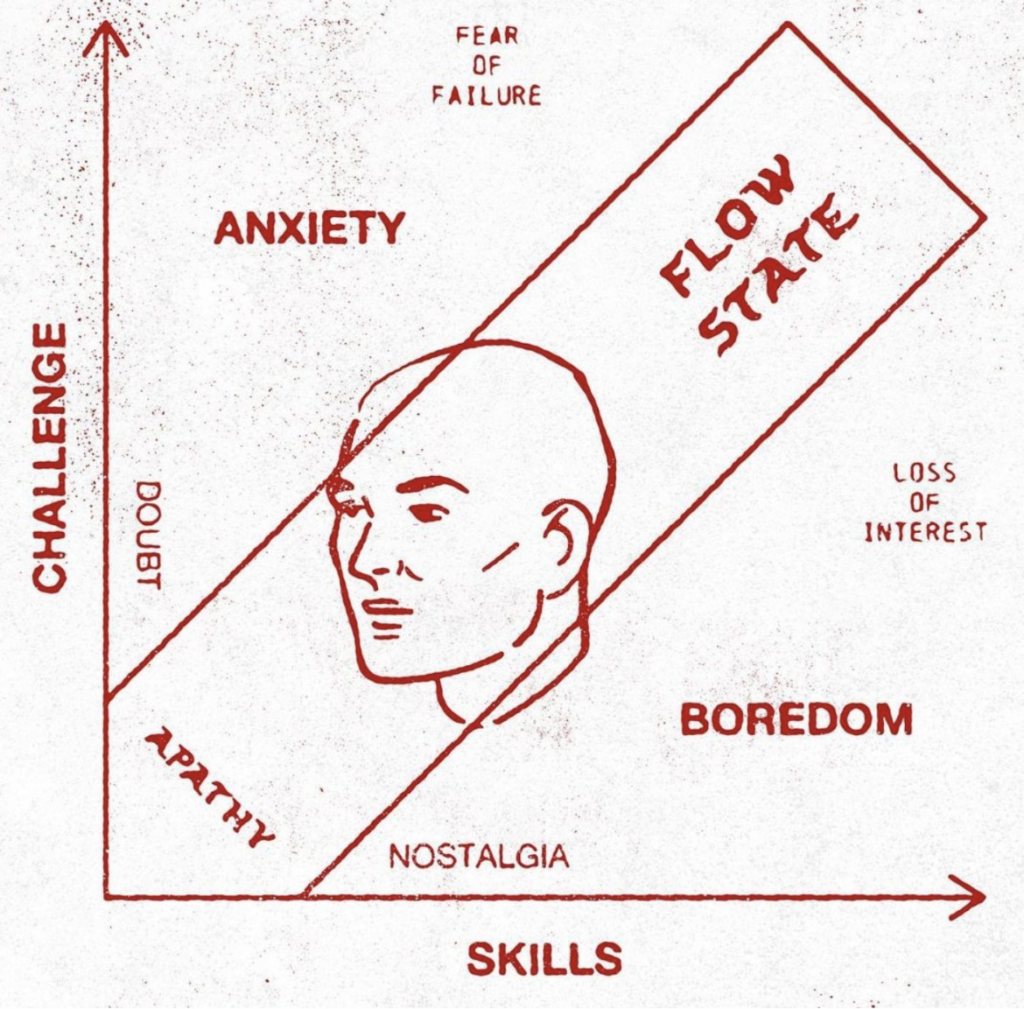
Last week, I stumbled upon this image from the Near Future Laboratory, based on a theory from psychologist Mihaly Csikszentmihalyi’s book Flow:
There’s a lot going on here, but four things jumped out at me:
When we don’t have the skills needed to do something challenging, we feel anxiety
When we don’t feel challenged because our skills exceed the task, we feel boredom
When we don’t feel challenged and we don’t have the skills, we feel apathy
When we have the skills and feel challenged, we are in flow
Four different states. Only one of them is positive.
I don’t love those odds.
Yet we live them every day.
Every day, in every activity and interaction, we dance in and through these stages. Anxiety when given a new project and doubt that we have what it takes. Boredom when asked to explain something for the 82nd time to a new colleague and nostalgia for when people stayed in jobs longer or spent time figuring things out for themselves. Sometimes, we get lucky and find ourselves in a Flow State, where our skills perfectly match the challenge, and we lose track of space and time as we explore and create. Sometimes, we are mired in apathy.
Round and round we go.
The same is true when we have a creative or innovative idea. We have creative thoughts, but the challenge seems too great, so we get nervous, doubt our abilities, and never speak up. We have an innovative idea, but we don’t think management will understand, let alone approve it, so we keep it to ourselves.
Anxiety. Boredom. Apathy.
One (or more) of these tells you that your creative thoughts are crazy and your innovative ideas are wild. They tell you that none of them are ready to be presented to your boss with a multi-million-dollar funding request. In fact, none of them should be shared with anyone, lest they think you, not your idea, is crazy.
Then overcome them
I’m not going to tell you not to feel anxiety, boredom, or apathy. I feel all three of those every day.
I am telling you not to get stuck there.
Yes, all the things anxiety, boredom, and apathy tell you about your crazy thoughts and innovative ideas may be true. AND it may also be true that there’s a spark of genius in your crazy thoughts and truly disruptive thinking in your innovative ideas. But you won’t know if you don’t act:
When you feel anxious, ask a friend, mentor, or trusted colleague if the challenge is as big as it seems or if you have the skills to take it on.
When you feel bored, find a new challenge
When you feel apathetic, change everything
Your thoughts and ideas are valuable. Without them, nothing changes, and nothing gets better.
In 2014, rumors started to circulate that Apple was developing a self-driving autonomous car to compete with Tesla. At the end of February 2024, rumors circulated that Apple was shutting down “Project Titan,” its car program. According to multiple media outlets, the only logical conclusion from the project’s death is that this decision signals the beginning of the end of Apple.
As much as I enjoy hyperbole and unnecessary drama, the truth is far more mundane.
The decision was just another day in the life of an innovation.
As always, there is a silver lining to this car-shaped cloud: the lessons we can learn from Apple’s efforts.
Lesson 1: Innovation isn’t all rainbows and unicorns
People think innovation is fun. It is. It is also gut-wrenching, frustrating, and infuriating. Doing something new requires taking risks, which is uncomfortable for most people. Even more challenging is that, more often than not, when you take a risk, you “fail.” (if you learned something, you didn’t fail, but that’s another article).
What you can do: Focus on the good stuff – moments of discovery, adventures when experimenting, signs that you’re making life better for others – but don’t forget that you’re defying the odds.
Lesson 2: More does not mean success
It’s been reported that Apple spent over ten billion dollars on Project Titan and that over 2000 people were working on it before it was canceled. With a market cap of over two trillion dollars, a billion dollars a year isn’t even a rounding error. But it’s still an eye-popping number, which makes Apple’s decision to cut its losses downright courageous.
What you can do: Be on guard for the sunk-cost fallacy. It’s easy to believe that you’ll eventually succeed if you keep working and pouring resources into a project. That’s not true, as Apple experienced. And in the rare cases when it is, executives are often left wondering if the success was worth the cost.
Lesson 3: Pivot based on data, not opinions
At least four different executives led Project Titan during its decade in development, and each leader brought their own vision for what the Apple Car should be. First, it was an electric vehicle with driver assistance that would compete with Tesla. Next, it was a self-driving car to compete with Google’s WayMo. Then, plans for fully autonomous driving were canceled. Finally, the team returned to its original target of matching Tesla’s Level 2 automation.
Changes in project objectives, strategies, and execution plans are necessary for innovation, so there’s nothing obviously wrong with these pivots. But the fact that they tended to happen when a new leader was appointed (and that Jony Ive caused an 18-month hiring freeze simply by expressing “displeasure”) makes me question how data-based these pivots actually were
What you can do: Be willing to change but have a high standard for what is required to cause a change. Data, even qualitative and anecdotal data, should be seriously considered. The opinion of a single executive, not so much.
Lesson 4: Dream big, build small
Apple certainly dreamed big with its aspirations to build a fully semi-autonomous vehicle and it poured billions into developing and testing the sensors, batteries, and partnership required to make it a reality. But it was never all-or-nothing in its pursuit of the automotive industry. Apple introduced CarPlay the same year it kicked off Project Titan, and it continues to offer regular updates to the system. Car Key was announced in 2020 and is now offered by BMW, Genesis, Hyundai, and Kia.
What you can do: Take a portfolio approach towards your overall innovation portfolio (Apple kept working on the iPhone, iPad, Apple Watch, and Vision Pro) and within each project. It’s not unusual that a part of the project turns out to be more valuable than the whole project.
Lesson 5: ___________________________
Yes, that is a fill-in-the-blank because I want to hear from you. What lesson are you taking away from Project Titan’s demise, and how will it make you a better innovator?
AI is NOT a substitute for person-to-person discovery conversations or Jobs to be Done interviews.
But it is a freakin’ fantastic place to start…if you do the work before you start.
Get smart about what’s possible
When ChatGPT debuted, I had a lot of fun playing with it, but never once worried that it would replace qualitative research. Deep insights, social and emotional Jobs to be Done, and game-changing surprises only ever emerge through personal conversation. No matter how good the Large Language Model (LLM) is, it can’t tell you how feelings, aspirations, and motivations drive their decisions.
Then I watched JTBD Untangled’s video with Evan Shore, WalMart’s Senior Director of Product for Health & Wellness, sharing the tests, prompts, and results his team used to compare insights from AI and traditional research approaches.
In a few hours, he generated 80% of the insights that took nine months to gather using traditional methods.
Get clear about what you want and need.
Before getting sucked into the latest shiny AI tools, get clear about what you expect the tool to do for you. For example:
Provide a starting point for research: I used the free version of ChatGPT to build JTBD Canvas 2.0 for four distinct consumer personas. The results weren’t great, but they provided a helpful starting point. I also like Perplexity because even the free version links to sources.
Conduct qualitative research for me: I haven’t used it yet, but a trusted colleague recommended Outset.ai, a service that promises to get to the Why behind the What because of its ability to “conduct and synthesize video, audio, and text conversations.”
Synthesize my research and identify insights: An AI platform built explicitly for Jobs to be Done Research? Yes, please! That’s precisely what JobLens claims to be, and while I haven’t used it in a live research project, I’ve been impressed by the results of my experiments. For non-JTBD research, Otter.ai is the original and still my favorite tool for recording, live transcription, and AI-generated summaries and key takeaways.
Visualize insights:Mural, Miro, and FigJam are the most widely known and used collaborative whiteboards, all offering hundreds of pre-formatted templates for personas, journey maps, and other consumer research templates. Another colleague recently sang the praises of theydo, an AI tool designed specifically for customer journey mapping.
Practice your prompts
“Garbage in. Garbage out.” Has never been truer than with AI. Your prompts determine the accuracy and richness of the insights you’ll get, so don’t wait until you’ve started researching to hone them. If you want to start from scratch, you can learn how to write super-effective prompts here and here. If you’d rather build on someone else’s work, Brian at JobsLens has great prompt resources.
Spend time testing and refining your prompts by using a previous project as a starting point. Because you know what the output should be (or at least the output you got), you can keep refining until you get a prompt that returns what you expect. It can take hours, days, or even weeks to craft effective prompts, but once you have them, you can re-use them for future projects.
Defend your budget
Using AI for customer research will save you time and money, but it is not free. It’s also not just the cost of the subscription or license for your chosen tool(s).
Remember the 80% of insights that AI surfaced in the JTBD Untangled video? The other 20% of insights came solely from in-person conversations but comprised almost 100% of the insights that inspired innovative products and services.
AI can only tell you what everyone already knows. You need to discover what no one knows, but everyone feels. That still takes time, money, and the ability to connect with humans.
Run small experiments before making big promises
People react to change differently. Some will love the idea of using AI for customer research, while others will resist with. Everyone, however, will pounce on any evidence that they’re right. So be prepared. Take advantage of free trials to play with tools. Test tools on friends, family, and colleagues. Then underpromise and overdeliver.
AI is a starting point. It is not the ending point.
I’m curious, have you tried using AI for customer research? What tools have you tried? Which ones do you recommend?