It’s not easy leading innovation. Especially these days. You need to do more with less. Take risks while guaranteeing results. Keep up with competition through incremental innovation and redefine the industry with radical and disruptive innovation. It’s maddening. Until you find the Goldilocks Zone of adjacent innovation.
Adjacent Innovation: From Middle Child to Just Right
As HBS Professor Regina E. Herzlinger and her co-authors point out in a recent HBR article, the US is in the midst of an innovation crisis. The cost of lost productivity, estimated at over $10 trillion between 2006 and 2018, is a stark reminder of the economic consequences of a lack of innovation. This figure, equivalent to $95,000 per US worker, should serve as a wake-up call to the importance of innovation in driving economic growth.
The authors identify the root cause of this loss as the ‘polarized approach companies take to innovation.’ While companies focus on incremental innovation, the safe and reliable oldest child of the innovation family, the VCs chase after radical, transformative innovations, the wild, charismatic, free-spirited youngest child. Meanwhile, adjacent innovation – new offerings and business models fo existing customers or new customers for existing offerings and business models – is, like the middle child, too often overlooked.
It’s time to rediscover it. In fact, it’s also time to embrace and pursue it as the most promising path back to growth. While incremental innovation is safe and reliable, it’s also the equivalent of cold porridge. Radical or transformative innovation is sexy, but, like hot porridge, it’s more likely to scorch than sustain you. Adjacent innovation, however, is just right – daring enough to change the game and leapfrog the competition and safe enough to merit investment and generate short-term growth.
Proof in the Porridge: 4x the returns in ½ the time
Last year, I worked with an industrial goods company. Their products aren’t sexy, and their brands are far from household names, but they make the things that make America run and keep workers (and the public) safe. The pandemic’s supply chain disruptions battered their business, and their backlog ballooned from weeks to months and even years. Yet amidst these challenges, they continued to look ahead, and what they saw was a $6M revenue cliff that had to be filled in three years and a product and innovation pipeline covered in dust and cobwebs.
From Day 1, we agreed to focus on adjacent innovation. For four weeks, we brainstormed, interviewed customers, and analyzed their existing offerings and capabilities, ultimately developing three concepts – two new products for existing customers and one existing product repositioned to serve a new customer. After eight more weeks of work, we had gathered enough data to reject one of the concepts and double down on the other two. Three months later, the teams had developed business cases to support piloting two of the concepts.
It took 6 months to go from a blank piece of paper to pilot approval.
It took just another 12 months to record nearly $25M in new revenue.
Those results are more than “just right.”
Be Goldilocks. Pursue Adjacent Innovation
Every organization can pursue adjacent innovation. In fact, most of the companies we consider amongst the world’s “Most Innovative” have that reputation because of adjacent innovation.
How will you become your organization’s Innovation Goldilocks and use adjacent innovation to create “just right” growth?
Purpose. Goal. Mission. You hear these words a lot this time of year. Not because it’s the start of the annual business planning cycle but because it’s graduation season.
Across the country, commencement speakers and wise family members espouse the importance of having a purpose to guide and sustain graduates as they set out on their next adventures.
All the talk of purpose can feel overwhelming, especially as you listen to graduates’ wide-eyed optimism about how they will change the world while stewing in an existential crisis that makes you wonder if you even have a purpose.
You do.
And part of that purpose is finding and creating purpose.
What is “Purpose?’
Purpose hasn’t reached buzzword status, but it’s close, so let’s start with a definition, or three, courtesy of The Britannica Dictionary:
the reason why something is done or used: the aim or intention of something – The purpose of innovation is to create value
the feeling of being determined to do or achieve something – The team worked with purpose
the aim or goal of a person: what a person is trying to do, become, etc. – He knew from a young age that her sole purpose in life was to be an orthodontist
Three different definitions of purpose. Three questions that it’s part of your purpose to ask.
“What’s THE purpose?”
Innovation is all about creating value. Sometimes, to create value, you need to do new things. Sometimes, you need to stop doing things. It’s hard to tell the difference if you don’t ask.
That’s why innovative leaders are curious. You aren’t afraid to ask, “What’s the purpose of this product/process/meeting/decision/(fill in the blank).” You want to know “why something is done or used,” and they know that the best way to figure that out is by asking.
You ask this question at least once a day. When you ask it, you’re genuinely curious about the answer. After all, we’ve all experienced people and cultures that weaponize questions – “Johnny, is that where the scissors go?” or “Why did you think that was a good idea?” – and you reassure people that you’re asking a genuine question, even if they should know that by your tone.
“What’s OUR purpose?”
Innovation is hard. You live in ambiguity and uncertainty. You fail (learn) more often than you succeed. You are told “No” and “Stop” more than “Yes,” “Keep going,” and “Thank You.”
Innovators are courageous. You do the hard work of innovation because you are “determined to do or achieve something.”
You also know that sustaining courage and purpose requires a team.
You aren’t fooled by the myth of the lone genius. After all, Thomas Edison worked with as many as 200 people in his West Orange lab. Heck, even Steve Jobs needed Sir Jony Ive (and a few hundred other people) to bring his vision of “1,000 songs in your pocket” to life.
“What’s MY purpose?”
Innovation takes a long time. Change happens gradually, then suddenly. We chose to preserve what we have, rather than take a risk to get more.
Innovators are committed. You are patient for change, steadfast in the face of resistance, and optimistic when others are afraid because of your “aim or goal…what [you are] trying to do, become, etc.”
Even if you can’t articulate it in a grand statement or simple, pithy soundbite, you have a purpose. As Viktor Frankl wrote, “Those who have a ‘why’ to live, can bear with almost any ‘how’.”
Three Purposes. Three questions
Even if you lack the wide-eyed optimism of a new graduate and feel like you spend most days just muddling through life, because you are here, you have a purpose. So tell me:
When was the last time you were curious and asked, “What’s the purpose of (artifact of the status quo)?”
When was the last time you were courageous and used your feeling of determination to inspire others to join your purpose, overcome obstacles, and get something done?
When was the last time you had to dig deep, rediscover your purpose, and reinforce your commitment so that you could bear and overcome the “how?”
Doing nothing fuels creativity and innovation, but that fuel is wasted if you don’t put it to use. Idleness clears the mind, allowing fresh ideas to emerge, but those ideas must be acted upon to create value.
Why is doing something with that fuel so difficult?
Don’t blame the status quo.
The moment we get thrown back into the topsy-turvy, deadline-driven, politics-navigating, schedule-juggling humdrum of everyday life, we slide back into old habits and routines. The status quo is a well-known foe, so it’s tempting to blame it for our lack of action.
But it’s not stopping us from taking the first step.
We’re stopping ourselves.
Blame one (or more) of these.
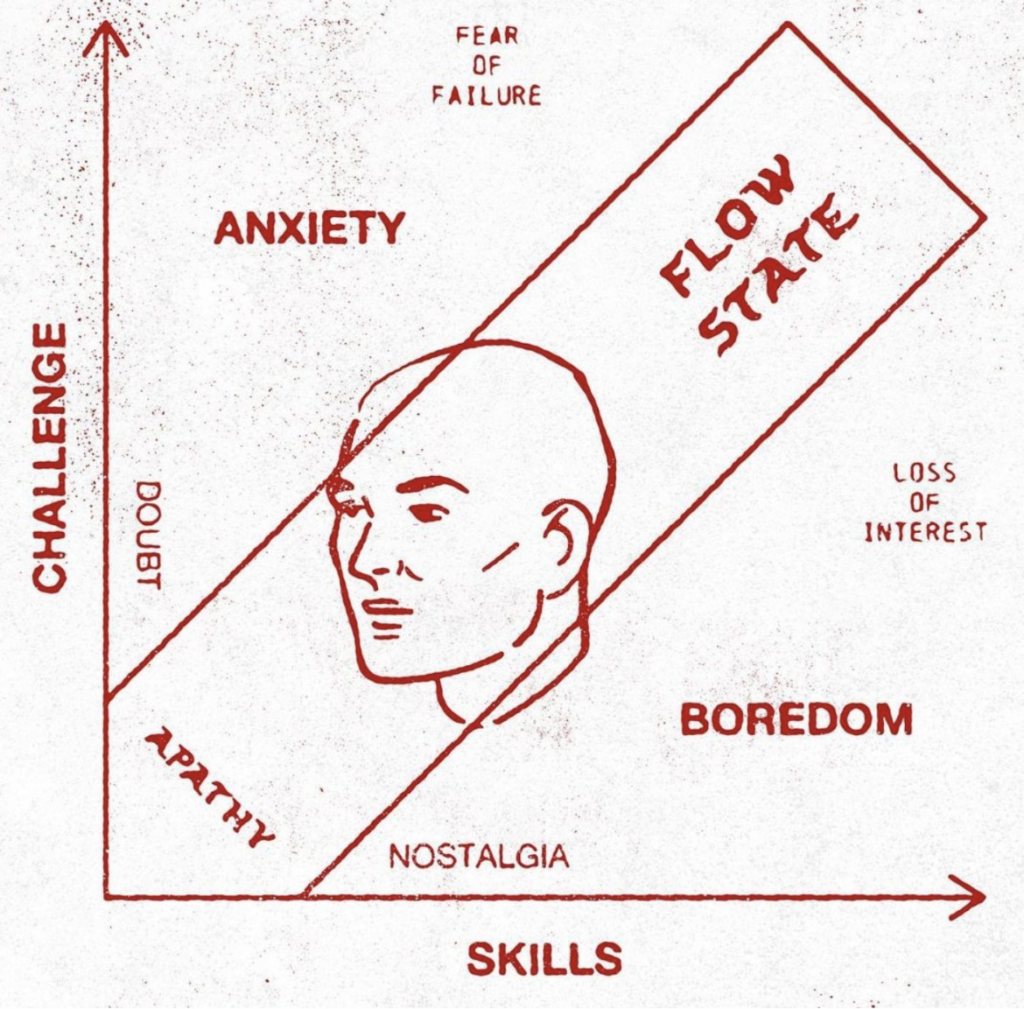
Last week, I stumbled upon this image from the Near Future Laboratory, based on a theory from psychologist Mihaly Csikszentmihalyi’s book Flow:
There’s a lot going on here, but four things jumped out at me:
When we don’t have the skills needed to do something challenging, we feel anxiety
When we don’t feel challenged because our skills exceed the task, we feel boredom
When we don’t feel challenged and we don’t have the skills, we feel apathy
When we have the skills and feel challenged, we are in flow
Four different states. Only one of them is positive.
I don’t love those odds.
Yet we live them every day.
Every day, in every activity and interaction, we dance in and through these stages. Anxiety when given a new project and doubt that we have what it takes. Boredom when asked to explain something for the 82nd time to a new colleague and nostalgia for when people stayed in jobs longer or spent time figuring things out for themselves. Sometimes, we get lucky and find ourselves in a Flow State, where our skills perfectly match the challenge, and we lose track of space and time as we explore and create. Sometimes, we are mired in apathy.
Round and round we go.
The same is true when we have a creative or innovative idea. We have creative thoughts, but the challenge seems too great, so we get nervous, doubt our abilities, and never speak up. We have an innovative idea, but we don’t think management will understand, let alone approve it, so we keep it to ourselves.
Anxiety. Boredom. Apathy.
One (or more) of these tells you that your creative thoughts are crazy and your innovative ideas are wild. They tell you that none of them are ready to be presented to your boss with a multi-million-dollar funding request. In fact, none of them should be shared with anyone, lest they think you, not your idea, is crazy.
Then overcome them
I’m not going to tell you not to feel anxiety, boredom, or apathy. I feel all three of those every day.
I am telling you not to get stuck there.
Yes, all the things anxiety, boredom, and apathy tell you about your crazy thoughts and innovative ideas may be true. AND it may also be true that there’s a spark of genius in your crazy thoughts and truly disruptive thinking in your innovative ideas. But you won’t know if you don’t act:
When you feel anxious, ask a friend, mentor, or trusted colleague if the challenge is as big as it seems or if you have the skills to take it on.
When you feel bored, find a new challenge
When you feel apathetic, change everything
Your thoughts and ideas are valuable. Without them, nothing changes, and nothing gets better.
It’s easy to get caught up in the hunt for unique insights that will transform your business, conquer your competition, and put you on an ever-accelerating path to growth. But sometimes, the most valuable insights can come from listening to customers in their natural environment. That’s precisely what happened when I eavesdropped on a conversation at a local pizza joint. What I learned could be worth millions to your business.
A guy walked into a pizza place.
Last Wednesday, I met a friend for lunch. As usual, I was unreasonably early to the local wood-fired pizza joint, so I settled into my chair, content to spend time engaged in one of my favorite activities – watching people and eavesdropping on their conversations.
Although the restaurant is on the main street of one of the wealthier Boston suburbs, it draws an eclectic crowd, so I was surprised when a rather burly man in a paint-stained hoodie flung open the front door. As he stomped to the take-out order window, dust fell from his shoes, and you could hear the clanging of tools in his tool belt. He placed his order and thumped down at the table next to me.
A Multi-Million Dollar Chat
He pulled out his cell phone and made a call. “Hey, yeah, I’m at the pizza place, and they need your help. Yeah, they hate their current system, but they don’t have the time to figure out a new one or how to convert. Yeah, ok, I’ll get his number. Ok if I give him yours. Great. Thanks.”
A few minutes later, his order was ready, and the manager walked over with his pizza.
Hoodie-guy: “Hey, do you have a card?”
Manager: “No, I don’t. Something I can help you with?”
H: “I just called a friend of mine. He runs an IT shop, and I told him you’re using the RST restaurant management system, and you hate it…”
M: “I hate it so much…”
H: “So my buddy’s business can help you change it. He’s helped other restaurants convert away from RST, and he’d love to talk to you or the owner.”
M: “I’m one of the co-owners, and I’d love to stop using RST, but we use it for everything – our website, online ordering, managing our books, everything. I can’t risk changing.”
H: “That’s the thing, my friend does it all for you. He’ll help you pick the new system, set it up, migrate you from the other system, and ensure everything runs smoothly. You have nothing to worry about.”
M: “That would be amazing. Here’s my direct line. Have him give me a call. And if he’s good, I can guarantee you that every other restaurant on this street will change, too. We all use RST, and we all hate it. We even talked about working together to find something better, but no one had time to figure everything out.”
They exchanged numbers, and the hoodie guy walked out with his pizza. The manager/owner walked back to the open kitchen, told his staff about the conversation, and they cheered. Cheered!
Are You Listening?
In just a few minutes of eavesdropping, I uncovered a potential goldmine for a B2B business – 15 frustrated customers, all desperate to switch from a system they hate but unable to do so due to time and resource constraints. The implications are staggering – an entire local market worth tens of millions of dollars ripe for the taking simply by being willing to listen and offer a solution.
As a B2B leader, the question is: are you truly tapping into the insights right in front of you? When was the last time you left your desk, observed your customers in their natural habitat, and listened to their unvarnished feedback? If you’re not doing that, you’re missing out on opportunities that could transform your business.
The choice is yours. Will you stay in your office and rely on well-worn tools, or venture into the wild and listen to your customers? Your answer could be worth millions.