by Robyn Bolton | Mar 3, 2026 | Leadership, Leading Through Uncertainty, Strategy
“Change is changing: How to meet the challenge of radical reinvention” – McKinsey
“End to End Reinvention Unleashes a Technology’s Full Potential” – BCG
“Reinvention: The Overlooked Skills Leaders Need Right Now” – Forbes
Don’t look now but we’ve got a new buzzword!
Hello, REINVENTION
Wait, what happened to Transformation?
Oh hon, “Transformation” is so 2025 and for good reason. In a survey of 750 global organizations, researchers found that 52% of respondents suffer from “transformation fatigue,” 44% cite constant change as the reason for their burnout, and more than one-third are considering quitting as a result of never-ending transformations.
Unfortunately, massive technologic, economic, and societal shifts demand executives rethink every aspect of their organizations. So, what do you do when you need to transform but using the word is likely to lead to a revolution?
As fans of The Wire know, you rebrand.
So, Reinvention is the new Transformation?
Yes and no.
Both terms apply to large-scale organizational changes that often hit at the heart of an organization’s operations. As a result, they require leadership commitment, employee buy-in, and lots of money and time to execute.
The difference is that Transformation is positioned as a finite endeavor to increase performance, usually through technology adoption and integration or restructuring. Reinvention, however, “requires leaders to embrace more radical approaches and actions – in effect, to embrace the creative destruction of the company so it creates value in new ways.”
On-going. Radical approaches. Creative destruction.
Just what C-Suite execs want.
Honestly, it sounds like Reinvention is needed so why is it BS?
To be fair, it’s only two-thirds BS.
Building a capability for ongoing change, iteration, and learning isn’t BS. In fact, it’s mission critical in a world of constant change and uncertainty. But this capability requires new mindsets and skills that take time, consistent role modeling by senior leaders, before they stick.
What is BS is the need for radical approaches and creative destruction.
Instead, leaders need to return to their roots and reimagine their future.
Return and Reimagine?
Return
Jørgen Vig Knudstorp is widely credited with saving LEGO from bankruptcy and turning it into the world’s biggest toy company. At the 2025 Thinkers50 Summit, he shared his 10 rules for a successful transformation. Number one, “Why do we exist?” He spent three years trying to answer this question.
Why do we exist? What makes us relevant, valuable, rare, hard to imitate?
The answer isn’t your industry, products, or processes. It’s something more fundamental. It’s the Job to be Done that your organization and ONLY your organization can do.
John Fallon, who led Pearson’s turnaround as their CEO, answered this question in a recent conversation with Outthinkers’ Kaihan Krippendorf.
“The job to be done was not publishing textbooks. The job to be done was empowering people to progress in their lives through learning.”
Reimagine
When you know why you exist, you’re able to go beyond rebuilding to reimagining what your organization could be. Knowing your Why changes how you think about your organization and its potential. It enables you to step out of the hype, ignore the peer pressure, and explore all the future Whats and Hows before committing to action.
Then, and only then, do you commit to action. To concrete changes in business models, operations, and capabilities. To Reinvention.
I think I get it. Reinvention is BS not because it’s wrong but because it skips two essential steps.
Reinvention implies rebuilding, but if you don’t know why your company exists, how can you be sure you’re building something that matters?
And, if your “reimagining” is focused only on the latest tech or doubling down on a dying business model, you’ll never see all the other possibilities that may be more resilient.
Return. Reimagine. Reinvent. The 3Rs. That’s a buzzword I can support.
by Robyn Bolton | Feb 16, 2026 | Leadership, Leading Through Uncertainty, Strategy
“None of it worked. When I pulled the executive team back together and asked what went wrong, these executives said, ‘You told us what to do. You never asked us what to do.
“What I should have done is just said, ‘I don’t know.’ And when you say those words, what happens is everybody wants to help you.”
That is how Josh D’Amaro, the newly named CEO of the Walt Disney Company, characterized his defining leadership development moment.
Sound familiar?
Every executive, at some point in their career, has faced this moment. The business is doing poorly, the future is uncertain, and everyone is looking to you for answers.
But few of us learn the lesson that Mr. D’Amaro did. So, we keep telling and wondering why compliance isn’t generating the results we expected.
Compliance and Buy-In are not the same
In our world of “using positive words to describe uncomfortable realities,” we often characterize compliance as buy-in. And that’s a dangerous mistake.
“Compliance,” explains innovation expert Tendayi Viki, “comes from external pressures to follow rules and policies due to fear of consequences. In contrast, buy-in comes from internal motivation where people genuinely view the initiative as valuable and legitimate.”
Compliance is what happened when D’Amaro convened the market and sales executives of Hong Kong Disneyland together and told them “to adjust, build, and set ourselves up for the future.”
When things are not going well and the future is uncertain (and therefore scary) it’s normal to think that, because you are in a role with authority, that you need to have all the answers. But you don’t. Because you can’t. Because no one has the answers.
You need help.
Why Buy-in, not compliance, is required for success
No one is going to help you when they’re afraid. Instead, they’re going to execute orders regardless of their own experiences or judgment, which may be more informed and likely to result in the desired outcome (as was the case with D’Amaro and his team).
But when you ask for help, people help. They feel ownership of both the problem and the solution and seek out creative ideas and alternatives. They work across traditional organizational boundaries, like functions and levels, and they’re more resilient when faced with adversity. Even better for you, they don’t require constant instruction, surveillance, and micromanagement.
Getting buy-in frees you up to do the very thing you want to do: lead a team to a common goal and better future.
Buy-in is NOT another Change Management initiative
I’m sorry to say that getting buy-in is much harder than running the standard Change Management playbook.
Change management gives leaders a structured playbook of communication plans, training schedules, governance milestones. It’s systematic, observable, and leader-driven. And it’s not wrong. It’s just not sufficient to gain buy-in.
Buy-in is individual, nonlinear, and rooted in belief, not process. It forms one person at a time based on trust, relevance, and whether the individual sees themselves in the future state. It happens when one human being trusts the motives and behaviors of another human being.
How to get Buy-In
Earning buy-in requires you to do what D’Amaro eventually learned: invite dissent, share incomplete thinking, and say “I don’t know.” But that’s just the beginning.
You also have to find where things are breaking down internally, the gaps that allowed the situation to grow ever more concerning and dire. And it’s rarely at the obvious boundaries between silos that everyone can see and org charts try to fix.
It’s at the seams: the hidden disconnects between people, decisions, handoffs, and incentives where functions, levels, and priorities intersect. These seams are where compliance lives and buy-in dies. And until you make them visible, you’ll keep mistaking one for the other. But they can be made visible and that changes everything.
Now that you see the difference, where is compliance masquerading as buy-in in your organization?
by Robyn Bolton | Feb 8, 2026 | AI, Leadership, Leading Through Uncertainty, Strategic Foresight, Strategy
In 2023, Klarna’s CEO proudly announced it had replaced 700 customer service workers with AI and that the chatbot was handling two-thirds of customer queries. Labor costs dropped and victory was declared.
By 2025, Klarna was rehiring. Customer satisfaction had tanked. The CEO admitted they “went too far,” focusing on efficiency over quality.
Like Captain Robert Scott, Klarna misjudged the circumstance it was in, applied the wrong playbook, and lost. It thought it had facts but all it has was technical specs. It made tons of assumptions about chatbots’ ability to replace human judgment and how customers would respond.
Calibrated Decision Design, a process for diagnosing your circumstances before picking a playbook, consistently proves to be a quick and necessary step to ensure success.
When you have the facts and need results ASAP: Go NOW!
General Mills, like its competitors, had been digitizing its supply chain for years and so facts based on experience and a list of the facts it needed.
To close the gap and achieve end-to-end visibility in its supply chain, it worked with Palantir to develop a digital twin of its entire supply chain. Results: 30% waste reduction, $300 million in savings, decisions that took weeks now takes hours. It proves that you don’t need all the answers to make a move, but you need to know more than you don’t.
When you have hypotheses but can’t wait for results: Discovery Planning
Morgan Stanley Wealth Management’s (MSWM) clients expect advisors to bring them bespoke advice based on mountains of analysis, and insights. But it’s impossible for any advisor to process all that data. Confident that AI could help but uncertain whether its would improve relationships or create friction, MSWM partnered with OpenAI.
Within six months, they debuted a GenAI chatbot to help Financial Advisors quickly access the firm’s IP. Document retrieval jumped from 20% to 80% and 98% now use it daily. Two years later, MSWM expanded into a meeting summary tool to summarize meetings into actionable outputs and update the CRM with notes and follow-ups. A perfect example of how a series of experiments leads to a series of successes.
When you have facts and time to achieve results: Patient Planning
Drug discovery requires patience and, while the process may be predictable, the results aren’t. That’s why pharma companies need strategies that are thoughtfully planned as they are responsive.
Lilly is doing just that by investing in its own capabilities and building an ecosystem of partners. It started by launching TuneLab, a platform offering access to AI-enabled drug discovery models based on data that Lilly spent over $1 billion developing. A month later, the pharma giant announced a partnership with NVIDIA to build the pharmaceutical industry’s most powerful AI supercomputer. Two months later, it committed over $6 billion to a new manufacturing facility in Alabama. These aren’t billion-dollar bets, they’re thoughtful investments in a long-term future that allows Lilly to learn now and stay flexible as needs and technology evolve.
When you’re making assumptions and have time to learn: Resilient Strategy
There’s no way of knowing what the global energy system will look like in 40 years. That’s why Shell’s latest scenario planning efforts resulted in three distinct scenarios, Surge, Archipelagos, and Horizon. Multiple scenarios allows the company to “explore trade-offs between energy security, economic growth and addressing carbon emissions” and build resilient strategies to recognize which one is unfolding and pivot before competitors even spot what’s happening.
Stop benchmarking. Start diagnosing.
It’s easy to feel like you’re behind when it comes to AI. But the rush to act before you know the problem and the circumstances is far more likely to make you a cautionary tale than a poster child for success.
So, stop benchmarking what competitors do and start diagnosing the circumstances you’re in, so you use the playbook you need.
by Robyn Bolton | Jan 25, 2026 | AI, Leadership, Leading Through Uncertainty
Spain, 1896
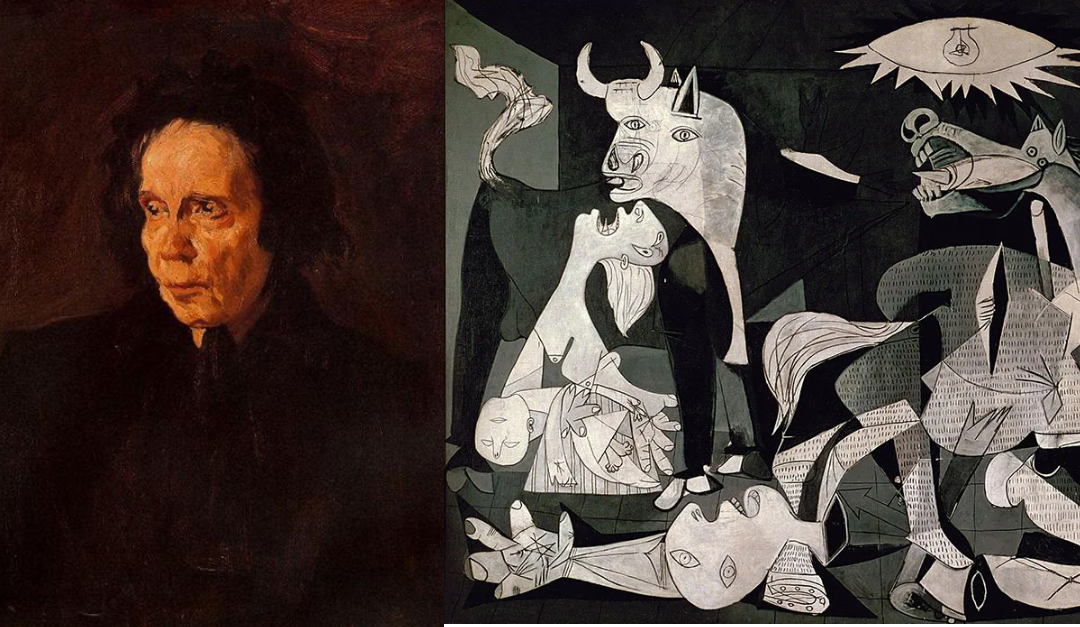
At the tender age of 14, Pablo Ruiz Picasso painted a portrait of his Aunt Pepa a work of brilliant academic realism that would go on to be hailed as “without a doubt one of the greatest in the whole history of Spanish painting.”
In 1901, he abandoned his mastery of realism, painting only in shades blue and blue-green.
There’s debate over why Picasso’s Blue Period began. Some argue that it’s a reflection of the poverty and desperation he experienced as a starving artist in Paris. Others claim it was a response to the suicide of his friend, Carles Casagemas. But Bill Gurley, a longtime venture capitalist, has a different theory.
Picasso abandoned realism because of the Kodak Brownie.
Introduced on February 1, 1900, the Kodak Brownie made photography widely available, fulfilling George Eastman’s promise that “you press the button, we do the rest.”
An ocean away, Gurley argues, Picasso’s “move toward abstraction wasn’t a rejection of skill; it was a recognition that realism had stopped being the frontier….So Picasso moved on, not because realism was wrong, but because it was finished.”
Washington DC, 2004
Three years before Drive took the world by storm, Daniel Pink published his third book, A Whole New Mind: Why Right-Brainers Will Rule the Future.
In it, he argues that a combination of technological advancements, higher standards of living, and access to cheaper labor are pushing us from a world that values left brain skills like linear thought, analysis, and optimization towards one that requires right brain skills like artistry, empathy, and big picture thinking.
As a result, those who succeed in the future will be able to think like designers, tell stories with context and emotional impact, and combine disparate pieces into a whole greater than the sum of its parts. Leaders will need to be empathetic, able to create “a pathway to more intense creativity and inspiration,” and guide others in the pursuit of meaning and significance.
California, 2026
Barry O’Reilly, author of Unlearn, published his monthly blog post, “Six Counterintuitive Trends to Think about for 2026,” in which he outlines what he believes will be the human reactions to a world in which AI is everywhere.
Leadership, he asserts, will cease to be measured by the resources we control (and how well we control them to extract maximum value) but by judgment. Specifically, a leader’s ability to:
- Ask better questions
- Frame decisions clearly
- Hold ambiguity without freezing
- Know when not to use AI
The Price of Safety vs the Promise of Greatness
Picasso walked away from a thriving and lucrative market where he was an emerging star to suffer the poverty, uncertainty, and desperation of finding what was next. It would take more than a decade for him to find international acclaim. He would spend the rest of his life as the most famous and financially successful artist in the world.
Are you willing to take that same risk?
You can cling to the safety of what you know, the markets, industries, business models, structures, incentives that have always worked. You can continue to demand immediate efficiency, obedience, and profit while experimenting with new tech and playing with creative ideas.
Or you can start to build what’s next. You don’t have to abandon what works, just as Picasso didn’t abandon paint. But you do have to start using your resources in new ways. You must build the characteristics and capabilities that Daniel Pink outlines. You must become the “counterintuitive” leader that embraces ambiguity, role models critical thinking, and rewards creativity and risk-taking.
Do you have the courage to be counterintuitive?
Are you willing to embrace your inner Picasso?

by Robyn Bolton | Jan 17, 2026 | AI, Leadership, Leading Through Uncertainty, Stories & Examples
You’ve clarified the vision and strategy. Laid out the priorities and simplified the message. Held town halls, answered questions, and addressed concerns. Yet the AI initiative is stalled in ‘pilot mode,’ your team is focused solely on this quarter’s numbers, and real change feels impossible. You’re starting to suspect this isn’t a “change management” problem.
You’re right. It’s not.
The Data You’re Not Seeing
You’ve been doing what the research tells you to do: communicate clearly and frequently, clarify decision rights, and reduce change overload. And these things worked. Until employees went from grappling with two to 10 planned change initiatives in a single year. As the number went up, willingness to support organization change crashed, falling from 74% of employees in 2016 to 43% in 2022.
But here’s what the research isn’t telling you: despite your organizational fixes, your people are terrified. 77% of workers fear they’ll lose their jobs to AI in the next year. 70% fear they’ll be exposed as incompetent. And 66% of consumers, the highest level in a decade, expect unemployment to continue to rise.
Why doesn’t the research focus on fear? Because it’s uncomfortable. Messy. It’s a people (Behavior) problem, not a process (Architecture) problem and, as a result, you can’t fix it with a new org chart or better meeting cadence.
The organizational fixes are necessary. They’re just not sufficient to give people the psychological reassurance, resilience, and tools required to navigate an environment in which change is exponential, existential, and constant.
What Actually Works
In 2014, Microsoft was toxic and employees were afraid. Stack ranking meant every conversation was a competition, every mistake was career-limiting, and every decision was a chance to lose status. The company was dying not from bad strategy, but from fear.
CEO Satya Nadella didn’t follow the old change management playbook. He did more:
First, he eliminated the structures that created fear, including the stack ranking system, the zero-sum performance reviews, the incentives that punished mistakes. These were Architecture fixes, and they mattered.
And he addressed the messy, uncomfortable emotions that drove Behavior and Culture. He role modeled the Behaviors required to make it psychologically safe to be wrong. He introduced the “growth mindset” not as a poster on the wall, but as explicit permission to not have all the answers. When he made a public gaffe about gender equality, he immediately emailed all 200,000 employees: “My answer was very bad.” No spin. No excuses. Just modeling the vulnerability that he expected from everyone.
Ten years later, Microsoft is worth $2.5 trillion. Employee engagement and morale are dramatically improved because Nadella addressed the structures that fed fear AND the fear itself.
What This Means for You
You don’t need to be Satya Nadella. But you do need to stop pretending fear doesn’t exist in your organization.
Name it early and often. Not just in the all-hands meeting, but in the team meetings and lunch-and-learns. Be honest, “Some roles will change with this AI implementation. Here’s what we know and don’t know.” Make the implicit explicit.
Eliminate the structures that create fear. If your performance system pits people against each other, change it. If people get punished for taking smart risks, stop. If people ask questions or make suggestions, listen and act.
Be vulnerable. Share what you’re uncertain about. Admit when you don’t know. Show that it’s safe to be learning. Demonstrate that learning is better than (pretending to) know.
The stakes aren’t abstract: That AI pilot stuck in testing. The strategic initiative that gets compliance but not commitment. The team so focused on surviving today they can’t prepare for tomorrow. These aren’t communication failures. They’re misaligned ABCs that allow fear to masquerade as pragmatism.
And the masquerade only stops when you align align the ABCs all at once. Because fixing Architecture without changing your Behavior simply gives fear a new place to hide.

by Robyn Bolton | Jan 11, 2026 | Leading Through Uncertainty, Strategy
We’re two full weeks into the new year and I’m curious, how is the strategy and operating plan you spent all Q3 and Q4 working on progressing? You nailed it, right? Everything is just as you expected and things are moving forward just as you planned.
I didn’t think so.
So, like many others, you feel tempted to double down on what worked before or chase every opportunity with the hope that it will “future-proof” your business.
Stop.
Remember the Cheshire Cat, “If you don’t know where you’re going, any road will get you there.”
You DO know where you’re going because your goals didn’t change. You still need to grow revenue and cut costs with fewer resources than last year.
The map changed. So you need to find a new road.
You’re not going to find it by looking at old playbooks or by following every path available.
You will find it by following these three steps (and don’t require months or millions to complete).
Return to First Principles
When old maps fail and new roads are uncertain, the most successful leaders return to first principles, the fundamental, irreducible truths of a subject:
- Organizations are systems
- Systems seek equilibrium and resist change when elements are misaligned
- People in the system do what the system allows, models, and rewards
Returning to these principles is the root of success because it forces you to pause and ask the right questions before (re)acting.
Ask Questions to Find the Root Cause
Based on the first principles, think of your organization as a lock. All the tumblers need to align to unlock the organization’s potential to get to where you need to go. When the tumblers don’t align, you stay stuck in the dying status quo.
Every organization has three tumblers – Architecture (how you’re organized), Behavior (what leaders actually do), and Culture (what gets rewarded) – that must align to develop and execute a strategy in an environment of uncertainty and constant change.
But ensuring that you’ve aligned all three tumblers, and not just one or two, requires asking questions to get to the root cause of the challenges.
Is your leadership team struggling to align on a decision because they don’t have enough data or can’t agree on what it means? The Behavior and Culture tumblers are misaligned with the structure and incentives of Architecture
Are people resisting the new AI tools you rolled out? Architectural incentives and metrics, and leadership communications and behaviors are preventing buy-in.
Struggling to squeeze growth out of a stagnant business? Structures and systems combined with organization culture are reinforcing safety and a fixed mindset rather than encouraging curiosity and learning.
Align the Tumblers
When you diagnose the root causes you find the misaligned tumbler. And, in the process of bringing it into alignment, it will likely pull the others in, too.
By role modeling leadership behaviors that encourage transparent communication (no hiding behind buzzwords), quantifying confidence, and smart risk taking, you’ll also influence culture and may reveal a needed change in Architecture.
Modifying the metrics and rewards in Architecture and making sure that your communications and behavior encourage buy-in to new AI tools, will start to establish an AI-friendly culture.
Overhauling Architecture to encourage and reward actions that expand that stagnant business into new markets or brings new solutions to your existing customers, will build new leadership Behaviors will drive culture change.
Get to your Goals
It’s a VUCA/BANI world AND It’s only going to accelerate. That means that the strategy you developed last quarter and the operational plans you set last month will be obsolete by the end of the week.
But the strategy and the plan were never the goal. They were the road you planned based on the map you had. When the map changes, the road does, too. But you can still get to the goal if you’re willing to fiddle with a lock.