
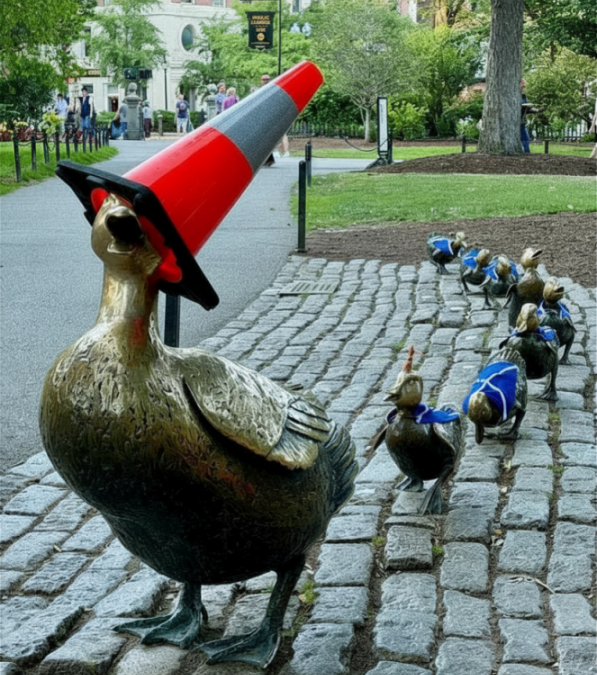
For eight days, the Tartan Army filled Boston’s streets with kilts, bagpipes, and the constant refrain of “No Scotland. No Party.” Bars ran out of beer, traffic cones adorned statues, and resident’s souls were healed.
Now, some are saying corporate managers should have the same effect on the people around them (presumably without consuming all the beer in the office).
The possibility of collective effervescence
Collective effervescence is everywhere right now: in New York at the Knicks’ championship parade, the Tarps Off shirtless section at baseball games, at every unexpected draw or win at the World Cup.
It’s the “emotional electricity or excitement that lifts people outside of themselves and makes them feel like they’re connecting to something transcendent,” explains Christina Simko, and associate professor of sociology at William College. “They (members of a crowd) have to have a common focus and a common mood, and through that physical interaction, they generate something … greater than the sum of its parts.”
Greater than the sum of its parts.
Where have a I heard that before?
Could it be in every press release announcing an acquisition, all-hands meeting kicking of a transformation, and email confirming a re-org?
Which explains why I’m reading about the need for executives to create collective effervescence to ensure the success of transformational initiatives.
Seventy percent of transformations fail and one of the leading causes of failure is insufficiently high aspirations. Collective effervescence is sufficiently high but setting that as a metric of success will only drive up the failure rate.
The probability of emotional contagion
Emotional contagion is also everywhere: in the laugh that spreads through a room, the frown that moves around a conference table, the yawns that can’t be suppressed in meetings.
It’s the “phenomenon in which a person unconsciously mirrors or mimics the emotions of those around them” through nonverbal, conversational, or behavioral cues. It can be positive, like smiles and laughs, or negative like frowns or the tension from a tough conversation.
That’s good news for executives.
Leaders are “emotional amplifiers” because team members are more likely to mirror the leader’s tone than their peers. Research out of USC also indicates that, historically, positive emotions are more contagious than negative ones.
It’s also bad news for executives.
The emotional amplifier role cuts both ways and research shows that people tend to “overperceive” negative cues from leaders, even magnifying small emotional cues well beyond what a leader intended.
That means the frown everyone on the company-wide Zoom was most likely interpreted as disagreement, even opposition, to what was being discussed. And not that your shoes are too tight.
The reality of leading humans through change
Leading people through change is hard. It’s even harder when you’re under a microscope and every smile, frown, sigh, cough, and eye roll is scrutinized and interpreted as if it were a secret code foretelling the future of thousands.
It’s not. But your team believes it is.
And perception is reality.
Here’s how to start shaping reality to make the changes happen:
- Start with self-awareness. What is your mood right now? If it’s useful to the team, spend time with them. If it’s not, reschedule the meeting or send a proxy.
- Make direct eye contact with people. According to the research, eye contact during verbal communication activates brain regions that help us understand what someone is saying and what they mean. Just don’t stare. That’s creepy.
- Neutralize the negativity publicly. A bit of skepticism can be healthy for teams going through change but too much easily crosses over into pessimism and even hostility that spreads throughout the team. So stop the spread by publicly and patiently calling out the behavior and seeking to understand the root cause.
You don’t need collective effervescence to successfully lead change.
You do need spread the belief that change is possible and beneficial.
And you can do that without wearing a kilt.