
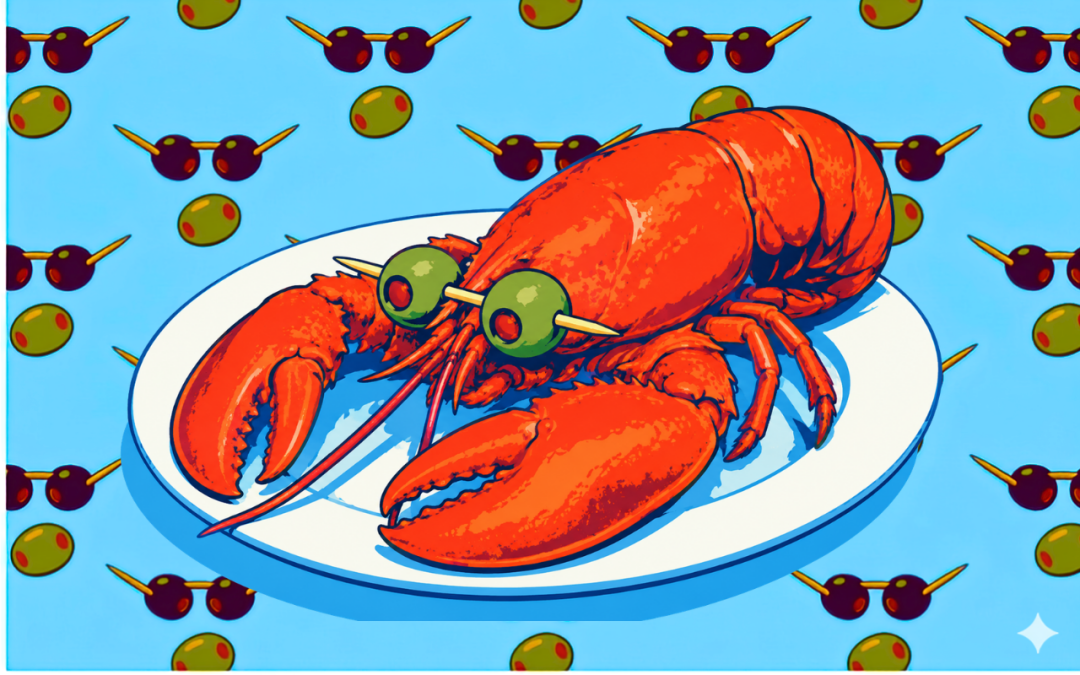
Up and down New England’s coastline you’ll find lobster (pronounced “lob-stah”) shacks. These weathered wood structures produce the freshest lobster and crispiest fried seafood anywhere, enjoyed on picnic tables as the sun beats down and the waves crash against the rocky shore.
It was at one of these shacks that, many years ago, I learned priceless lesson.
As my friends and I placed our orders, I asked that the head of my lobster be removed before serving. The waitress looked at me like I had nine heads but wrote down my request and returned to the kitchen. A few minutes later she reappeared and announced that the kitchen refused to decapitate the lobster prior to serving.
“I don’t like making eye contact with my food,” I stammered.
She nodded and walked away.
When she returned with our lobsters, they all had heads but one was noticeably different. It was wearing “sunglasses” made of olives and toothpicks.
“Here,” our waitress said. “Now you don’t have to make eye contact with it.”
A short-term “solution”
As VUCA-ness (volatile, uncertain, complex, ambiguous) accelerates, C-suite executives do everything possible to create certainty and construct safety. After all, if the company doesn’t survive the short-term, even the best long-term plans don’t matter.
Evidence of this approach is everywhere:
- Return to Office mandates to improve productivity, encourage collaboration, build culture, and encourage mentorship
- Layoffs affecting tens of thousands of experienced employees and decisions to stop hiring entry-level employees altogether
- Draconian cuts to R&D (Moderna’s $1.1B cut across five development programs and AbbVie’s record 29% YOY cuts) and innovation efforts (Nike’s “Win Now” plan and Heidelberg Materials decision to divest all non-core assets)
When these decisions land on your desk, you sigh, knowing they are short-sighted but understanding the rationale. Then, you go implement them, knowing unintended consequences are coming.
Unintended doesn’t mean unpredictable
In fact, because you are on the frontlines of your business, striving to deliver today and build tomorrow, you can predict what those consequences will be:
- No improvement in productivity, lower job satisfaction and the disproportionate departure of high-performing, senior, and highly skilled employees due to RTO mandates
- Loss of institutional knowledge costing Fortune 500 companies $31.5B annually, 20% reduction in productivity, and a disproportionate decrease in R&D effectiveness due to layoffs
- Stalled profit margins, irreversible market share loss to faster competitors, and severely degraded organizational agility, resilience, and culture from cutting innovation
It’s frustrating to see the problems coming but feel powerless to avoid them.
But what does any of this have to do with a lobster wearing sunglasses?
When you know the Why, you can choose the How
When directives land on your desk, don’t sigh and roll them out. Ask for the Why behind the What.
- Why are employees being forced back to the office? Did productivity decrease? Are mission-critical operations not occurring? Are top-performers leaving for in-person roles?
- Why are experienced people being let go? Is the work being outsourced or has it genuinely gone? Why are you no longer hiring entry-level people? Are they too expensive to train? Is retention genuinely poor?
- Why are innovation initiatives being cut? Is the core business in that much trouble? Do we lack the talent? Are we pursuing growth through other means?
Each directive’s Why is different which means you have more options than you realize for delivering the How. Understanding the outcomes the company needs, reveals options for delivering it while minimizing the unintended consequences.
Don’t decapitate the lobster. Find opportunities for sunglasses.
The kitchen could have easily removed the head from my lobster, but they foresaw the unintended consequences of a disappointing dining experience. When they understood my why, they created a spectacular how.
You don’t control the system so asking “Why?” feels scary, hostile, even mutinous.
You do control your piece of it. You know it better than anyone, so there’s no one better to determine the how.