
by Robyn Bolton | Jun 23, 2026 | Leadership, Leading Through Uncertainty, Tips, Tricks, & Tools
For eight days, the Tartan Army filled Boston’s streets with kilts, bagpipes, and the constant refrain of “No Scotland. No Party.” Bars ran out of beer, traffic cones adorned statues, and resident’s souls were healed.
Now, some are saying corporate managers should have the same effect on the people around them (presumably without consuming all the beer in the office).
The possibility of collective effervescence
Collective effervescence is everywhere right now: in New York at the Knicks’ championship parade, the Tarps Off shirtless section at baseball games, at every unexpected draw or win at the World Cup.
It’s the “emotional electricity or excitement that lifts people outside of themselves and makes them feel like they’re connecting to something transcendent,” explains Christina Simko, and associate professor of sociology at William College. “They (members of a crowd) have to have a common focus and a common mood, and through that physical interaction, they generate something … greater than the sum of its parts.”
Greater than the sum of its parts.
Where have a I heard that before?
Could it be in every press release announcing an acquisition, all-hands meeting kicking of a transformation, and email confirming a re-org?
Which explains why I’m reading about the need for executives to create collective effervescence to ensure the success of transformational initiatives.
Seventy percent of transformations fail and one of the leading causes of failure is insufficiently high aspirations. Collective effervescence is sufficiently high but setting that as a metric of success will only drive up the failure rate.
The probability of emotional contagion
Emotional contagion is also everywhere: in the laugh that spreads through a room, the frown that moves around a conference table, the yawns that can’t be suppressed in meetings.
It’s the “phenomenon in which a person unconsciously mirrors or mimics the emotions of those around them” through nonverbal, conversational, or behavioral cues. It can be positive, like smiles and laughs, or negative like frowns or the tension from a tough conversation.
That’s good news for executives.
Leaders are “emotional amplifiers” because team members are more likely to mirror the leader’s tone than their peers. Research out of USC also indicates that, historically, positive emotions are more contagious than negative ones.
It’s also bad news for executives.
The emotional amplifier role cuts both ways and research shows that people tend to “overperceive” negative cues from leaders, even magnifying small emotional cues well beyond what a leader intended.
That means the frown everyone on the company-wide Zoom was most likely interpreted as disagreement, even opposition, to what was being discussed. And not that your shoes are too tight.
The reality of leading humans through change
Leading people through change is hard. It’s even harder when you’re under a microscope and every smile, frown, sigh, cough, and eye roll is scrutinized and interpreted as if it were a secret code foretelling the future of thousands.
It’s not. But your team believes it is.
And perception is reality.
Here’s how to start shaping reality to make the changes happen:
- Start with self-awareness. What is your mood right now? If it’s useful to the team, spend time with them. If it’s not, reschedule the meeting or send a proxy.
- Make direct eye contact with people. According to the research, eye contact during verbal communication activates brain regions that help us understand what someone is saying and what they mean. Just don’t stare. That’s creepy.
- Neutralize the negativity publicly. A bit of skepticism can be healthy for teams going through change but too much easily crosses over into pessimism and even hostility that spreads throughout the team. So stop the spread by publicly and patiently calling out the behavior and seeking to understand the root cause.
You don’t need collective effervescence to successfully lead change.
You do need spread the belief that change is possible and beneficial.
And you can do that without wearing a kilt.

by Robyn Bolton | Apr 28, 2026 | Leadership, Leading Through Uncertainty, Strategy
“Never half-ass two things. Whole-ass one thing.” – Ron Swanson, Parks and Rec
With all due respect to Ron Swanson, leaders today need to whole-ass two things. In a world of constrained resources, you don’t have enough time, money, or people to put against your highest priority, let alone multiple high priorities.
But if you think you must choose between investing in today or the future, know that you’re most likely choosing between killing your company quickly or slowly. That’s what “And, not or,” and it’s required in these three areas.
Development AND Research
“Right now, it’s not sufficient to just keep treading water.” – L. Rafael Reif, former MIT president and current professor of electrical engineering and computer science
“America Is Losing the Innovation Race” screamed the Foreign Affairs article in which Reif detailed evidence that America is falling behind China in electric vehicles, nuclear energy, war technologies, and other areas of critical technology.
Since 2015, as China invested in science and technology to develop the capability to produce high-end products at scale, US federal spending on basic research, as measured in real 2017 dollars, has declined.
Even the research that is funded isn’t keeping up. A paper published in 2022 examined nearly 50 million academic papers and patents from 1945 to 2010 and found a precipitous decline in the “disruptiveness” (i.e. makes previous findings obsolete or pushes the field in a new direction) of research across all scientific fields, including a 100% drop in the physical sciences and a 78.7% decline in computer and communications patents.
The funding story is quite different but no less alarming on the corporate side. Between 1964 and 2022, business funding as a source of R&D funds more than doubled but the vast majority of those funds are spent on applied research (13%) and development (80%), not the type of fundamental research that launches a country forward economically or societally.
Operators AND Innovators
“It’s a trap” – MBA student
For two hours, we discussed Netflix’s culture: the no vacation policy” policy, the “act in Netflix’s best interest” expense policy, and the management philosophy that stresses hiring people for their expertise and then trusting them to make decisions.
To me it sounded like a dream. So, when I asked who wanted to work for Netflix, I was shocked when not a single hand went up.
To my students, it sounded like a trap.
And that’s ok. Not everyone wants to face the accountability and repercussions of taking risks, exercising judgment, and making decisions.
Companies need people who want to follow processes, become experts in their fields, and keep the business steady and growing. AND they need people who question processes, explore far beyond their industries, and challenge the business to do better and grow further.
AI AND Humans
“What keeps me up is the fact that so many people are being convinced that they don’t matter anymore.” – Former Canadian Prime Minister Justin Trudeau
When 16,000 jobs, on average, have been lost each month for the past year due to AI, it’s pretty hard to convince a human and they matter.
Yet a growing body of research shows that humans enabled by AI generate new and novel ideas more quickly and cost efficiently than either AI or humans alone. In a battle between 125 “global problem solvers” and one expert in prompt engineering, the latter produced 180 ideas in 5.5 hours at a total cost of $27.01 and none of the ideas were meaningfully different in terms of strategic viability, environmental or financial value, or overall quality than the human-only ideas. At P&G, researchers found that the most innovative ideas were generated by AI-enabled teams and that those teams worked about 12% faster than other teams and AI-enabled individuals.
Ultimately, the companies that succeed won’t be the ones that make the best bets.
They’ll be the ones that learn to whole-ass two things.

by Robyn Bolton | Mar 18, 2026 | AI, Customer Centricity, Leadership, Leading Through Uncertainty, Strategy
If you’re uncertain, you’re not alone. According to data from FactSet, 87% of Fortune 500 companies cited “uncertainty” during their 2025 Q1 earnings calls. And while things are definitely a tad chaotic in the world, I’ve started asking my clients, “What would you do if you were certain?”
It’s not an academic thought experiment. It’s a very practical exercise that radically shifts the way the think about and lead their businesses.
An Example That Proves the Rule
Most leaders facing disruption do one of two things: freeze and hope that “this too shall pass” or follow and hope that there is safety in numbers.
Neither is a strategy. Both are knee jerk reactions rooted in fear and communicated in the language and buzzwords of business.
This behavior didn’t start with AI. It happens every time a disruptive technology or philosophy bursts onto the scene. The printing press. The industrial revolution. Microchips. Each time, a new leader and paradigm emerges. How do they do it?
They’re certain.
Not because they’re omniscient. But because they know the answers to three questions
Question 1: Who Are You?
When photography made academic realism obsolete, Picasso didn’t freeze. He didn’t pick up a camera. He created something entirely new. Why? Because he knew exactly who he was. “I don’t seek,” he said. “I find.”
Today’s business icons are no different. Richard Branson describes himself as curious and someone who challenges the status quo. Lou Gerstner, when he arrived at a floundering IBM, declared himself a results man, not a visionary.
These self-definitions aren’t marketing. They’re decisions filters that define what you are and aren’t willing to do, agnostic of events, technologies, and capabilities.
Question 2: What Does Your Organization Actually Do?
Not what you make. Not what you sell. What Job to be Done do customers hire you to do?
Nintendo’s answer has been consistent across 130 years of radical product change: help me have fun with friends and family. From playing cards to the Game Boy, Wii, and Switch, their products changed completely. The Job didn’t.
IBM has done the same. From punch card tabulators to consulting and AI, the Job of helping customers make sense of complex information to run better never change. Amex moved from freight forwarding to credit and debit cards, but it’s commitment to move value securely when direct exchange isn’t an option never wavered.
When you know the Job you do, you stop chasing trends and start making choices.
Question 3: How Do You Move Forward?
You can’t answer this question without answering the first two. When you try, you get caught in the same freeze/follow trap as everyone else.
But when you answer the first two questions, the answer to this one becomes clear. For Picasso and Branson, they create. For Gerstner, he optimized the status quo. For most businesses, the answer is “And, not Or.” They must stabilize today’s business, step into (even follow) the next wave, and invest in creating the new.
Satya Nadella’s transformation of Microsoft is a perfect example. He defined himself as a learner, not a knower. He defined Microsoft’s job as helping people make a difference in their roles. From those two answers, every major move followed logically: maintain Office 365, step into cloud, create quantum computing technology.
None of it was reactive. All of it felt certain.
Your Moment Is Now
Yes, the world is uncertain. You don’t have to be.
Before you close this tab and tell yourself you’ll think about it later, answer the first two questions. You can change your answers later, but you need to start now.
The leaders who navigate this moment won’t be the ones who wait and see or follow the crowd. They’ll be the ones who know themselves and their organizations well enough to be certain.
by Robyn Bolton | Mar 3, 2026 | Leadership, Leading Through Uncertainty, Strategy
“Change is changing: How to meet the challenge of radical reinvention” – McKinsey
“End to End Reinvention Unleashes a Technology’s Full Potential” – BCG
“Reinvention: The Overlooked Skills Leaders Need Right Now” – Forbes
Don’t look now but we’ve got a new buzzword!
Hello, REINVENTION
Wait, what happened to Transformation?
Oh hon, “Transformation” is so 2025 and for good reason. In a survey of 750 global organizations, researchers found that 52% of respondents suffer from “transformation fatigue,” 44% cite constant change as the reason for their burnout, and more than one-third are considering quitting as a result of never-ending transformations.
Unfortunately, massive technologic, economic, and societal shifts demand executives rethink every aspect of their organizations. So, what do you do when you need to transform but using the word is likely to lead to a revolution?
As fans of The Wire know, you rebrand.
So, Reinvention is the new Transformation?
Yes and no.
Both terms apply to large-scale organizational changes that often hit at the heart of an organization’s operations. As a result, they require leadership commitment, employee buy-in, and lots of money and time to execute.
The difference is that Transformation is positioned as a finite endeavor to increase performance, usually through technology adoption and integration or restructuring. Reinvention, however, “requires leaders to embrace more radical approaches and actions – in effect, to embrace the creative destruction of the company so it creates value in new ways.”
On-going. Radical approaches. Creative destruction.
Just what C-Suite execs want.
Honestly, it sounds like Reinvention is needed so why is it BS?
To be fair, it’s only two-thirds BS.
Building a capability for ongoing change, iteration, and learning isn’t BS. In fact, it’s mission critical in a world of constant change and uncertainty. But this capability requires new mindsets and skills that take time, consistent role modeling by senior leaders, before they stick.
What is BS is the need for radical approaches and creative destruction.
Instead, leaders need to return to their roots and reimagine their future.
Return and Reimagine?
Return
Jørgen Vig Knudstorp is widely credited with saving LEGO from bankruptcy and turning it into the world’s biggest toy company. At the 2025 Thinkers50 Summit, he shared his 10 rules for a successful transformation. Number one, “Why do we exist?” He spent three years trying to answer this question.
Why do we exist? What makes us relevant, valuable, rare, hard to imitate?
The answer isn’t your industry, products, or processes. It’s something more fundamental. It’s the Job to be Done that your organization and ONLY your organization can do.
John Fallon, who led Pearson’s turnaround as their CEO, answered this question in a recent conversation with Outthinkers’ Kaihan Krippendorf.
“The job to be done was not publishing textbooks. The job to be done was empowering people to progress in their lives through learning.”
Reimagine
When you know why you exist, you’re able to go beyond rebuilding to reimagining what your organization could be. Knowing your Why changes how you think about your organization and its potential. It enables you to step out of the hype, ignore the peer pressure, and explore all the future Whats and Hows before committing to action.
Then, and only then, do you commit to action. To concrete changes in business models, operations, and capabilities. To Reinvention.
I think I get it. Reinvention is BS not because it’s wrong but because it skips two essential steps.
Reinvention implies rebuilding, but if you don’t know why your company exists, how can you be sure you’re building something that matters?
And, if your “reimagining” is focused only on the latest tech or doubling down on a dying business model, you’ll never see all the other possibilities that may be more resilient.
Return. Reimagine. Reinvent. The 3Rs. That’s a buzzword I can support.
by Robyn Bolton | Feb 16, 2026 | Leadership, Leading Through Uncertainty, Strategy
“None of it worked. When I pulled the executive team back together and asked what went wrong, these executives said, ‘You told us what to do. You never asked us what to do.
“What I should have done is just said, ‘I don’t know.’ And when you say those words, what happens is everybody wants to help you.”
That is how Josh D’Amaro, the newly named CEO of the Walt Disney Company, characterized his defining leadership development moment.
Sound familiar?
Every executive, at some point in their career, has faced this moment. The business is doing poorly, the future is uncertain, and everyone is looking to you for answers.
But few of us learn the lesson that Mr. D’Amaro did. So, we keep telling and wondering why compliance isn’t generating the results we expected.
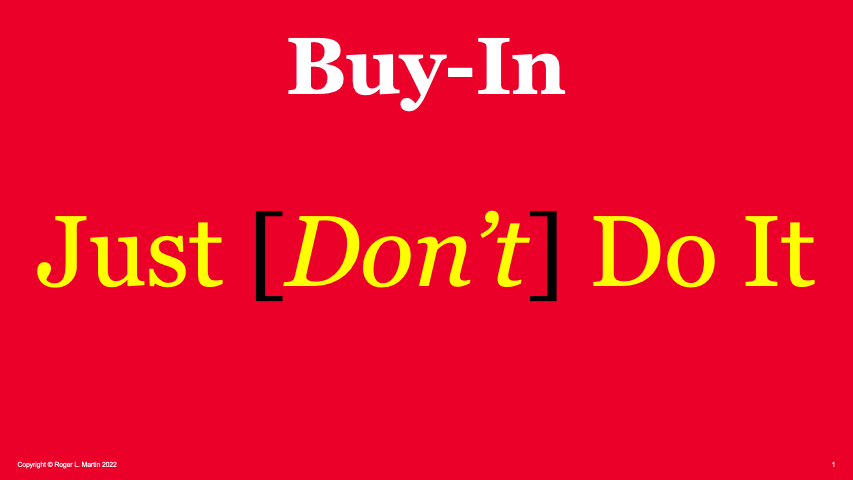
Compliance and Buy-In are not the same
In our world of “using positive words to describe uncomfortable realities,” we often characterize compliance as buy-in. And that’s a dangerous mistake.
“Compliance,” explains innovation expert Tendayi Viki, “comes from external pressures to follow rules and policies due to fear of consequences. In contrast, buy-in comes from internal motivation where people genuinely view the initiative as valuable and legitimate.”
Compliance is what happened when D’Amaro convened the market and sales executives of Hong Kong Disneyland together and told them “to adjust, build, and set ourselves up for the future.”
When things are not going well and the future is uncertain (and therefore scary) it’s normal to think that, because you are in a role with authority, that you need to have all the answers. But you don’t. Because you can’t. Because no one has the answers.
You need help.
Why Buy-in, not compliance, is required for success
No one is going to help you when they’re afraid. Instead, they’re going to execute orders regardless of their own experiences or judgment, which may be more informed and likely to result in the desired outcome (as was the case with D’Amaro and his team).
But when you ask for help, people help. They feel ownership of both the problem and the solution and seek out creative ideas and alternatives. They work across traditional organizational boundaries, like functions and levels, and they’re more resilient when faced with adversity. Even better for you, they don’t require constant instruction, surveillance, and micromanagement.
Getting buy-in frees you up to do the very thing you want to do: lead a team to a common goal and better future.
Buy-in is NOT another Change Management initiative
I’m sorry to say that getting buy-in is much harder than running the standard Change Management playbook.
Change management gives leaders a structured playbook of communication plans, training schedules, governance milestones. It’s systematic, observable, and leader-driven. And it’s not wrong. It’s just not sufficient to gain buy-in.
Buy-in is individual, nonlinear, and rooted in belief, not process. It forms one person at a time based on trust, relevance, and whether the individual sees themselves in the future state. It happens when one human being trusts the motives and behaviors of another human being.
How to get Buy-In
Earning buy-in requires you to do what D’Amaro eventually learned: invite dissent, share incomplete thinking, and say “I don’t know.” But that’s just the beginning.
You also have to find where things are breaking down internally, the gaps that allowed the situation to grow ever more concerning and dire. And it’s rarely at the obvious boundaries between silos that everyone can see and org charts try to fix.
It’s at the seams: the hidden disconnects between people, decisions, handoffs, and incentives where functions, levels, and priorities intersect. These seams are where compliance lives and buy-in dies. And until you make them visible, you’ll keep mistaking one for the other. But they can be made visible and that changes everything.
Now that you see the difference, where is compliance masquerading as buy-in in your organization?