by Robyn Bolton | Mar 3, 2026 | Leadership, Leading Through Uncertainty, Strategy
“Change is changing: How to meet the challenge of radical reinvention” – McKinsey
“End to End Reinvention Unleashes a Technology’s Full Potential” – BCG
“Reinvention: The Overlooked Skills Leaders Need Right Now” – Forbes
Don’t look now but we’ve got a new buzzword!
Hello, REINVENTION
Wait, what happened to Transformation?
Oh hon, “Transformation” is so 2025 and for good reason. In a survey of 750 global organizations, researchers found that 52% of respondents suffer from “transformation fatigue,” 44% cite constant change as the reason for their burnout, and more than one-third are considering quitting as a result of never-ending transformations.
Unfortunately, massive technologic, economic, and societal shifts demand executives rethink every aspect of their organizations. So, what do you do when you need to transform but using the word is likely to lead to a revolution?
As fans of The Wire know, you rebrand.
So, Reinvention is the new Transformation?
Yes and no.
Both terms apply to large-scale organizational changes that often hit at the heart of an organization’s operations. As a result, they require leadership commitment, employee buy-in, and lots of money and time to execute.
The difference is that Transformation is positioned as a finite endeavor to increase performance, usually through technology adoption and integration or restructuring. Reinvention, however, “requires leaders to embrace more radical approaches and actions – in effect, to embrace the creative destruction of the company so it creates value in new ways.”
On-going. Radical approaches. Creative destruction.
Just what C-Suite execs want.
Honestly, it sounds like Reinvention is needed so why is it BS?
To be fair, it’s only two-thirds BS.
Building a capability for ongoing change, iteration, and learning isn’t BS. In fact, it’s mission critical in a world of constant change and uncertainty. But this capability requires new mindsets and skills that take time, consistent role modeling by senior leaders, before they stick.
What is BS is the need for radical approaches and creative destruction.
Instead, leaders need to return to their roots and reimagine their future.
Return and Reimagine?
Return
Jørgen Vig Knudstorp is widely credited with saving LEGO from bankruptcy and turning it into the world’s biggest toy company. At the 2025 Thinkers50 Summit, he shared his 10 rules for a successful transformation. Number one, “Why do we exist?” He spent three years trying to answer this question.
Why do we exist? What makes us relevant, valuable, rare, hard to imitate?
The answer isn’t your industry, products, or processes. It’s something more fundamental. It’s the Job to be Done that your organization and ONLY your organization can do.
John Fallon, who led Pearson’s turnaround as their CEO, answered this question in a recent conversation with Outthinkers’ Kaihan Krippendorf.
“The job to be done was not publishing textbooks. The job to be done was empowering people to progress in their lives through learning.”
Reimagine
When you know why you exist, you’re able to go beyond rebuilding to reimagining what your organization could be. Knowing your Why changes how you think about your organization and its potential. It enables you to step out of the hype, ignore the peer pressure, and explore all the future Whats and Hows before committing to action.
Then, and only then, do you commit to action. To concrete changes in business models, operations, and capabilities. To Reinvention.
I think I get it. Reinvention is BS not because it’s wrong but because it skips two essential steps.
Reinvention implies rebuilding, but if you don’t know why your company exists, how can you be sure you’re building something that matters?
And, if your “reimagining” is focused only on the latest tech or doubling down on a dying business model, you’ll never see all the other possibilities that may be more resilient.
Return. Reimagine. Reinvent. The 3Rs. That’s a buzzword I can support.
by Robyn Bolton | Feb 16, 2026 | Leadership, Leading Through Uncertainty, Strategy
“None of it worked. When I pulled the executive team back together and asked what went wrong, these executives said, ‘You told us what to do. You never asked us what to do.
“What I should have done is just said, ‘I don’t know.’ And when you say those words, what happens is everybody wants to help you.”
That is how Josh D’Amaro, the newly named CEO of the Walt Disney Company, characterized his defining leadership development moment.
Sound familiar?
Every executive, at some point in their career, has faced this moment. The business is doing poorly, the future is uncertain, and everyone is looking to you for answers.
But few of us learn the lesson that Mr. D’Amaro did. So, we keep telling and wondering why compliance isn’t generating the results we expected.
Compliance and Buy-In are not the same
In our world of “using positive words to describe uncomfortable realities,” we often characterize compliance as buy-in. And that’s a dangerous mistake.
“Compliance,” explains innovation expert Tendayi Viki, “comes from external pressures to follow rules and policies due to fear of consequences. In contrast, buy-in comes from internal motivation where people genuinely view the initiative as valuable and legitimate.”
Compliance is what happened when D’Amaro convened the market and sales executives of Hong Kong Disneyland together and told them “to adjust, build, and set ourselves up for the future.”
When things are not going well and the future is uncertain (and therefore scary) it’s normal to think that, because you are in a role with authority, that you need to have all the answers. But you don’t. Because you can’t. Because no one has the answers.
You need help.
Why Buy-in, not compliance, is required for success
No one is going to help you when they’re afraid. Instead, they’re going to execute orders regardless of their own experiences or judgment, which may be more informed and likely to result in the desired outcome (as was the case with D’Amaro and his team).
But when you ask for help, people help. They feel ownership of both the problem and the solution and seek out creative ideas and alternatives. They work across traditional organizational boundaries, like functions and levels, and they’re more resilient when faced with adversity. Even better for you, they don’t require constant instruction, surveillance, and micromanagement.
Getting buy-in frees you up to do the very thing you want to do: lead a team to a common goal and better future.
Buy-in is NOT another Change Management initiative
I’m sorry to say that getting buy-in is much harder than running the standard Change Management playbook.
Change management gives leaders a structured playbook of communication plans, training schedules, governance milestones. It’s systematic, observable, and leader-driven. And it’s not wrong. It’s just not sufficient to gain buy-in.
Buy-in is individual, nonlinear, and rooted in belief, not process. It forms one person at a time based on trust, relevance, and whether the individual sees themselves in the future state. It happens when one human being trusts the motives and behaviors of another human being.
How to get Buy-In
Earning buy-in requires you to do what D’Amaro eventually learned: invite dissent, share incomplete thinking, and say “I don’t know.” But that’s just the beginning.
You also have to find where things are breaking down internally, the gaps that allowed the situation to grow ever more concerning and dire. And it’s rarely at the obvious boundaries between silos that everyone can see and org charts try to fix.
It’s at the seams: the hidden disconnects between people, decisions, handoffs, and incentives where functions, levels, and priorities intersect. These seams are where compliance lives and buy-in dies. And until you make them visible, you’ll keep mistaking one for the other. But they can be made visible and that changes everything.
Now that you see the difference, where is compliance masquerading as buy-in in your organization?

by Robyn Bolton | Feb 2, 2026 | AI, Leadership, Strategic Foresight, Strategy
It was a race. And the whole world was watching.
In 1911, Captain Robert Scott set out to reach the South Pole. He’d been to Antarctica before and because of his past success, he had more funding, more expertise, and more experience. He had all the equipment needed.
Racing him to fame, fortune and glory was Norwegian Roald Amundsen. Originally heading to the North Pole, he turned around when he learned that Robert Peary had beaten him there. He had dogs and skis, equipment perfect for the Arctic but unproven in Antarctica.
Amundsen won the race, by over a month.
Scott and his crew died 11 miles from the South Pole.
When the Playbook Stops Working
Scott wasn’t guessing. He’d tested motor sledges in the Alps. He’d seen ponies work on a previous Antarctic expedition. He built a plan around the best available equipment and the general playbook that had served British expeditions for decades: horses and motors move heavy loads, so use horses and motors.
It just wasn’t right for Antarctica. The motors broke down in the cold. The ponies sank through the ice. The plan that looked solid on paper fell apart the moment it met the actual environment it had to operate in.
The same thing is happening today with AI.
For decades, when new technologies emerge, executives have followed a similarly familiar playbook: assess the opportunity, build a business case, plan the rollout, execute.
And for decades it worked. Cloud migrations and ERP implementations were architectural changes to known processes with predictable outcomes. As time went on, information grew more solid, timelines became better understood, and the playbook solidified.
AI is different. Executives are so focused on picking the right AI tools and building the right infrastructure that they aren’t thinking about what happens when they hit the ice. Even if the technology works as designed, you have no idea whether it will deliver the intended results or create a ripple of unintended consequences that paralyze your business and put egg on your face.
Diagnose Before You Prescribe
The circumstances of AI are different too, and that requires a new playbook. Make that playbooks. Picking the right playbook requires something my clients and I call Calibrated Decision Design.
We start by asking how long it will take to realize the ultimate goals of the investment. Do we need to break even this year, or is this a multi-year bet where results slowly roll in? Most teams have a sense of this, so it allows us to move quickly to the next, much harder question.
What do we know and what do we believe? This is where most teams and AI implementations fail. To seem confident and indispensable, people present hypotheses as if they are facts resulting in decisions based on a single data points or best guesses. The result is a confident decision destined to crumble.
Where you land on these two axes determines your playbook. Apply the wrong one and you’ll either waste money on over-analysis or burn through budget on premature action.
Pick from the Four Playbooks
Go NOW!: You have the facts and need results now. Stop deliberating. Execute.
Predictable Planning: You have confidence in the outcome, but the payoff takes patience. Build a flexible strategy and operational plan to stay responsive as things progress.
Discovery Planning: You need results fast, but you don’t have proof your plan will work. Run small, fast experiments before scaling anything.
Resilient Strategy: The time horizon is long and you’re short on facts. The worst thing you can do is go all in. Instead, envision multiple futures, identify early warning signs, find commonalities and prepare a strategy that can pivot.
Apply it
Which playbook are you using and which one is best for your circumstance?

by Robyn Bolton | Dec 10, 2025 | Customer Centricity, Innovation, Leading Through Uncertainty
In times of great uncertainty, we seek safety. But what does “safety” look like?
What we say: Safety = Data
We tend to believe that we are rational beings and, as a result, we rely on data to make decisions.
Great! We’ve got lots of data from lots of uncertain periods. HBR examined 4,700 public companies during three global recessions (1980, 1990, and 2000). They found that the companies that the companies that emerged “outperforming rivals in their industry by at least 10% in terms of sales and profits growth” had one thing in common: They aggressively made cuts to improve operational efficiency and ruthlessly invested in marketing, R&D, and building new assets to better serve customers have the highest probability of emerging as markets leaders post-recession.
This research was backed up in 2020 in a McKinsey study that found that “Organizations that maintained their innovation focus through the 2009 financial crisis, for example, emerged stronger, outperforming the market average by more than 30 percent and continuing to deliver accelerated growth over the subsequent three to five years.”
What we do: Safety = Hoarding
The reality is that we are human beings and, as a result, make decisions based on how we feel and the use data to justify those decisions.
How else do you explain that despite the data, only 9% of companies took the balanced approach recommended in the HBR study and, ten years later, only 25% of the companies studied by McKinsey stated that “capturing new growth” was a top priority coming out of the COVID-19 pandemic.
Uncertainty is scary so, as individuals and as organizations, we scramble to secure scarce resources, cut anything that feels extraneous, and shift or focus to survival.
What now? And, not Or.
What was true in 2010 is still true today and new research from Bain offers practical advice for how leaders can follow both their hearts and their heads.
Implement systems to protect you from yourself. Bain studied Fast Company’s 50 Most Innovative Companies and found that 79% use two different operating models for innovation to combat executives’ natural risk aversion. The first, for sustaining innovation uses traditional stage-gate models, seeks input from experts and existing customers, and is evaluated on ROI-driven metrics.
The second, for breakthrough innovations, is designed to embrace and manage uncertainty by learning from new customers and emerging trends, working with speed and agility, engaging non-traditional collaborators, and evaluating projects based on their long-term potential and strategic option value.
Don’t outspend. Out-allocate. Supporting the two-system approach, nearly half of the companies studied send less on R&D than their peers overall and spend it differently: 39% of their R&D budgets to sustaining innovations and 61% to expanding into new categories or business models.
Use AI to accelerate, not create. Companies integrating AI into innovation processes have seen design-to-launch timelines shrink by 20% or more. The key word there is “integrate,” not outsource. They use AI for data and trend analysis, rapid prototyping, and automating repetitive tasks. But they still rely on humans for original thinking, intuition-based decisions, and genuine customer empathy.
Prioritize humans above all else. Even though all the information in the world is at our fingerprints, humans remain unknowable, unpredictable, and wonderfully weird. That’s why successful companies use AI to enhance, not replace, direct engagement with customers. They use synthetic personas as a rehearsal space for brainstorming, designing research, and concept testing. But they also know there is no replacement (yet) for human-to-human interaction, especially when creating new offerings and business models.
In times of great uncertainty, we seek safety. But safety doesn’t guarantee certainty. Nothing does. So, the safest thing we can do is learn from the past, prepare (not plan) for the future, make the best decisions possible based on what we know and feel today, and stay open to changing them tomorrow.
by Robyn Bolton | Dec 2, 2025 | AI
“It just popped up one day. Who knows how long they worked on it or how many of millions were spent. They told us to think of it as ChatGPT but trained on everything our company has ever done so we can ask it anything and get an answer immediately.”
The words my client was using to describe her company’s new AI Chatbot made it sound like a miracle. Her tone said something else completely.
“It sounds helpful,” I offered. “Have you tried it?”
“I’m not training my replacement! And I’m not going to train my R&D, Supply Chain, Customer Insights, or Finance colleagues’ replacements either. And I’m not alone. I don’t think anyone’s using it because the company just announced they’re tracking usage and, if we don’t use it daily, that will be reflected in our performance reviews.”
All I could do was sigh. The Underpants Gnomes have struck again.
Who are the Underpants Gnomes?
The Underpants Gnomes are the stars of a 1998 South Park episode described by media critic Paul Cantor as, “the most fully developed defense of capitalism ever produced.”
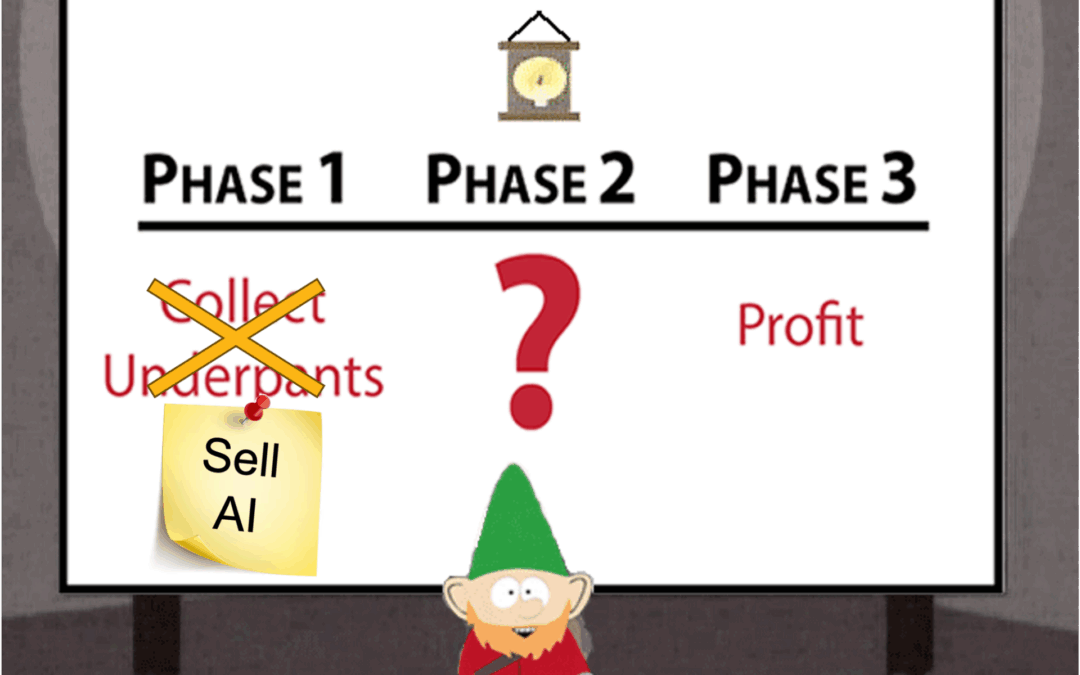
Claiming to be business experts, the Underpants Gnomes sneak into South Park residents’ homes every night and steal their underpants. When confronted by the boy in their underground lair, the Gnomes explain their business plan:
- Collect underpants
- ?
- Profit
It was meant as satire.
Some took it as a an abbreviated MBA.
How to Spot the Underpants AI Gnomes
As the AI hype grows, fueling executive FOMO (Fear of Missing Out), the Underpants Gnomes, cleverly disguised as experts, entrepreneurs and consultants, saw their opportunity.
- Sell AI
- ?
- Profit
While they’ve pivoted their business focus, they haven’t improved their operations so the Underpants AI Gnomes as still easy to spot:
- Investment without Intention: Is your company investing in AI because it’s “essential to future-proofing the business?” That sounds good but if your company can’t explain the future it’s proofing itself against and how AI builds a moat or a life preserver in that future, it’s a sign that the Gnomes are in the building.
- Switches, not Solutions: If your company thinks that AI adoption is as “easy as turning on Copilot” or “installing a custom GPT chatbot, the Gnomes are gaining traction. AI is a tool and you need to teach people how to use tools, build processes to support the change, and demonstrate the benefit.
- Activity without Achievement: When MIT published research indicating that 95% of corporate Gen AI pilots were failing, it was a sign of just how deeply the Gnomes have infiltrated companies. Experiments are essential at the start of any new venture but only useful if they generate replicable and scalable learning.
How to defend against the AI Gnomes
Odds are the gnomes are already in your company. But fear not, you can still turn “Phase 2:?” into something that actually leads to “Phase 3: Profit.”
- Start with the end in mind: Be specific about the outcome you are trying to achieve. The answer should be agnostic of AI and tied to business goals.
- Design with people at the center: Achieving your desired outcomes requires rethinking and redesigning existing processes. Strategic creativity like that requires combining people, processes, and technology to achieve and embed.
- Develop with discipline: Just because you can (run a pilot, sign up for a free trial), doesn’t mean you should. Small-scale experiments require the same degree of discipline as multi-million-dollar digital transformations. So, if you can’t articulate what you need to learn and how it contributes to the bigger goal, move on.
AI, in all its forms, is here to stay. But the same doesn’t have to be true for the AI Gnomes.
Have you spotted the Gnomes in your company?