by Robyn Bolton | Mar 18, 2026 | AI, Customer Centricity, Leadership, Leading Through Uncertainty, Strategy
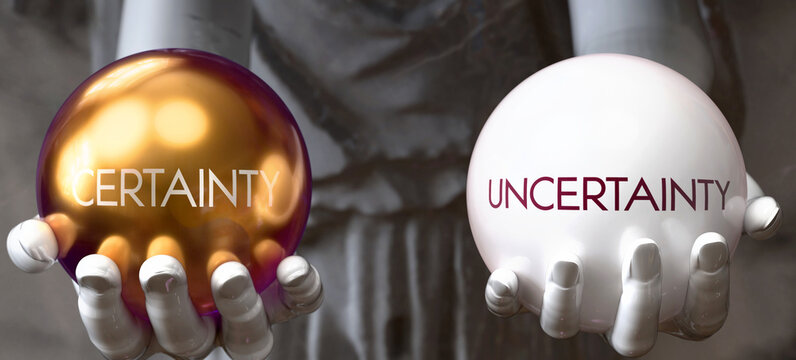
If you’re uncertain, you’re not alone. According to data from FactSet, 87% of Fortune 500 companies cited “uncertainty” during their 2025 Q1 earnings calls. And while things are definitely a tad chaotic in the world, I’ve started asking my clients, “What would you do if you were certain?”
It’s not an academic thought experiment. It’s a very practical exercise that radically shifts the way the think about and lead their businesses.
An Example That Proves the Rule
Most leaders facing disruption do one of two things: freeze and hope that “this too shall pass” or follow and hope that there is safety in numbers.
Neither is a strategy. Both are knee jerk reactions rooted in fear and communicated in the language and buzzwords of business.
This behavior didn’t start with AI. It happens every time a disruptive technology or philosophy bursts onto the scene. The printing press. The industrial revolution. Microchips. Each time, a new leader and paradigm emerges. How do they do it?
They’re certain.
Not because they’re omniscient. But because they know the answers to three questions
Question 1: Who Are You?
When photography made academic realism obsolete, Picasso didn’t freeze. He didn’t pick up a camera. He created something entirely new. Why? Because he knew exactly who he was. “I don’t seek,” he said. “I find.”
Today’s business icons are no different. Richard Branson describes himself as curious and someone who challenges the status quo. Lou Gerstner, when he arrived at a floundering IBM, declared himself a results man, not a visionary.
These self-definitions aren’t marketing. They’re decisions filters that define what you are and aren’t willing to do, agnostic of events, technologies, and capabilities.
Question 2: What Does Your Organization Actually Do?
Not what you make. Not what you sell. What Job to be Done do customers hire you to do?
Nintendo’s answer has been consistent across 130 years of radical product change: help me have fun with friends and family. From playing cards to the Game Boy, Wii, and Switch, their products changed completely. The Job didn’t.
IBM has done the same. From punch card tabulators to consulting and AI, the Job of helping customers make sense of complex information to run better never change. Amex moved from freight forwarding to credit and debit cards, but it’s commitment to move value securely when direct exchange isn’t an option never wavered.
When you know the Job you do, you stop chasing trends and start making choices.
Question 3: How Do You Move Forward?
You can’t answer this question without answering the first two. When you try, you get caught in the same freeze/follow trap as everyone else.
But when you answer the first two questions, the answer to this one becomes clear. For Picasso and Branson, they create. For Gerstner, he optimized the status quo. For most businesses, the answer is “And, not Or.” They must stabilize today’s business, step into (even follow) the next wave, and invest in creating the new.
Satya Nadella’s transformation of Microsoft is a perfect example. He defined himself as a learner, not a knower. He defined Microsoft’s job as helping people make a difference in their roles. From those two answers, every major move followed logically: maintain Office 365, step into cloud, create quantum computing technology.
None of it was reactive. All of it felt certain.
Your Moment Is Now
Yes, the world is uncertain. You don’t have to be.
Before you close this tab and tell yourself you’ll think about it later, answer the first two questions. You can change your answers later, but you need to start now.
The leaders who navigate this moment won’t be the ones who wait and see or follow the crowd. They’ll be the ones who know themselves and their organizations well enough to be certain.
by Robyn Bolton | Jan 25, 2026 | AI, Leadership, Leading Through Uncertainty
Spain, 1896
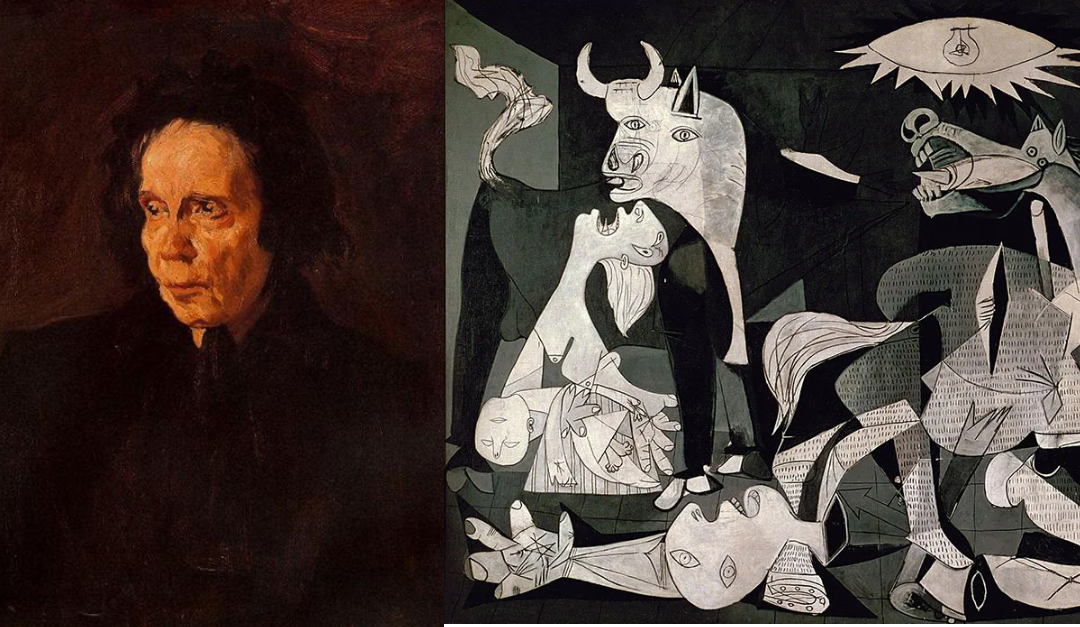
At the tender age of 14, Pablo Ruiz Picasso painted a portrait of his Aunt Pepa a work of brilliant academic realism that would go on to be hailed as “without a doubt one of the greatest in the whole history of Spanish painting.”
In 1901, he abandoned his mastery of realism, painting only in shades blue and blue-green.
There’s debate over why Picasso’s Blue Period began. Some argue that it’s a reflection of the poverty and desperation he experienced as a starving artist in Paris. Others claim it was a response to the suicide of his friend, Carles Casagemas. But Bill Gurley, a longtime venture capitalist, has a different theory.
Picasso abandoned realism because of the Kodak Brownie.
Introduced on February 1, 1900, the Kodak Brownie made photography widely available, fulfilling George Eastman’s promise that “you press the button, we do the rest.”
An ocean away, Gurley argues, Picasso’s “move toward abstraction wasn’t a rejection of skill; it was a recognition that realism had stopped being the frontier….So Picasso moved on, not because realism was wrong, but because it was finished.”
Washington DC, 2004
Three years before Drive took the world by storm, Daniel Pink published his third book, A Whole New Mind: Why Right-Brainers Will Rule the Future.
In it, he argues that a combination of technological advancements, higher standards of living, and access to cheaper labor are pushing us from a world that values left brain skills like linear thought, analysis, and optimization towards one that requires right brain skills like artistry, empathy, and big picture thinking.
As a result, those who succeed in the future will be able to think like designers, tell stories with context and emotional impact, and combine disparate pieces into a whole greater than the sum of its parts. Leaders will need to be empathetic, able to create “a pathway to more intense creativity and inspiration,” and guide others in the pursuit of meaning and significance.
California, 2026
Barry O’Reilly, author of Unlearn, published his monthly blog post, “Six Counterintuitive Trends to Think about for 2026,” in which he outlines what he believes will be the human reactions to a world in which AI is everywhere.
Leadership, he asserts, will cease to be measured by the resources we control (and how well we control them to extract maximum value) but by judgment. Specifically, a leader’s ability to:
- Ask better questions
- Frame decisions clearly
- Hold ambiguity without freezing
- Know when not to use AI
The Price of Safety vs the Promise of Greatness
Picasso walked away from a thriving and lucrative market where he was an emerging star to suffer the poverty, uncertainty, and desperation of finding what was next. It would take more than a decade for him to find international acclaim. He would spend the rest of his life as the most famous and financially successful artist in the world.
Are you willing to take that same risk?
You can cling to the safety of what you know, the markets, industries, business models, structures, incentives that have always worked. You can continue to demand immediate efficiency, obedience, and profit while experimenting with new tech and playing with creative ideas.
Or you can start to build what’s next. You don’t have to abandon what works, just as Picasso didn’t abandon paint. But you do have to start using your resources in new ways. You must build the characteristics and capabilities that Daniel Pink outlines. You must become the “counterintuitive” leader that embraces ambiguity, role models critical thinking, and rewards creativity and risk-taking.
Do you have the courage to be counterintuitive?
Are you willing to embrace your inner Picasso?

by Robyn Bolton | Dec 10, 2025 | Customer Centricity, Innovation, Leading Through Uncertainty
In times of great uncertainty, we seek safety. But what does “safety” look like?
What we say: Safety = Data
We tend to believe that we are rational beings and, as a result, we rely on data to make decisions.
Great! We’ve got lots of data from lots of uncertain periods. HBR examined 4,700 public companies during three global recessions (1980, 1990, and 2000). They found that the companies that the companies that emerged “outperforming rivals in their industry by at least 10% in terms of sales and profits growth” had one thing in common: They aggressively made cuts to improve operational efficiency and ruthlessly invested in marketing, R&D, and building new assets to better serve customers have the highest probability of emerging as markets leaders post-recession.
This research was backed up in 2020 in a McKinsey study that found that “Organizations that maintained their innovation focus through the 2009 financial crisis, for example, emerged stronger, outperforming the market average by more than 30 percent and continuing to deliver accelerated growth over the subsequent three to five years.”
What we do: Safety = Hoarding
The reality is that we are human beings and, as a result, make decisions based on how we feel and the use data to justify those decisions.
How else do you explain that despite the data, only 9% of companies took the balanced approach recommended in the HBR study and, ten years later, only 25% of the companies studied by McKinsey stated that “capturing new growth” was a top priority coming out of the COVID-19 pandemic.
Uncertainty is scary so, as individuals and as organizations, we scramble to secure scarce resources, cut anything that feels extraneous, and shift or focus to survival.
What now? And, not Or.
What was true in 2010 is still true today and new research from Bain offers practical advice for how leaders can follow both their hearts and their heads.
Implement systems to protect you from yourself. Bain studied Fast Company’s 50 Most Innovative Companies and found that 79% use two different operating models for innovation to combat executives’ natural risk aversion. The first, for sustaining innovation uses traditional stage-gate models, seeks input from experts and existing customers, and is evaluated on ROI-driven metrics.
The second, for breakthrough innovations, is designed to embrace and manage uncertainty by learning from new customers and emerging trends, working with speed and agility, engaging non-traditional collaborators, and evaluating projects based on their long-term potential and strategic option value.
Don’t outspend. Out-allocate. Supporting the two-system approach, nearly half of the companies studied send less on R&D than their peers overall and spend it differently: 39% of their R&D budgets to sustaining innovations and 61% to expanding into new categories or business models.
Use AI to accelerate, not create. Companies integrating AI into innovation processes have seen design-to-launch timelines shrink by 20% or more. The key word there is “integrate,” not outsource. They use AI for data and trend analysis, rapid prototyping, and automating repetitive tasks. But they still rely on humans for original thinking, intuition-based decisions, and genuine customer empathy.
Prioritize humans above all else. Even though all the information in the world is at our fingerprints, humans remain unknowable, unpredictable, and wonderfully weird. That’s why successful companies use AI to enhance, not replace, direct engagement with customers. They use synthetic personas as a rehearsal space for brainstorming, designing research, and concept testing. But they also know there is no replacement (yet) for human-to-human interaction, especially when creating new offerings and business models.
In times of great uncertainty, we seek safety. But safety doesn’t guarantee certainty. Nothing does. So, the safest thing we can do is learn from the past, prepare (not plan) for the future, make the best decisions possible based on what we know and feel today, and stay open to changing them tomorrow.
by Robyn Bolton | Dec 2, 2025 | AI
“It just popped up one day. Who knows how long they worked on it or how many of millions were spent. They told us to think of it as ChatGPT but trained on everything our company has ever done so we can ask it anything and get an answer immediately.”
The words my client was using to describe her company’s new AI Chatbot made it sound like a miracle. Her tone said something else completely.
“It sounds helpful,” I offered. “Have you tried it?”
“I’m not training my replacement! And I’m not going to train my R&D, Supply Chain, Customer Insights, or Finance colleagues’ replacements either. And I’m not alone. I don’t think anyone’s using it because the company just announced they’re tracking usage and, if we don’t use it daily, that will be reflected in our performance reviews.”
All I could do was sigh. The Underpants Gnomes have struck again.
Who are the Underpants Gnomes?
The Underpants Gnomes are the stars of a 1998 South Park episode described by media critic Paul Cantor as, “the most fully developed defense of capitalism ever produced.”
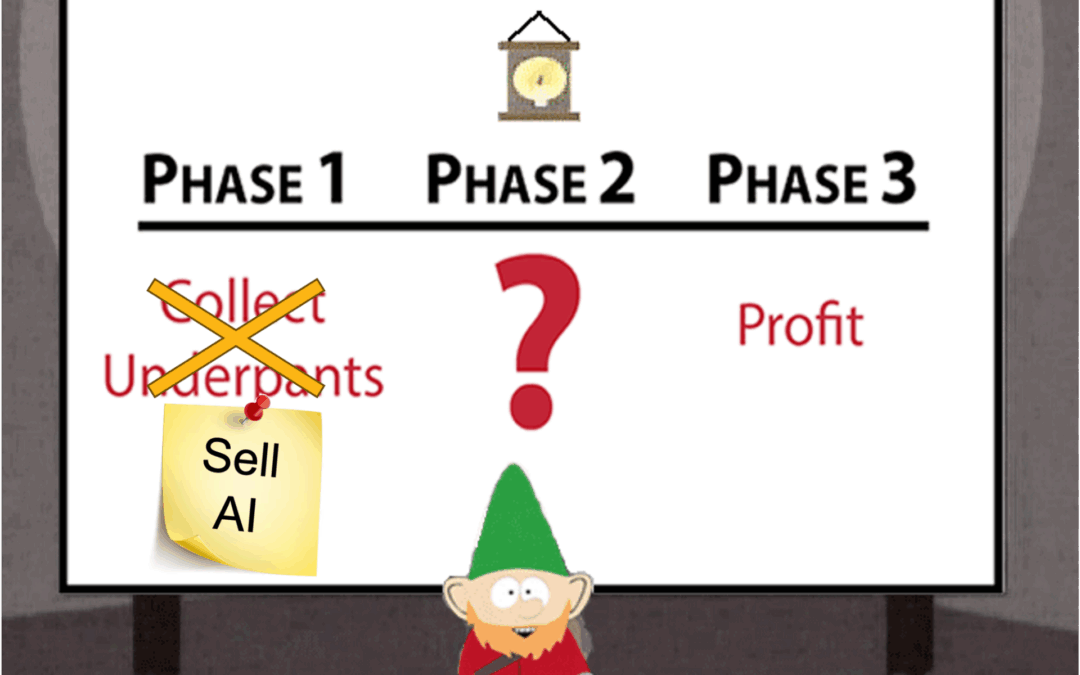
Claiming to be business experts, the Underpants Gnomes sneak into South Park residents’ homes every night and steal their underpants. When confronted by the boy in their underground lair, the Gnomes explain their business plan:
- Collect underpants
- ?
- Profit
It was meant as satire.
Some took it as a an abbreviated MBA.
How to Spot the Underpants AI Gnomes
As the AI hype grows, fueling executive FOMO (Fear of Missing Out), the Underpants Gnomes, cleverly disguised as experts, entrepreneurs and consultants, saw their opportunity.
- Sell AI
- ?
- Profit
While they’ve pivoted their business focus, they haven’t improved their operations so the Underpants AI Gnomes as still easy to spot:
- Investment without Intention: Is your company investing in AI because it’s “essential to future-proofing the business?” That sounds good but if your company can’t explain the future it’s proofing itself against and how AI builds a moat or a life preserver in that future, it’s a sign that the Gnomes are in the building.
- Switches, not Solutions: If your company thinks that AI adoption is as “easy as turning on Copilot” or “installing a custom GPT chatbot, the Gnomes are gaining traction. AI is a tool and you need to teach people how to use tools, build processes to support the change, and demonstrate the benefit.
- Activity without Achievement: When MIT published research indicating that 95% of corporate Gen AI pilots were failing, it was a sign of just how deeply the Gnomes have infiltrated companies. Experiments are essential at the start of any new venture but only useful if they generate replicable and scalable learning.
How to defend against the AI Gnomes
Odds are the gnomes are already in your company. But fear not, you can still turn “Phase 2:?” into something that actually leads to “Phase 3: Profit.”
- Start with the end in mind: Be specific about the outcome you are trying to achieve. The answer should be agnostic of AI and tied to business goals.
- Design with people at the center: Achieving your desired outcomes requires rethinking and redesigning existing processes. Strategic creativity like that requires combining people, processes, and technology to achieve and embed.
- Develop with discipline: Just because you can (run a pilot, sign up for a free trial), doesn’t mean you should. Small-scale experiments require the same degree of discipline as multi-million-dollar digital transformations. So, if you can’t articulate what you need to learn and how it contributes to the bigger goal, move on.
AI, in all its forms, is here to stay. But the same doesn’t have to be true for the AI Gnomes.
Have you spotted the Gnomes in your company?

by Robyn Bolton | Nov 1, 2025 | Innovation, Leading Through Uncertainty
“Is this what the dinosaurs did before the asteroid hit?”
That was the first question I was asked at IMPACT, InnoLead’s annual gathering of innovation practitioners, experts, and service providers.
It was also the first of many that provided insight into what’s on innovators and executives’ minds as we prepare for 2026
How can you prevent failure from being weaponized?
This is both a direct quote and a distressing insight into the state of corporate life. The era of “fail fast” is long gone and we’re even nostalgic for the days when we simply feared failure. Now, failure is now a weapon to be used against colleagues.
The answer is neither simple nor quick because it comes down to leadership and culture. Jit Kee Chin, Chief Technology Officer at Suffolk Construction, explained that Suffolk is able to stop the weaponization of failure because its Chairman goes to great lengths to role model a “no fault” culture within the company. “We always ask questions and have conversations before deciding on, judging, or acting on something,” she explained
How do you work with the Core Business to get things launched?
It’s long been innovation gospel that teams focused on anything other than incremental innovation must be separated, managerially and physically, from the core business to avoid being “infected” by the core’s unquestioning adherence to the status quo.
The reality, however, is the creation of Innovation Island, where ideas are created, incubated, and de-risked but remain stuck because they need to be accepted and adopted by the core business to scale.
The answer is as simple as it is effective: get input and feedback during concept development, find a core home and champion as your prototype, and work alongside them as you test and prepare to launch.
How do you organize for innovation?
For most companies, the residents of Innovation Island are a small group of functionally aligned people expected to usher innovations from their earliest stages all the way to launch and revenue-generation.
It may be time to rethink that.
Helen Riley, COO/CFO of Google X, shared that projects start with just one person working part-time until a prototype produces real-world learning. Tom Donaldson, Senior Vice President at the LEGO Group, explained that rather than one team with a large mandate, LEGO uses teams specially created for the type and phase of innovation being worked on.
What are you doing about sustainability?
Honestly, I was surprised by how frequently this question was asked. It could be because companies are combining innovation, sustainability, and other “non-essential” teams under a single umbrella to cut costs while continuing the work. Or it could be because sustainability has become a mandate for innovation teams.
I’m not sure of the reason and the answer is equally murky. While LEGO has been transparent about its sustainability goals and efforts, other speakers were more coy in their responses, for example citing the percentage of returned items that they refurbish or recycle but failing to mention the percentage of all products returned (i.e. 80% of a small number is still a small number).
How can humans thrive in an AI world?
“We’ll double down,” was Rana el Kaliouby’s answer. The co-founder and managing partner of Blue Tulip Ventures and host of Pioneers of AI podcast, showed no hesitation in her belief that humans will continue to thrive in the age of AI.
Citing her experience listening to Radiotopia Presents: Bot Love, she encouraged companies to set guardrails for how, when, and how long different AI services can be used. She also advocated for the need for companies to set metrics that go beyond measuring and maximizing usage time and engagement to considering the impact and value created by their AI-offerings.
What questions do you have?