
How to Experiment with Experimenting

How to Experiment with Experimenting

Is it just me?

I hate running experiments.

I know that I’m not supposed to say that, especially because I tell other people that they absolutely must run experiments.

After all, experiments are an essential part of the innovation process. There are some things that you absolutely cannot learn unless you go out into the world, interact with other humans, and operate in a real-world setting.

But run an experiment, especially if it’s on something I created? No, thank you. I’ll just sit right here in the safety of my office and polish my idea to within an inch of its theoretical life.

It’s all of us

To understand why running experiments can be stress-inducing, itself helpful to understand what happens in our brains when we’re conducting them.

No matter the type of experiment you’re running, the context in which you’re experimenting, or what you’re trying to learn, simply by running an experiment you are saying to the world (or your team, or your boss, or you peers), “I’m not entirely certain that I’m right. I may be wrong.” That is a very uncomfortable, even vulnerable, position to be in and our brains, always on the look-out for danger, activate our fight-or-flight response, resulting in something that feels a lot like fear.

According to Scott Steinberg, bestselling author of Make Change Work for Youthe seven most common fears people report feeling in the workplace are:

  1. Fear of Failure
  2. Embarrassment
  3. Underperformance
  4. Rejection
  5. Change and Uncertainty
  6. Confrontation
  7. Isolation

When you run an experiment, especially if you’re in a function/company/culture where experimentation is not the norm, you are at risk of experiencing at least one, and often all, of the fears listed.

Don’t believe me?

The experiment that never happened

Imagine that you work for a big multi-national food company and you’ve been tasked with creating a new line of snacks targeting Baby Boomers and offering functional benefits like improved version, greater stability, better muscle tone. You’ve done the research and you know the ingredients that can deliver each of the desired benefits. You’ve done some small scale taste testing and you’re confident that the products taste good and have the right texture. You’ve even checked with Legal and they’re confident that you can make the claims you want to make.

The last thing you need to test is that people will pay what you need them to pay for the new products.

You could ask people what they’re willing to pay but you know you’ll get better data if you actually sell the new products to people, asking them to exchange their hard earned money for a bag of nuts. You decide that the fastest, easiest, and cheapest way to do this is to set up a little stand in the company cafeteria, sell your new products, and see what happens.

That’s when things come to a grinding halt.

“What if we don’t sell as much as we need to?” one person asks (fear of failure and underperformance).

“What if people don’t like the products?” says another (fear of embarrassment)

“What if no one buys?” says a third (fear of rejection)

“There is no way that Legal will let us do this. No one has ever done this before. Plus, we’re talking about selling something that contains allergens.” says a fourth (fear of uncertainty and confrontation)

“You’re right,” you finally agree. “It’s better than we keep this work on the down-low. If people find out what we’re doing, they may feel like we’re stepping on their toes and we’ll get shut down.” (fear of isolation).

True story (but I bet you already knew that).

I’ve seen the same thing happen at other clients and in other industries. People want to experiment. They know they need to experiment. But they don’t experiment. Instead, they come up with all sorts of reasons, some very real and true and some greatly exaggerated, why they can’t.

Experiment with experimenting

First, let’s be clear — there are are LOTS of good reasons why some experiments can not or should not happen. If you know for a fact that an experiment is going to break a law, put someone at risk, or potentially result in an unrecoverable financial loss, do not do it! Common sense, people.

But fears are not facts. They are feelings. Feelings that can be acknowledged, addressed, and overcome.

So how do you overcome the feelings that can get in the way of experiments?

Start with a Plan B.

I don’t know about you, but I always feel better when I have a fall-back plan. Many people decide on the type of experiment they need to run and then go for it. Until they hit a roadblock. Then they stop….not just the experiment but ALL experiments. This type of “all or nothing” mindset — if we can’t do this experiment we can’t experiment at all — creates incredible stress because it makes the mere act of experimenting super high stakes.

Instead, start by getting very clear and very specific on what you need to learn — not “Will people pay for this?” but “Will people pay $4.99 for an 8oz bag of nuts.” Then, brainstorm all the ways you could learn what you need to learn, without worrying about the quality of the data you’ll get. Once you have a long list of different possible experiments, assess how complex it would be to run each (high/medium/low) and the reliability/quality of the data you’ll get (high/medium/low). You now have a list of different experiments to run and a sense of the trade-offs inherent in each one. As a result, you should feel more confident in choosing an experiment to pursue because you already have your Plan B (and C and D) identified in case you discover a legal, regulatory, or financial reason that your stops you from pursuing your original experiment.

Change how you talk about experiments.

When people ask we need to run experiments, we often answer with things like, “because I don’t know if…” or “because we need to if….” There’s nothing wrong with those answers per se but admitting that you don’t know something or are unsure of something can feel really really risky. After all, uncertainty can be perceived as risky, dangerous, and even a sign of incompetence.

So try phrasing answers in a way to show that you are somewhere good and the experiment will move you somewhere better. For example, “We know that we need to sell an 8oz bag for $4.99 in order to make our numbers and based on your benchmarks we’re confident that we can do that, but we want proof and this experiment is the best way to get it.” Of course you don’t want to lie but you also shouldn’t discount all the work and learning you’ve done to get to this point. Share that knowledge, get credit for the work, and explain the benefit of continuing the journey.

Turn around your thinking.

Ok, this is going to sound a bit “woo” but, if you’re like me and tend to focus on the worst-case scenario (because then you’re prepared for it!), you need to get out of your head, see your feelings for what they are, and get focused back on the facts before you can move forward. One technique for this is a series of questions known as “The Turnaround”in which you ask (and answer) a series of 5 questions. The questions below are how they would have been phrased in the example above, the root of the question (the part that doesn’t change) is underlined:

  1. Is it true that we will get shut down if we run this experiment? (Maybe)
  2. Can I absolutely know whether it is true before I run the experiment? (No)
  3. What happens when I believe that it is true that we will be shut down? (I don’t want to run the experiment)
  4. What would I do if I didn’t believe that we’ll be shut down? (I would run the experiment)
  5. What are 3 examples of when this thought in this context was not true (1. When our first concept got terrible results, 2. when our initial financial estimates didn’t achieve the required profit margin, 3. when the first taste tests got mediocre results)

By the end of this, you now have 3 facts that refute your 1 feeling. And as I like to say, “don’t bring feelings to a fact party ’cause we ain’t got time for that.”

In conclusion

Everyone gets uncomfortable at some point in the innovation process. For some people it’s the uncertainty at the start, for others it’s the process of setting KPIs without knowing whether you can hit them or not, and for others (like me) it’s the moment when you have to take your beautiful precious idea out into the world and face the fact that it might fail.

By experimenting with the way we approach planning for experiments, talking about them, and even thinking about them, both my clients and I have been able to lessen the fear and anxiety we feel when we don’t know what will happen next and find the courage to move forward, make things happen, and learn what needs to be learned.

6 Lessons from Watching 40 FIFA World Cup Games

6 Lessons from Watching 40 FIFA World Cup Games

I am not a soccer fan but my husband is. So why, as a non-soccer fan, would I watch so many World Cup games?

I could spin a high-minded tale about the importance of diverse experiences in driving empathy and creativity and that “getting out of your comfort zone” and experiencing new things can be as simple as watching a new channel or program.

I could go all business guru and pratter on about the fact that sports tend to produce wonderful case studies of what to do and not to do in the areas of leadership, teaming, and all other things management

But the truth is that I spent most of June sick in bed with something that exactly mirrored Whooping Cough (it wasn’t) and, during the Group Phase, I didn’t have the energy to commandeer the remote control and change the channel. By the time we got to the knock-out phase, however, I had a bit more energy, had adopted several teams as my own (Sweden, Denmark, and England) and was peppering my husband with questions about players, teams, rules, and all other things soccer.

So, with the Final match scheduled for Sunday, thought I would share what I’ve learned about leadership and innovation from watching 40 soccer games.


#1: Teams need Leaders, not managers

Argentina’s coach, Jorge Sampaoli

Argentina’s coach, Jorge Sampaoli, yelling from the sidelines (SOURCE: Getty — Contributor)

Untold books have been written on this subject and it played out for the world to see during Argentina’s World Cup run.

Argentina was considered one of the top contenders for the World Cup, having come in 2nd during the 2014 World Cup. The country has some of the world’s greatest players and perhaps none are greater than “The Magician,” Lionel Messi. With such a dominant line-up, it would seem that the coach’s job would be relatively easy — win the trust and respect of the team’s stars, inspire them to play well together as a team and then get out of the way.

But Argentina’s coach, Jorge Sampaoli, couldn’t seem to do that.

During Argentina’s first game, three top players were inexplicably benched and the game, which Argentina should have won easily, ended in a tie (more on that in the next lesson). For the next game, Sampaoli “went with a bizarre 3-man backline” (I don’t know exactly what that means but “bizarre” is never a word you want associated with your starting line-up) and the “disconnect between Aguero, Messi, and the others was apparent from the first minute.”

The result? Argentina lost to Croatia 0–3 and the players staged a coup, holding a meeting with the Argentine FA chiefs (basically the “front office” of the team) to demand that Sampaoli and the entire coaching staff be fired as part of a “pact for life” because “the players want to build a team.”

The coup failed. Sampaoli was allowed to keep his job (but was told he would be fired at the end of the competition). And the players, having no confidence or respect for the coach, resisted, fielding their own starting line-up for the third and final game of the Group Stage, a 2–1 victory over Nigeria.

Argentina struggled in the lead-up to the World Cup and underperformed during its first two games because it didn’t have a Leader (someone the team respects and wants to follow), it had a Manager (someone who demands obedience based on a title or organization hierarchy). When leaders finally rose up, it was too late — Argentina barely qualified for the Knock-out stage and promptly lost 4–3 to France.

#2: Don’t get hung up on job titles. Hire for skills.

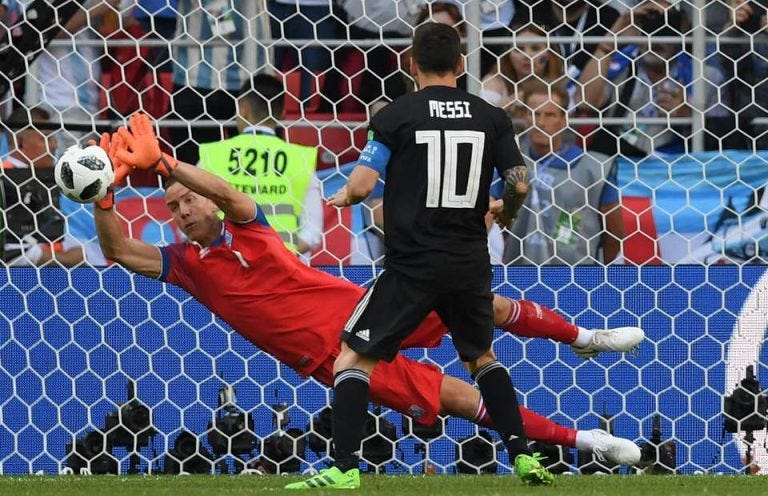
Lionel Messi taking a penalty kick

Lionel Messi takes his shot at Iceland’s goalie

In the first game of the Group Stage, Iceland, the smallest country ever to qualify for the World Cup, found itself playing Argentina. As if that were not challenging enough, in the 64th minute of a tied game, Argentina was granted a penalty kick and Lionel “The Magician” Messi stepped to the line. All he had to do was send the ball past Iceland’s goalie and his team would have a 2–1 lead.

He missed.

To be more specific, one of the greatest soccer players of all time, one who makes 76% of his penalty kicks, had his kick blocked by a goalie who is better known for directing a Coca-Cola commercial than for playing soccer. When asked how he achieved such an impossible feat, Hannes Halldorsson, a former filmmaker turned goalie, attributed his success to “film study.”

Sure, Halldorsson has soccer skills (basic job requirements) but kudos to Iceland’s coach for seeing value in non-traditional experience and to Halldorsson for using them to prepare for the big game.

#3: If you’re going to talk smack, you better be able to back it up

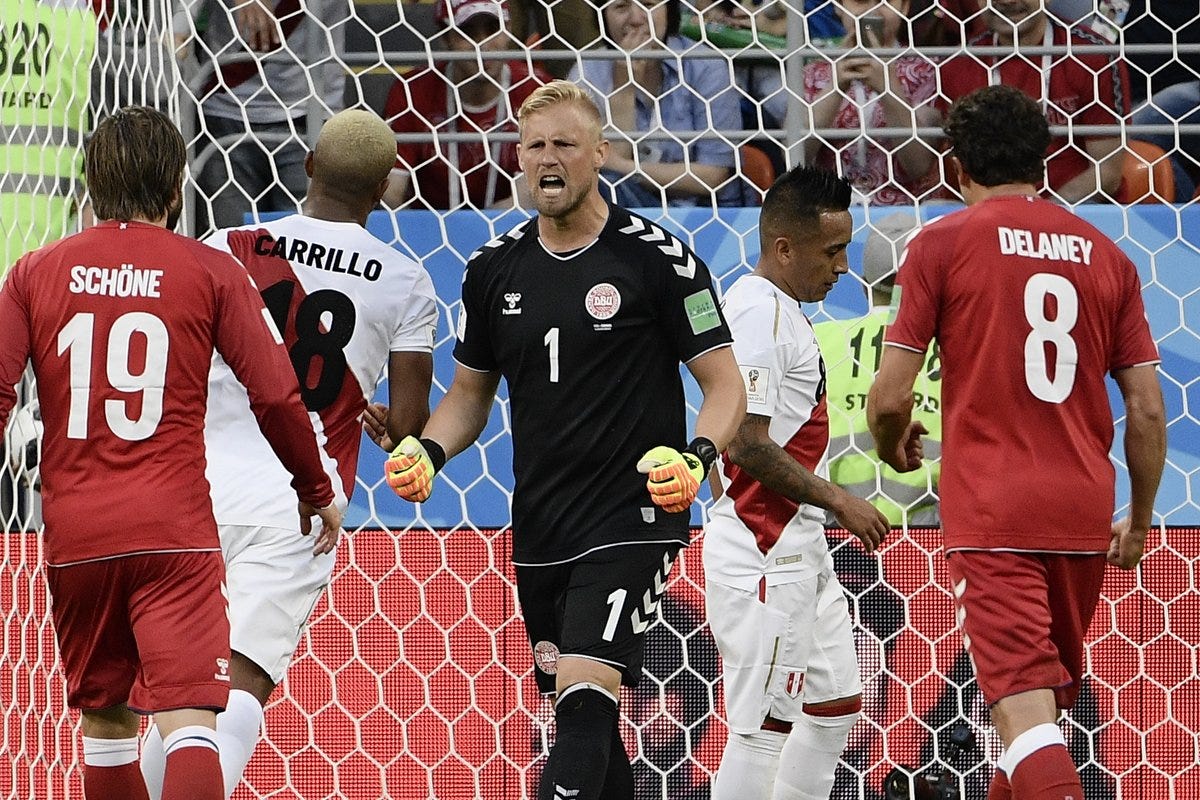
Denmark’s goalie, Kasper Schmeichel

Denmark’s goalie, Kasper Schmeichel, is PUMPED

Sticking with the theme of Nordic goalies, let’s talk about Denmark’s Kasper Schmeichel. If there were such a thing as Danish soccer royalty, it would be the Schmeichels.

Peter Schmeichel, the family patriarch, was voted world’s best goalkeeper in 1992 and 1993, captained Denmark to a championship in the 1992 UEFA World, AND captained Manchester United to the 1999 Champions League title and the Treble (it’s like the Triple Crown but for English soccer and it happens about as frequently…which is rarely). His son, Kasper made his World Cup debut this year and promptly beat his father’s record of most playing minutes (533 to be exact) for Denmark without conceding a goal.

So yeah, if Kasper talks smack to opposing players, daring them to try to get the ball past him, it’s pretty certain that he can back it up.

Until he can’t.

In Denmark’s match against Australia, Schmeichel came out of the goal to get in the face of a Mile Jedinak while the player was lining up for his penalty kick. Trash talk is nothing new in sports (in fact, I’d argue that it has been honed to a fine and humorous art form) but whatever Schmeichel said apparently went too far for commentators on social media, in the press, and even game officials who warned him about getting too close to the Australian.

A few seconds later, the ball went screaming past Schmeichel, scoring the tying goal for Australia and ending Schmeichel’s record.

#4: Don’t be afraid to experiment (and don’t let anyone tell you that you’re experimenting too much)

Mexico's National Football team coach, Juan Carlos Osorio

Mexico’s Tinkerer-In-Chief, Juan Carlos Osorio

Juan Carlos Osorio, Mexico’s coach, has the highest winning percentage of any Mexican national coach in the past 80 years. So why were 85,000 fans shouting “Fuera!” (Out!) at him during the team’s 1–0 victory over Scotland during a World Cup warm-up game in June?

Because he took the field with a new starting line-up.

It was his 48th different starting line-up in his 48 games as a national coach. That is a new line-up Every. Single. Game.

His tinkering continued into the World Cup where a new line-up beat defending World Cup Champions Germany only to be replaced by a new new line-up for game 2’s match-up against South Korea (which Mexico also won).

In his 52nd game as Mexico’s coach, Osorio changed tactics and did NOT change his line-up. They lost 3–0 to Sweden.

#5: Your performance, not your reputation, matters most

German players Mario Gomez (23) and Mats Hummels (5)

German players Mario Gomez (23) and Mats Hummels (5) react to losing to South Korea and their elimination from the tournament

Speaking of Germany, 2014’s World Cup champs came into the tournament ready to defend their title, ranked #1 in the world by FIFA, and with a 10–0 record in qualifying rounds.

They didn’t even make it out of the Group Stage.

How shocking was this? I think The Guardian summed it up nicely:

This, then, is how the world ends, not with a bang but with a whimper. There are certain events so apocalyptic that it feels they cannot just happen. They should be signalled beneath thunderous skies as owls catch falcons and horses turn and eat themselves. At the very least there should be a sense of fury, of thwarted effort, of energies exhausted. And yet Germany went out of the World Cup in the first round for the first time in 80 years on a pleasantly sunny afternoon with barely a flicker of resistance. There was no Sturm. There was no Drang.

Sports, business, heck, even life, is tough. Past performance should count for something and it usually does — it earns an opportunity. But it’s what you do with that opportunity that determines whether you win or lose.

#6: When all else fails, have a signature hairstyle

After watching 40 games, I have concluded that (1) hair is a big deal in soccer and (2) players must have access to hair product that the general public doesn’t because their hair maintains its original style of 90+ minutes of intense exercise. Some cases in point…

Neymar

Brazilian star Neymar debuts his World Cup hairstyle against Switzerland. For the next game, delighted fans responded by gluing raw clumps of ramen noodles to their foreheads in support of this style choice (SOURCE: Getty Images)

Olivier Giroud

French player Olivier Giroud’s hair defies gravity. Seriously, this is his hair at the END of a game! How is this even possible?!?!

Christiano Ronaldo

OK, I know that Portuguese star Christian Ronaldo’s hair doesn’t look as crazy as some others but it’s no less important. Prior to their World Cup match against Uruguay, the story of a 2010 match re-surfaced in which one of Uruguay’s players was asked how the team planned to stop Ronaldo. Plan A was to take him out with a tackle. If that didn’t work, Plan B was to “ruffle his hair to annoy him.” Plan A was enacted in the 6th minute of the game and didn’t work, so Uruguay when with Plan B. Ronaldo responded so furiously he was almost kicked out of the game. In the post-game press conference, Marcelo “Hair Ruffler” Sosa commented with amusement that Ronaldo seemed “more upset by me messing up his hair than the foul!”


There you have it. Every business/innovation/leadership/personal style lesson I learned from watching the World Cup. Now it’s off to the hair salon…