Winning in Times of Uncertainty Requires Doing what 91% of Executives Won’t

Winning in Times of Uncertainty Requires Doing what 91% of Executives Won’t

In times of great uncertainty, we seek safety. But what does “safety” look like?


What we say: Safety = Data

We tend to believe that we are rational beings and, as a result, we rely on data to make decisions.

Great! We’ve got lots of data from lots of uncertain periods. HBR examined 4,700 public companies during three global recessions (1980, 1990, and 2000).  They found that the companies that the companies that emerged “outperforming rivals in their industry by at least 10% in terms of sales and profits growth” had one thing in common: They aggressively made cuts to improve operational efficiency and ruthlessly invested in marketing, R&D, and building new assets to better serve customers have the highest probability of emerging as markets leaders post-recession.

This research was backed up in 2020 in a McKinsey study that found that “Organizations that maintained their innovation focus through the 2009 financial crisis, for example, emerged stronger, outperforming the market average by more than 30 percent and continuing to deliver accelerated growth over the subsequent three to five years.”


What we do: Safety = Hoarding


The reality is that we are human beings and, as a result, make decisions based on how we feel and the use data to justify those decisions.

How else do you explain that despite the data, only 9% of companies took the balanced approach recommended in the HBR study and, ten years later, only 25% of the companies studied by McKinsey stated that “capturing new growth” was a top priority coming out of the COVID-19 pandemic.

Uncertainty is scary so, as individuals and as organizations, we scramble to secure scarce resources, cut anything that feels extraneous, and shift or focus to survival.


What now? And, not Or.

What was true in 2010 is still true today and new research from Bain offers practical advice for how leaders can follow both their hearts and their heads.

Implement systems to protect you from yourself. Bain studied Fast Company’s 50 Most Innovative Companies and found that 79% use two different operating models for innovation to combat executives’ natural risk aversion.  The first, for sustaining innovation uses traditional stage-gate models, seeks input from experts and existing customers, and is evaluated on ROI-driven metrics.

The second, for breakthrough innovations, is designed to embrace and manage uncertainty by learning from new customers and emerging trends, working with speed and agility, engaging non-traditional collaborators, and evaluating projects based on their long-term potential and strategic option value.

Don’t outspend. Out-allocate. Supporting the two-system approach, nearly half of the companies studied send less on R&D than their peers overall and spend it differently: 39% of their R&D budgets to sustaining innovations and 61% to expanding into new categories or business models.

Use AI to accelerate, not create. Companies integrating AI into innovation processes have seen design-to-launch timelines shrink by 20% or more. The key word there is “integrate,” not outsource. They use AI for data and trend analysis, rapid prototyping, and automating repetitive tasks. But they still rely on humans for original thinking, intuition-based decisions, and genuine customer empathy.

Prioritize humans above all else. Even though all the information in the world is at our fingerprints, humans remain unknowable, unpredictable, and wonderfully weird. That’s why successful companies use AI to enhance, not replace, direct engagement with customers. They use synthetic personas as a rehearsal space for brainstorming, designing research, and concept testing. But they also know there is no replacement (yet) for human-to-human interaction, especially when creating new offerings and business models.


In times of great uncertainty, we seek safety.  But safety doesn’t guarantee certainty. Nothing does. So, the safest thing we can do is learn from the past, prepare (not plan) for the future, make the best decisions possible based on what we know and feel today, and stay open to changing them tomorrow.

In Defense of Innovation Theater

In Defense of Innovation Theater

I can’t believe that I’m writing this. Honestly, I can’t believe I’m even thinking this. I’m an open-minded person, but I truly never thought that anything would ever change my mind on this topic. And yet, I must confess that I’ve come to the conclusion that…

(deep breath)

Innovation Theater is important.

(Sorry, needed a minute to recover. It’s one thing to think something. It’s another to see it in writing.)

Why We All Hate(d) Innovation Theater.

The term “Innovation Theater” was coined by Steve Blank in a 2019 HBR article to describe innovation activities like hackathons, shark tanks, and workshops that “shape and build culture, but they don’t win wars, and they rarely deliver shippable/deployable product.”

The name stuck because it gave the Innovation Industrial Complex a perfect scapegoat. Innovation efforts weren’t producing results because companies were turning real strategy into theater—events that could be delegated and scheduled instead of the courage, commitment, and willingness to change that actual innovation requires.

And in many cases, this criticism was warranted.

But in our rush to dismiss Innovation Theater, we missed something important.


What I (Almost) Missed.

Recently, I visited a company’s Innovation Center, curious to see what ten years of innovation investments and two floors in a downtown high-rise had produced.

The answer was a framework to think more deeply about equity and inclusion. My immediate reaction was rage.  A decade of investments for this? Millions of dollars spent on the very definition of Innovation Theater? And they’re bragging about it?!?

Once the rage subsided, something remained. Something that I couldn’t shake. An inkling that I had missed something. That inkling became the realization that I was wrong.

Over the past five years, the framework had been used in carefully curated workshops to help teams across the organization see things they had previously overlooked, understand topics that were sensitive or taboo, and envision solutions that no one their heavily regulated industry had even considered.

Not every workshop resulted in action. But over time, something shifted.

Seasons. Not Shows.

Repetition created a shared language. Multiple touchpoints built permission. Small success stories accumulated to make risk feel manageable. The workshops didn’t send off isolated sparks of innovation. They built the conditions were acting on new ideas became progressively safer and more normal.

And after several seasons, enduring value was created. The company now enjoys the highest retention rate of customers in its industry and has attracted more new customers than all its competitors combined. A decade of “Innovation Theater” delivered exactly what innovation is supposed to deliver: measurable competitive advantage and revenue growth.


Don’t Cancel Your Next Innovation Event.

The problem isn’t Innovation Theater itself. It’s how we practice it.

A one-off hackathon? Theater. An annual workshop? Theater. But sustained investment over years, touching dozens of teams, building shared language and accumulated proof points? That’s a strategic bet on transformation that creates lasting competitive advantage.

The question isn’t whether Innovation Theater works. It’s whether you’re willing to commit to the season, not just the show. Are you prepared to invest consistently, measure differently, and wait for compounding effects that won’t show up in next quarter’s results?

Because when you commit to the season, not just the show, it’s the most strategic bet you can make.

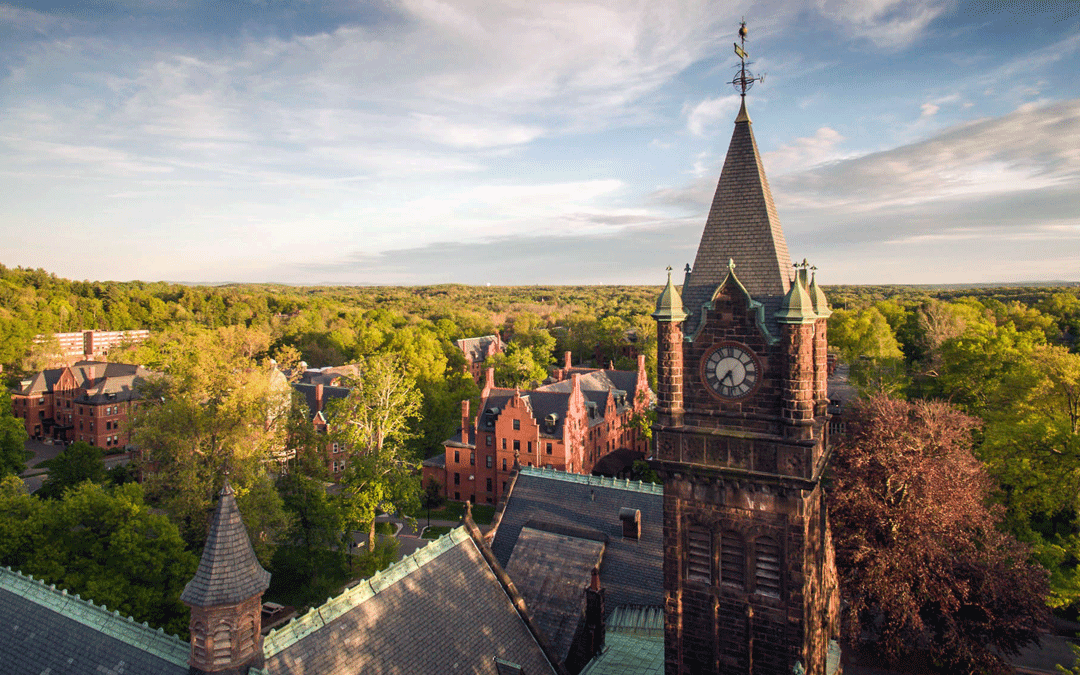
What’s next for higher ed?  Mt Holyoke gave us a hint.  In the 1980s.

What’s next for higher ed? Mt Holyoke gave us a hint. In the 1980s.

D-Day is less than 2 weeks away. On June 1, high school seniors and recent graduates will decide which, if any college to attend in the Fall. But, for most, they still won’t know where they’ll be living first semester.

Higher education, like so many other industries, has been rocked by the Coronavirus pandemic – classes are taught entirely on-line, students moved out of dorms and back home months before they planned, campuses are closed, and thousands of employees have been laid off or furloughed.

Like most other industries, colleges and universities have scrambled to respond and to prepare for what’s next.  Most pushed Decision Day back a month, from May 1 to June 1, to give prospective students more time to learn about schools offering admission and to assess their own ability to pay for and attend schools when classes resume.

But colleges and universities are facing a challenge that most industries are not.

Their customers are rebelling.  They are filing lawsuits.  They are asking a fundamental question, “What does my tuition actually buy?”

Before the pandemic, people though they knew.

It was only 30 years ago that most high school graduates opted to go to college.  According to research from the Georgetown Center on Education and the Workforce, in 1970, only 26% of middle-class workers had any post-high school education.  By 1992, it had jumped to 56% and 62% in 2018.

Today, prospective students, and their families believe that a college education is the cost of entry to a middle-class life.  You hear it in the Jobs to be Done (problems to be solved, goals to be achieved) they express when you ask why they want to go to college:

  • “I want to get a good job when I graduate” – functional Job to be Done
  • “I want to make a good living” – functional Job to be Done
  • “I want to have more independence” – Emotional Job to be Done (i.e. how I want to feel)
  • “I want to be part of something bigger than myself” – Social Job to be Done (i.e. how I want others to see me).

In response, colleges invested huge sums of money to convince students and their families that they offer the best solution to all of these Jobs to be Done.

  • Functional Jobs to be Done:. “I want to get a good job when I graduate” and “I want to make a good living”
    • Elements of the “College Solution”
      • Strong reputation
      • World-class education
      • Renowned faculty
      • Access to alumni network
      • Active Career services department
      • Relationships with employers
  • Emotional Job to be Done: “I want to have more independence”
    • Elements of the “College Solution”
      • Location near a major metro area or a fun college town
      • Access to student housing
      • Access to food
  • Social Job to be Done: “I want to be part of something bigger than myself”
    • Elements of the “College Solution”
      • Student clubs
      • Social clubs
      • Diverse student population
      • Championship athletics
      • Great living facilities

These elements and more are marketed in beautiful glossy brochures, recruiting roadshows, and campus tours.

The message is clear, “All of this and more could be yours if you are accepted and willing to pay.” And pay the students and their families did.

But here’s the rub.

When America went on lock-down in mid-March, colleges and universities were forced to close their campuses and send home students.  Classes were moved to virtual settings with little to no training to help faculty adjust to the new format. Overnight, almost all the elements of the “College solution” disappeared or were compromised, leaving a list that looks like this:

  • Functional Jobs to be Done:. “I want to get a good job when I graduate” and “I want to make a good living”
    • Elements of the “College Solution”
      • Strong reputation
      • World-class education*
      • Renowned faculty
      • Access to alumni network*
      • Active Career services department*
      • Relationships with employers*
  • Emotional Job to be Done: “I want to have more independence”
    • Elements of the “College Solution” – n/a
  • Social Job to be Done: “I want to be part of something bigger than myself”
    • Elements of the “College Solution” – n/a

(* = significantly compromised due to moving to a virtual setting or to economic conditions)

Yet the price of the “College solution” did not change. What happens when the customer thinks they’re paying for one thing (long list of elements) and the seller gives them something less (short list of elements) and refuses to refund a portion of their money? Lawsuits. As Mark Schaffer, the parent of a George Washington University student, explained in his Washington Post Oped:

“When my daughter was deciding where to go to college, we were persuaded by George Washington University’s promises of an extraordinary on-campus experience. The school’s recruiting materials tout a dazzling array of opportunities — to engage one-on-one with renowned faculty, join more than 450 clubs and organizations, or explore passions in high-tech labs, vast libraries, and state-of-the-art study spaces.

The university promises that living at the school opens the door to “world-class” internships, lifelong friendships with neighbors and roommates, and the chance to “become a part of the nation’s capital and make a difference in it every day.” In exchange, GWU expects around $30,000 per semester.   As college campuses across the country have shut down to slow the spread of the novel coronavirus, most schools, including GWU, have offered only online classes since mid-March. The reason for the shift is not the schools’ fault. But this remote education is nowhere near the caliber of the on-campus experience students were promised. For this reason, I and other GWU parents have requested a partial refund of this semester’s tuition and fees.   Unfortunately — and offensively — the university has refused these requests. This is why I am suing GWU for damages to compensate my family for losses suffered because of the school’s breach of contract, and why I am seeking to represent all families similarly harmed by the school through a class action.”

What happens in the Fall is unclear

As lawsuits against GWU, Northwestern, University of Chicago, NYU, Columbia, and other schools wind their ways through the legal system, everyone is scrambling to figure out what happens in the Fall. Most schools haven’t made decisions and the few schools that have seem to be falling into 3 buckets:

  • Return to pre-pandemic normal by resuming all on-campus classes, activities, and operations: Brown University (as advocated by their president in a NYT Oped), Purdue University
  • Proceed cautiously with a phased approach to resuming on-campus operations, classes, and living: UC Berkeley
  • Stayed closed and continue virtual classes: California State University (the largest university system in the US)

Students are also struggling with their decisions.  Without clarity as to what the Fall semester looks like and certainty as to their families’ financial means due to the economic downturn and rising unemployment, many students are considering taking a gap year or enrolling in a lower-cost option, such as a community college or public university.

What happens in 2021 and beyond is much easier to predict.

Certainly, the impact of decisions made about the Fall semester will reverberate for years to come as colleges cope with lost revenue from enrollment and a fairly high fixed costs base.

But the greater impact will come from students’ and families’ sudden awareness of the Mt. Holyoke Phenomenon and the role it’s played in their decision making.

First witnessed in the 1980s, the “Mt. Holyoke Phenomenon” reveals that  “charging higher tuition leads to a greater number of applicants, as well as academically higher quality applicants.”

The impact of this phenomenon is simple – higher tuition attracts better students, better students demand better education and experiences, better education and experiences improve the school’s brand, a better brand means schools can raise tuition and make more money.

Given that college tuition has increased 260% since 1980, compared to the 120% increase in all consumer items, it’s reasonable to assume that, more and more, tuition is buying access to the college’s reputation.

And, as the lawsuits and declining enrollments suggest, people thought skyrocketing tuition paid for a lot more and, suddenly aware that it doesn’t, may no longer be willing to pay the premium.

The result will re-shape higher education as we know it.

Instead of getting into the most prestigious school possible and relying on financial aid and loans to pay for it, high school seniors will consider a wider variety of post-high school options, including:

  • Trade schools which lead to high-paying and highly in demand skilled work
  • Community colleges that grant Associate’s degrees and/or a path to transfer to a 4-year college
  • Co-op programs that allow them to gain work experience at the same time as a college degree

Colleges, too, will step away from their all (on-campus) or nothing solution to offer a wider portfolio of options.  In fact, some schools already have:

  • Miami University has several campuses, one in Oxford offering a traditional, residential 4-year experience, and two other campuses nearby that offer part-time associates and bachelor’s degrees
  • Harvard University offers a traditional 4-year college education, and undergraduate and graduate degrees through the nonresidential Harvard Extension School, and online certificates through Harvard X
  • SNHU famously offers online and campus degree programs and a special “Military Experience” that offers generous tuition discounts, credit transfers, and support programs to active duty military and their spouses

 It will take years for demand (what students want and are willing to pay for) and supply (what colleges and universities can offer) to reach equilibrium.  But that equilibrium will look very different than it does today.  Mt Holyoke taught us that in the 1980s.  The coronavirus reminded us.

5 Unexpected Uses of Telemedicine and How They May Help You

5 Unexpected Uses of Telemedicine and How They May Help You

There is more to telemedicine – the exchange of medical information from one site to another through electronic communication to improve a patient’s health – than virtual visits with physicians.

Specialists like dentists, orthodontists, ophthalmologists, psychologists, and even veterinarians are using telemedicine solutions during the pandemic.

Like their physician counterparts, many resisted virtual visits until it became the only way to continue to care for patients and stay in business, as stay-at-home orders expanded from weeks to months.

Here’s a quick run-down of telemedicine’s use in other specialties and what the road ahead could look like for each.

DENTISTRY

Where we are now

According to the American Dental Association, since early March, 79% of dentistry practices closed except for emergency procedures, and another 18% closed completely.

This isn’t surprising given how COVID-19 is transmitted but, for patients in pain, it can be hard to know what constitutes a true emergency and what can be managed at home.  Helping patients figure out what needs immediate attention and what can wait seems to be tele-dentistry’s sweet spot.

“Research indicates that 80% of acute dental concerns can be addressed at home without an in-person visit,” explains Chelsea Acosta Patel, Head of Wally Experience at Wally Health, a dental care start-up based in Boston.  “Using technology, dentists can triage issues and care for patients while keeping them out of the chair.”

Where we go from here

The bigger, long-term opportunity, according to Patel, may be in preventative care by creating and monitoring at-home preventive care solutions across the patient dental journey.

“Most dentists don’t have the tools to keep an ongoing pulse with patients.  They just assume that if a patient has an issue or a question, they’ll call the office.  Teledentistry solutions enable dentists to develop customized, ongoing touchpoints to help patients remain healthy and catch potential issues early. This improves the patient’s experience, drives loyalty and word of mouth (pun intended) for the dentist, creating a virtuous oral health cycle.”

ORTHODONTICS

Where we are now

While Dentists need a way to answer questions, triage issues, and provide follow-up care, Orthodontists have a more pressing need – to make sure their patients’ jaws continue to develop and their teeth continue to move in the right way.

“We serve a vulnerable pediatric population whose jaws are developing.  The adjustments we make as part of their treatment affect that growth and development,” explains Dr. Adam Welmerink of Welmerink Orthodontics in Reno Nevada.  “When we realized this would be more than a 2-week shutdown, we needed a way to keep our patients safe, make sure their appliances weren’t doing any harm, and ensure their treatment was progressing as planned,”

Through services like Orthodontic Screening Kit (OSK), patients receive instructions on how to take photos and upload them to the OSK site for review by their orthodontists.  Of course, the orthodontist’s ability to assess the patient’s need is determined by the quality of the photos, but, at a minimum, the service creates an opportunity for orthodontists to reconnect with their patients and give them guidance on signs that could trigger an in-office visit.

Where we go from here

Telemedicine in orthodontics, like many other specialties, will likely continue to be used to triage issues or to serve patients in remote rural areas.

“Many of our patients live in rural areas, with some driving 2 hours for a 10-minute appointment.  We’ll probably continue to use (OSK) to see if they need to come in.  And I could see using it in a limited capacity to triage patients who call with an emergency to assess if they can treat the issue at home or if they need to come in.” Dr. Welmerink mused.  “Honestly, time-wise, it’s quicker to see a patient in the office. But this is great for right now.”

OPTHALMOLOGY & OPTOMETRTRY

Where we are now

Telemedicine’s use as a way to calm patients and triage concerns, deciding whether or not an in-office visit is required, continues with eye care.

“It is certainly a way to reassure patients that we are there for them, which is most important in these scary times,” NYC optometrist Dr. Susan Resnick told All About Vision.

While reassurance is important, most eye care professionals agree that telemedicine’s use is extremely limited.  Proper eye care requires pupil dilation and specialized tools to accurately identify problems like glaucoma or assess the health of optic nerves and retinas.

Where we go from here

Despite its limitations, Dr. Resnick sees value in continuing to use telemedicine, “We will continue to utilize this platform whenever necessary.  We do not view it as a disruptor or threat, but rather as a way to bolster our practice.”

Not everyone agrees.

“I’m not terribly enthusiastic (about remote eye exams),” Illinois ophthalmologist Dr. Benjamin Ticho told All About Vision.  “There’s going to be too many mistakes.  Plus, it diminishes the warmth and personality of the interaction.  For many patients, a good doctor visit is a pleasant social occasion, and for many doctors, that’s part of why we went into medicine.”

MENTAL HEALTH

Where we are now

The data is staggering.

Before the crisis, 20% of US adults lived with mental illness but less than half received treatment according to federal statistics.

In the last two weeks of March, 45% of US adults felt that worry and stress related to COVID-19 were harming their mental health.  It’s likely that number has increased as stay-at-home orders extend, and job losses and furloughs increase.

Yet the adoption of telemedicine to address mental health concerns has been slow.  A phenomenon that is far from new.  Case in point – over a decade ago, Congress excluded mental health providers from a $30M investment in digitizing patient health records.  Even now, as CMS, private insurers, and state regulators are easing restrictions and increasing reimbursement for telemedicine to treat physical concerns, similar attention and flexibility have not been shown to mental health concerns.

As a result, “(providers) are kind of trying everything right now and seeing what can work,” John Torous, director of the digital psychiatry division at Beth Israel Deaconess Medical Center told Politico.

Where we go from here

More than other specialties, the jury is out on what happens next with regards to telemedicine for mental health.

On one hand, “so much of counseling has to do with body language, being physically present in the room, intonation,” Lynn Linde for the American Counseling Association told Politco.  “Sometimes, that’s lost when you don’t have a good internet connection, or one of your starts getting garbled.”

On the other, this could be a “tipping point for the way we practice,” said Peter Yellowlees, a professor of clinical psychiatry at the University of California, Davis and former president of the American Telemedicine Association.

Optum, a division of UnitedHealth, seems to be betting on the latter.  Last week it announced that it was in talks to acquire AbleTo, a New York-based virtual therapy provider for $470M, or 10x forward revenue.

VETERINARY CARE

Where we are now

If telemedicine is good enough for humans, it’s good enough for our animal companions.

A relatively new addition to the specialties offering telemedicine solutions, only a handful of companies are currently playing in this field.  TeleVet, a “Texas-based, digitally optimized company focused on veterinary care,” is one.

Before the outbreak, TeleVet was in use in 1000 clinics across the US and even closed a $2M seed round in January.

“We can check for infections such as ear infections or drainage from either a still picture or a video, or even a live video conference with the owner,” Dr. Amy Garrou as Houston-area vet explained to Innovation Map. “The platform has been useful because we can do any of those consultations and get the information we need to manage the case without the pet owner having to come into the clinic.”

Where we go from here

Like dentistry, orthodontics, and eye care, telemedicine’s use in the Veterinary space is a boon for providers and patients at a time when it’s not safe to be in a crowded office.  But as restrictions lift, like the other health care fields, it’s likely to be used primarily to answer questions, triage concerns, and perform post-surgery check-ups.


THE CLINICAL APPLICATIONS ARE DIFFERENT BUT  THE ROAD AHEAD IS THE SAME.

Yes, telemedicine is an incredible tool to have in our collective healthcare toolkit.  Its use across medical specialties is evidence that it fills a need for clinicians (provide care for my patients) and patients (address my concerns).

In “normal” times, those needs are well addressed by in-office visits, retail clinics, and urgent care.  It is only in very specific circumstances, like when medical professionals cannot easily or safely see patients in-person, that existing solutions fall short and telemedicine becomes the most attractive option.

However, telemedicine only became an available option when regulators relaxed rules, insurers increased reimbursement, and patients accepted emails and video-chats as treatment.

It took a pandemic to create the confluence of circumstances required for physicians, dentists, orthodontists, eye care professionals, mental health caregivers, veterinarians, and other clinicians to begin or expand the use of telemedicine.  It’s their experience, and the experiences and decisions of other players in the healthcare ecosystem, that will lead them back to the office and the hands-on care that is both desired and required.

10 Moments of Innovation Zen: Travel

10 Moments of Innovation Zen: Travel

Sunday was Read a Roadmap Day which is, naturally, one of MileZero’s favorite days.

For hundreds of years, maps were works of art. Available to only the rich and powerful, they described the full sum of our understanding of the land and sea, and told stories of the fantastical creatures that lived beyond our shores.

Even as maps became more accessible, reading a roadmap still felt like reading a treasure map. As a kid, I loved to study the different types and colors of lines signaled different types of roads. Dozens of symbols each translated to some wondrous place or service. And don’t get me started on the wonder and magic of AAA’s TripTiks!

As time goes on, fewer and fewer people know how to read road maps, which is understandable given that technology puts real-time custom location information at our fingertips. But there’s still magic in maps and in the discoveries that only occur through travel.

So, for this week’s 10 Moments of Innovation Zen, and in honor of Read a Roadmap Day, here i are 10 innovations in travel that you can enjoy from your own home (which is really your only option at the moment)


Savage Beauty by Kari Kola in Connemara, Galway County, Ireland

Savage Beauty, the largest site-specific light artwork ever created because art need not be constrained to pencil, paint, and canvas

Nordlandsbanen Bodo — Trodheim

Slow TV in which there is no story line, no script, no drama, no climax, just 9+ hours of Norwegian landscape as viewed from a train

Easter Island

Heritage on the Edge by Google showing how World Heritage Sites are affected by global climate change

Animal Cams so you can virtually visit the pandas at the Smithsonian National Zoo or the penguins, fish, seals, and other inhabitants of the New England Aquarium

Dotonbori area in Osaka Japan

Virtual Walking Tours of NYC, South Korea, Japan, the Philippines, LA, San Diego, and a few US college campuses

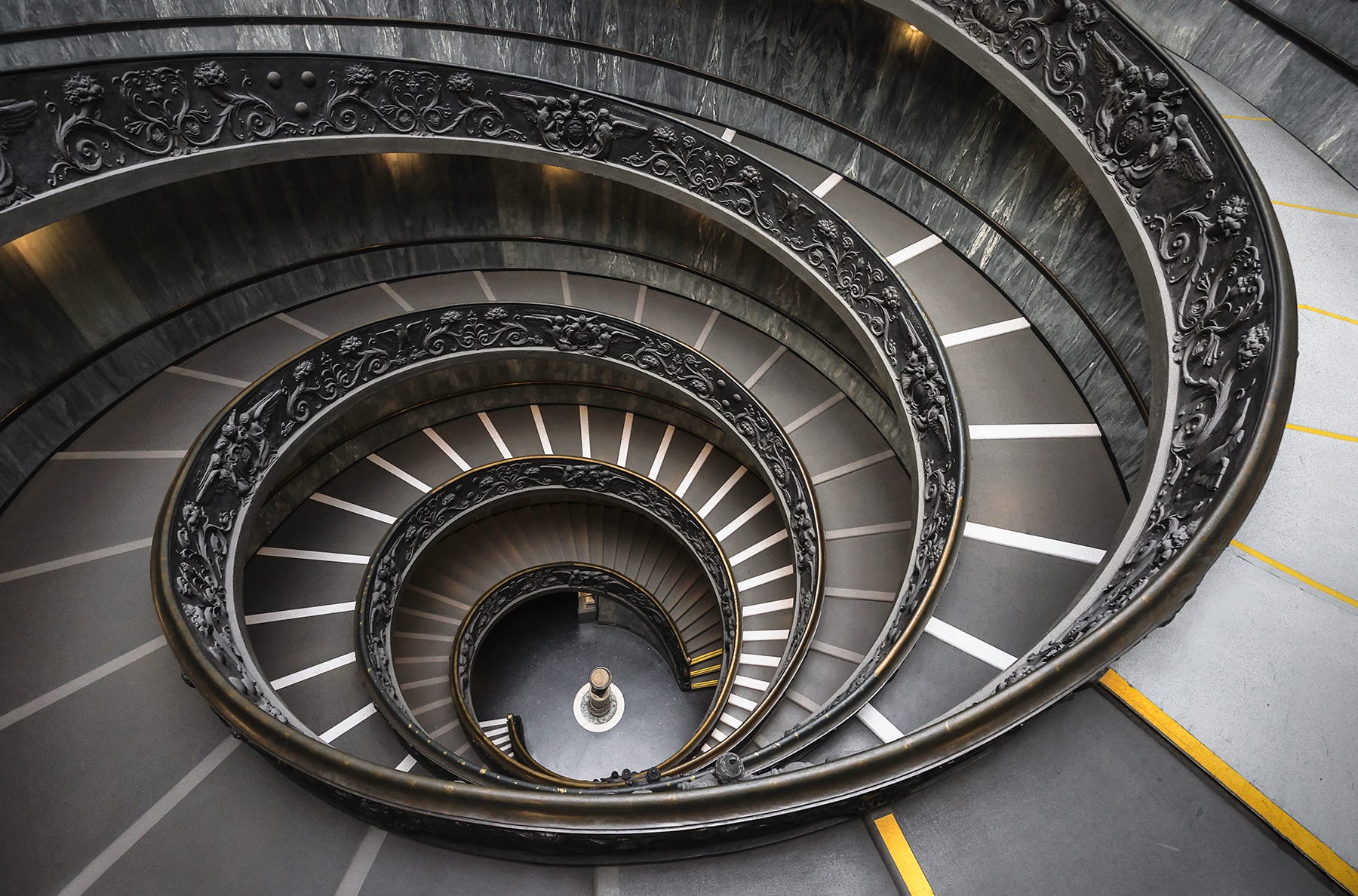
Staircase at The Vatican Museum

Virtual Museum Tours of the LouvreMadrid’s Museo Nacional Thyssen-Bornemisza, and The Vatican Museum

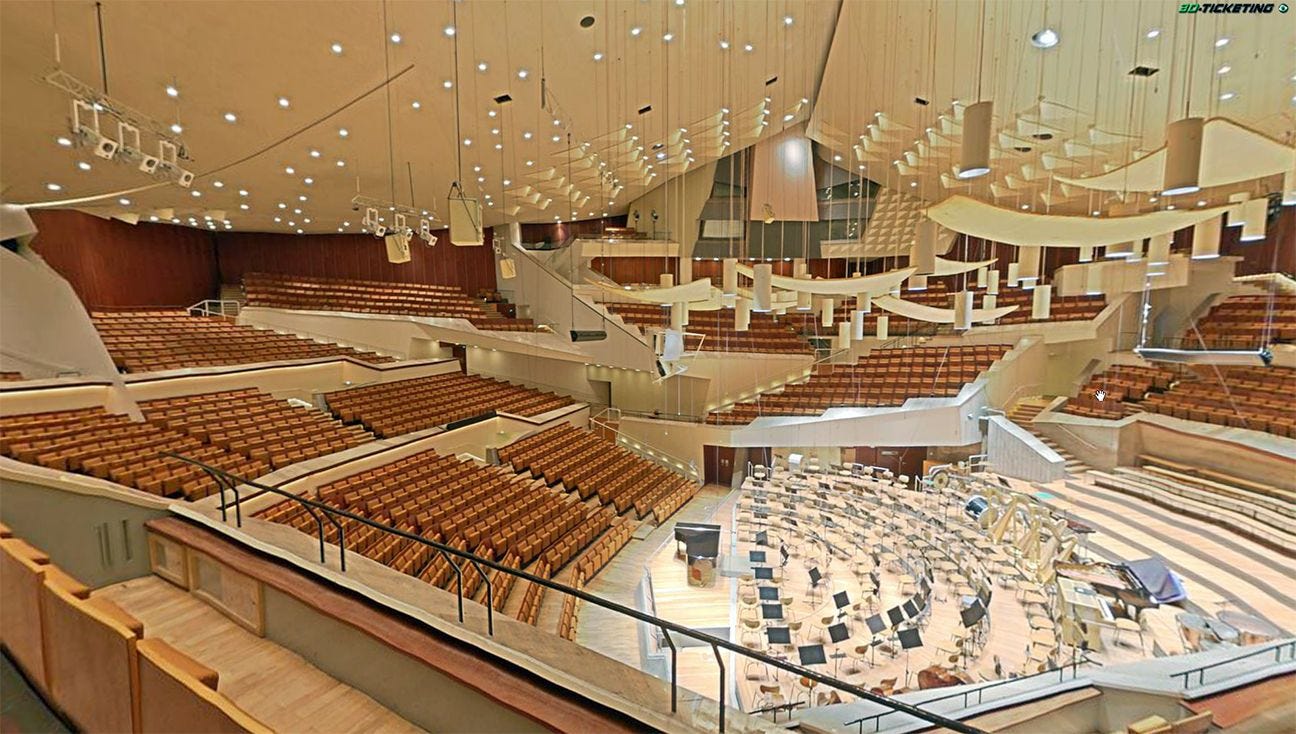
Berlin Philharmonic Hall

Virtual Concerts performed by the Melbourne Symphony Orchestra or the Berlin Philharmonic

Madama Butterfly, Royal Swedish Opera

Virtual Operas from all over the world, including the Royal Swedish Opera’s Madama Butterfly and the Polish National Opera’s Tosca

Arches National Park

Google Earth lets you visit anywhere on, well, earth and, with this link, you can visit any of the US National Parks

Royal Portuguese Reading Rooms, Rio de Janeiro, by Getty Images

Listicles of the best of anything, including the world’s most beautiful libraries (sorry, I just love books too much)