
by Robyn Bolton | Aug 4, 2026 | AI, Leadership
“Try AI. It will make you more efficient,” every executive at least once in the past three months.
And it always makes me laugh.
Yes, AI will make save you time and effort. Eventually. But not on the timeline you, or your boss, is comfortable with.
A story that proves the rule
A few days ago, I spent 4 hours building a single AI tool for one research task.
Some context: I use AI Daily and have built prompts, tools and agents to streamline regular tasks. The idea came from a Whop site that I use regularly, which outlined the specific tools, prompts, and steps required to successfully build an AEO (answer engine optimization) scanning tool.
That’s why I only blocked four hours for the build.
To build the tool, I created new accounts on four different websites, worked in Terminal, Claude Cowork, and Claude Code, and referred to instructions from both the originating website and Claude.
If I had a boss or an IT department, neither would be happy with me.
Why? After all, I built a tool for a task that was too complicated and time-consuming to do previously, will run automatically every week, recommends practical fixes, and measures impact against meaningful business metrics.
I’ve also had bosses that, if I told them I spent 10% of my week on this, would say, “that’s nice but where do we stand on (fill in the blank).”
The cost of efficiency
“Lean is the enemy of learning,” according to MIT professor, Ben Armstrong. That’s as true for AI in the office as it is on the manufacturing floor.
Learning is inherently inefficient. Baked into the experience are user mistakes, unexpected outcomes, and dead ends. But those mistakes, outcomes, and dead ends generate the insights required to increase the odds the next attempt will succeed.
As Thomas Edison said, “I have not failed. I’ve just found 10,000 ways that don’t work.”
When we do ultimately succeed, we almost immediately forget time, money, and effort the learning cost us. But forgetting is what makes harder to keep learning. And it results in nonsense like, “try AI. It will make you more efficient.”
The value of waste
Next time you’re tempted to say, “try AI,” stop and ask yourself these five questions:
- “Why am I saying this?” Do you really believe that AI is a solution to the problem you’re hearing or are you just saying it because the company is pushing AI? If it’s the latter, just provide a solution to the problem. If it’s the former, keep reading.
- “What does ‘efficiency’ look like?” As with all experiments, define success first. Do you expect time to completion to be cut in half? Or for it to take just as long, with fewer people? Or maybe it simply costs less. Without a goal, AI is just a toy.
- “How long am I willing to wait for efficiency?” Efficiency doesn’t magically appear the moment a prompt or tool spits out a response. Are you willing to dedicate an hour a week, even if it takes six months to be efficient. Or is success expected in a day, no matter how many hours?
- “Am I willing to pay the cost of learning?” The costs of learning go beyond trainings and tools. It’s the opportunity cost of time spent on another project, calls to customers, conversations with consumers, engagement in meetings. If you’re not willing to pay all those costs, don’t encourage people to “try AI.”
- “How will I reward and spread this learning?” Your “learning waste” can create value for your organization. But only if you reward the people who did the work and spread the learning beyond your team, enabling people to build on what’s known with less “waste.”
“Try AI” is a shortcut to avoid the hard and inefficient work of learning. But paying the cost is the only way to earn the efficiency.

by Robyn Bolton | Jul 21, 2026 | Leadership, Leading Through Uncertainty, Stories & Examples
“Disruption [is] driven by the pursuit of profit. That’s the causal mechanism for these things…”
Clayton Christensen at the 2011 Gartner Symposium ITExpo
When I told a client that peak profit was one of the signs that they were about to be disrupted, his jaw fell open. He didn’t believe me because, like any businessperson, achieving record profit is THE reason to celebrate. His company had just doubled revenue in the past five years and was positioned to double again in the next five. AND they supply mission-critical systems to build out data centers.
Business literally could not be better.
Which is exactly what the CEOs of Big Steel thought in 1968.
It wasn’t too big to fail.
“US Steel posted record profit margins in the years prior to unseating by the minimills; in many ways it was blind to its disruption.”
Clayton Christensen in HBR
Since the mid 1850s, steel was produced in integrated steel mills that performed every function required to produce the material that was building America. The costs to build a mill were high, about $8B in today’s dollars, and, to operate efficiently, mills ran 24/7 to produce at least 2M tons of steel per year.
In 1968, a metallurgist at Nucor invented something called the minimill. It could only perform half of the functions of an integrated mill and produced only rebar, the lowest quality of steel. But the minimill cost only $6M and could be profitable at just 50,000 tons of production.
Christensen called the minimill “not good enough.” He was being nice. The minimill was a joke.
Rebar was a joke, too. At just 4% of the steel market, it had the lowest gross margin of any type of steel. Ceding it to minimills freed up integrated mill capacity to produce more high profit steel. By 1977, Nucor was the leading manufacturer of rebar.
It had also spent 7 years improving the minimill.
The pattern continued:
- 1984: Big steel cedes the angle iron, bars, and rods to Nucor
- 1989: Bethlehem Steel’s market value jumps to $2.4B, from $175M just 3 years earlier
- 1993: Minimills directly compete with integrated mills in all segments of the market.
- 1995: Bethlehem Steel’s primary plant ceases operations
- 2001: Bethlehem Steel files for Chapter 11
- 2003: Minimills production exceeds integrated mills while Bethlehem Steel ceases to exist.
By 2017, only 9 integrated mills were still operating in the US, compared to 111 active minimills. The disruption took 35 years to play out.
You don’t have 35 years
The steel industry isn’t the only example:
| Company |
Time to Disruption |
Peak |
Disruption |
Disruptor |
| Sears |
30 years |
1969: World’s largest retailer |
1999: Removed from Dow Jones Industrial Average |
Walmart, Kmart, Target, Amazon |
| Kodak |
16 years |
1996: Record $16B revenue |
2012: Filed for Chapter 11 bankruptcy protection |
Digital photography |
| Blockbuster |
6 years |
2004: Record revenue: $6B |
2010: Filed for Chapter 11 bankruptcy protection |
Redbox, Netflix |
| Nokia |
7 years |
2007: Record Net Profit $51B, 40% of global handset market |
2014: Handset business sold to Microsoft for $7.2B |
iPhone, Android |
| Intel |
3 years |
2021: Record revenue $79B |
2024: Worst ever stock year as price goes below $18/share |
TSMC, Nvidia |
It’s happening right now. Are you seeing it?
“Financial results measure how healthy the business was, not how healthy the business is. Financial results are a particularly bad tool to manage disruption, because moving up-market feels good financially.”
Clayton Christensen and Michael E. Raynor, The Innovator’s Solution
Executives and shareholders may feel good right now because, despite supply chain disruptions and high interest rates, earnings are buoyed by “margin expansion” and “revenue beats.” AI feels like an opportunity, not a threat. And there’s no reason to believe that tomorrow’s results will be worse than today’s numbers.
It’s exactly how the CEOs of Big Steel felt in 1968.
You still have time to find the joke.

by Robyn Bolton | Jun 23, 2026 | Leadership, Leading Through Uncertainty, Tips, Tricks, & Tools
For eight days, the Tartan Army filled Boston’s streets with kilts, bagpipes, and the constant refrain of “No Scotland. No Party.” Bars ran out of beer, traffic cones adorned statues, and resident’s souls were healed.
Now, some are saying corporate managers should have the same effect on the people around them (presumably without consuming all the beer in the office).
The possibility of collective effervescence
Collective effervescence is everywhere right now: in New York at the Knicks’ championship parade, the Tarps Off shirtless section at baseball games, at every unexpected draw or win at the World Cup.
It’s the “emotional electricity or excitement that lifts people outside of themselves and makes them feel like they’re connecting to something transcendent,” explains Christina Simko, and associate professor of sociology at William College. “They (members of a crowd) have to have a common focus and a common mood, and through that physical interaction, they generate something … greater than the sum of its parts.”
Greater than the sum of its parts.
Where have a I heard that before?
Could it be in every press release announcing an acquisition, all-hands meeting kicking of a transformation, and email confirming a re-org?
Which explains why I’m reading about the need for executives to create collective effervescence to ensure the success of transformational initiatives.
Seventy percent of transformations fail and one of the leading causes of failure is insufficiently high aspirations. Collective effervescence is sufficiently high but setting that as a metric of success will only drive up the failure rate.
The probability of emotional contagion
Emotional contagion is also everywhere: in the laugh that spreads through a room, the frown that moves around a conference table, the yawns that can’t be suppressed in meetings.
It’s the “phenomenon in which a person unconsciously mirrors or mimics the emotions of those around them” through nonverbal, conversational, or behavioral cues. It can be positive, like smiles and laughs, or negative like frowns or the tension from a tough conversation.
That’s good news for executives.
Leaders are “emotional amplifiers” because team members are more likely to mirror the leader’s tone than their peers. Research out of USC also indicates that, historically, positive emotions are more contagious than negative ones.
It’s also bad news for executives.
The emotional amplifier role cuts both ways and research shows that people tend to “overperceive” negative cues from leaders, even magnifying small emotional cues well beyond what a leader intended.
That means the frown everyone on the company-wide Zoom was most likely interpreted as disagreement, even opposition, to what was being discussed. And not that your shoes are too tight.
The reality of leading humans through change
Leading people through change is hard. It’s even harder when you’re under a microscope and every smile, frown, sigh, cough, and eye roll is scrutinized and interpreted as if it were a secret code foretelling the future of thousands.
It’s not. But your team believes it is.
And perception is reality.
Here’s how to start shaping reality to make the changes happen:
- Start with self-awareness. What is your mood right now? If it’s useful to the team, spend time with them. If it’s not, reschedule the meeting or send a proxy.
- Make direct eye contact with people. According to the research, eye contact during verbal communication activates brain regions that help us understand what someone is saying and what they mean. Just don’t stare. That’s creepy.
- Neutralize the negativity publicly. A bit of skepticism can be healthy for teams going through change but too much easily crosses over into pessimism and even hostility that spreads throughout the team. So stop the spread by publicly and patiently calling out the behavior and seeking to understand the root cause.
You don’t need collective effervescence to successfully lead change.
You do need spread the belief that change is possible and beneficial.
And you can do that without wearing a kilt.
by Robyn Bolton | Jun 17, 2026 | Leadership, Leading Through Uncertainty, Tips, Tricks, & Tools
Up and down New England’s coastline you’ll find lobster (pronounced “lob-stah”) shacks. These weathered wood structures produce the freshest lobster and crispiest fried seafood anywhere, enjoyed on picnic tables as the sun beats down and the waves crash against the rocky shore.
It was at one of these shacks that, many years ago, I learned priceless lesson.
As my friends and I placed our orders, I asked that the head of my lobster be removed before serving. The waitress looked at me like I had nine heads but wrote down my request and returned to the kitchen. A few minutes later she reappeared and announced that the kitchen refused to decapitate the lobster prior to serving.
“I don’t like making eye contact with my food,” I stammered.
She nodded and walked away.
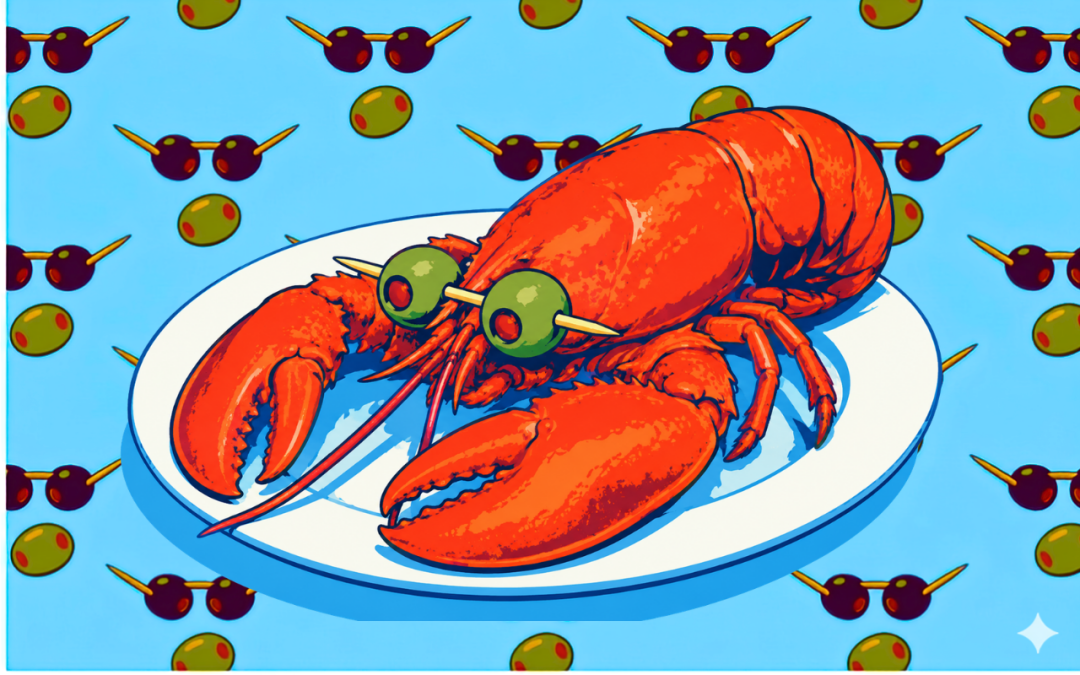
When she returned with our lobsters, they all had heads but one was noticeably different. It was wearing “sunglasses” made of olives and toothpicks.
“Here,” our waitress said. “Now you don’t have to make eye contact with it.”
A short-term “solution”
As VUCA-ness (volatile, uncertain, complex, ambiguous) accelerates, C-suite executives do everything possible to create certainty and construct safety. After all, if the company doesn’t survive the short-term, even the best long-term plans don’t matter.
Evidence of this approach is everywhere:
When these decisions land on your desk, you sigh, knowing they are short-sighted but understanding the rationale. Then, you go implement them, knowing unintended consequences are coming.
Unintended doesn’t mean unpredictable
In fact, because you are on the frontlines of your business, striving to deliver today and build tomorrow, you can predict what those consequences will be:
It’s frustrating to see the problems coming but feel powerless to avoid them.
But what does any of this have to do with a lobster wearing sunglasses?
When you know the Why, you can choose the How
When directives land on your desk, don’t sigh and roll them out. Ask for the Why behind the What.
- Why are employees being forced back to the office? Did productivity decrease? Are mission-critical operations not occurring? Are top-performers leaving for in-person roles?
- Why are experienced people being let go? Is the work being outsourced or has it genuinely gone? Why are you no longer hiring entry-level people? Are they too expensive to train? Is retention genuinely poor?
- Why are innovation initiatives being cut? Is the core business in that much trouble? Do we lack the talent? Are we pursuing growth through other means?
Each directive’s Why is different which means you have more options than you realize for delivering the How. Understanding the outcomes the company needs, reveals options for delivering it while minimizing the unintended consequences.
Don’t decapitate the lobster. Find opportunities for sunglasses.
The kitchen could have easily removed the head from my lobster, but they foresaw the unintended consequences of a disappointing dining experience. When they understood my why, they created a spectacular how.
You don’t control the system so asking “Why?” feels scary, hostile, even mutinous.
You do control your piece of it. You know it better than anyone, so there’s no one better to determine the how.
by Robyn Bolton | Jun 10, 2026 | Leadership, Tips, Tricks, & Tools
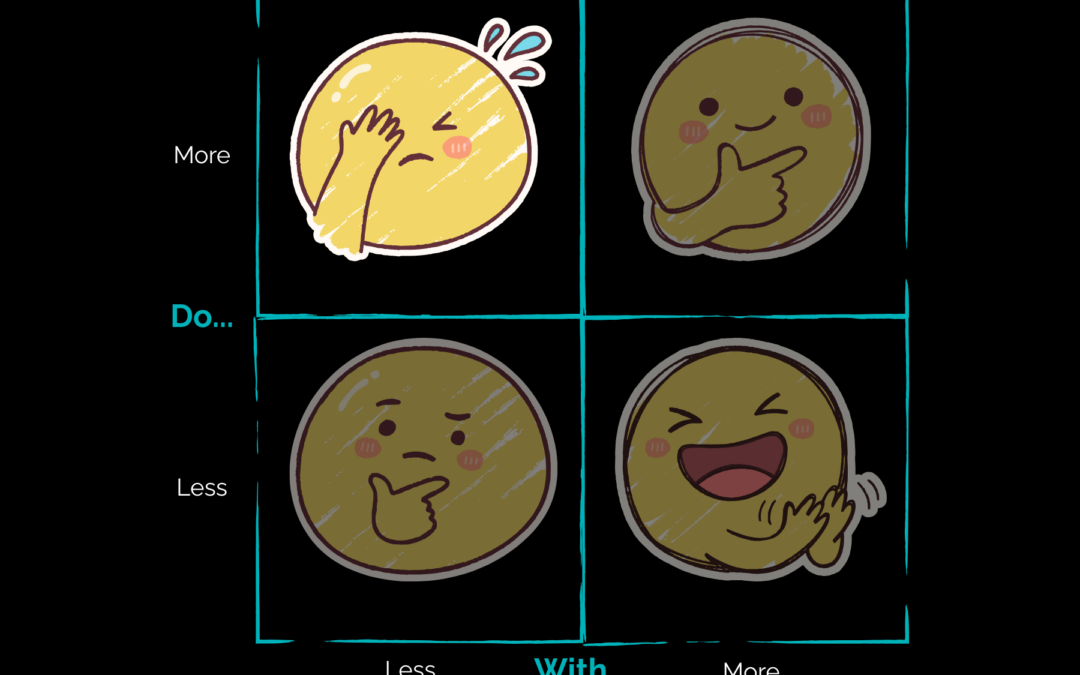
We have entered the “do more with less” era of management edicts.
And, just like the eras of “fail fast,” “synergy,” and “we’re a family,” the phrase is met with eye rolls, silent groans, and a deepening certainty that management is completely out of touch with the reality on the ground.
But what if doing more with less is possible without the extra hours and stress that lead to burnout?
(Re)Define “more.”
When we hear “more,” we naturally think of work. More meetings. More emails. More Slacks, texts, Zooms. For most of my career, I believed the more emails I received, meetings I attended, and documents I wrote, the more valuable I was.
Volume does not equal value.
“More” can’t (and shouldn’t) mean more work. It must mean something else.
More value creation. Less box checking.
More progress. Less process.
More meaningful work. Less meaningless activity.
What is the “more” you want from your team? Define it or you’ll get more emails, meetings, and documents. Name it (value, efficiency, progress), and your team will figure out how to do it.
Experiment with “less.”
A client’s team stopped sending meeting summaries. They didn’t send shorter ones, change the distribution list, or even share the link to the AI note-taker. They just stopped.
No one noticed.
Six months later, a new team member asked if they would send a meeting summary. The team leader said no but offered to recap next steps before everyone left the room. No one argued. Everyone left the meeting with clarity on what they needed to do next.
Activity does not equal achievement.
Our days are filled with BS work, tasks that we do because we’ve always done them, because they feel important, and because we worry what happens if we stop.
Documents don’t ensure that people are informed, aligned, or are ready to act.
Meetings don’t guarantee that everyone has thoughtfully considered and agreed on a decision.
Meeting summaries don’t make people complete their next steps.
It doesn’t mean we don’t need documents, meetings, or meeting summaries. But “less” is possible.
Ask your team what you can do less of. Stop doing things and see if people notice. If you can’t stop something completely, ask what less of it looks like. Instead of a meeting summary, send next steps. Instead of a presentation, write a one-page summary. Instead of a spreadsheet build a visual dashboard.
Rethink “indispensable.”
The managers in my client’s training program were in roles that everyone called the most pivotal in the company. They didn’t feel pivotal. They felt reactive and overwhelmed, with no control over their own calendars.
The COO’s fix was simple. Just stop attending.
It surprised him that they wouldn’t. They couldn’t. The fear of missing something kept them in every room, including the ones that ran fine without them.
You’re in every meeting because you’re good at your job. Being good got you invited into every decision, and somewhere along the way no one uninvited you. Now you stay out of habit, not need. The permission to step back is usually there. You just haven’t tested it long enough to know what happens.
Presence does not equal performance.
Look at your calendar for the meetings you sit in out of habit. Pick one this week to not attend. Resist the urge to instructions. Simply tell the team lead you won’t attend and that you trust them to keep things moving.
Your absence isn’t dropping the ball. It’s demonstrating that you trust the team and empowering them to do their jobs. It’s the rare version of less that gives you more time and your team their autonomy.
“Do more with less” isn’t a demand to work harder
The constraint isn’t going anywhere. Volume isn’t value. Activity isn’t achievement. Presence isn’t performance. It’s a reason to finally drop what doesn’t matter.

by Robyn Bolton | Jun 3, 2026 | Leadership, Strategy
“How much did your last 1,000 long-distance calls cost you?”
Juan Enríquez Cabot, Mexican-American academic, businessman, author, and speaker.
Strategy requires making choices. It’s an exercise in trade-offs. It requires prioritizing one thing over another and saying “no” to more things than you say “yes.”
The same is true for life. It also requires making choices, setting priorities, saying “no,” and making trade-offs.
But what happens when you no longer need to make trade-offs?
That’s one of the questions that Juan Enriquez, best-selling author and TED All-Star, posed during his speech “An Uncertain, Scary, Exciting Future.” To illustrate his point, he took us back to the late 20th century when we used to pay for long-distance calls. In the 1970s, long-distance (state-to-state) calls cost a minimum of $3.50 per minute (in 2020 dollars). In the 1980s as industry competition increased, phone companies started offering discounted rates for evening and late-night calls.
I remember my mom talking to my grandma in Pennsylvania for an hour each week and my grandma in California for two hours each month. Assuming those were the only interstate calls made (they weren’t), at a discounted rate of $1.25/minute, those five calls cost $450 in 2020 dollars.
That’s more than 3x what I currently pay for unlimited calls and text.
We used to trade off money, frequency, convenience, and quality simply to stay in touch with family and friends. Now we don’t.
But we’re still making trade-offs.
There are ALWAYS trade-offs
No one likes trade-offs. We’d much rather have everything than just one thing. After all, if you have (or do) everything then when things change, you’re prepared. You’re safe.
But “all of the above” is not an option.
My mom would have been stuck on the phone for hours every day talking to my grandmas if long-distance calls were free. But, because we couldn’t afford the financial trade-off required for daily multi-hour, long-distance calls, my mom was free to live her life untethered from the kitchen phone.
Now, the financial and physical trade-offs of long-distance calls have gone away but we’re still tethered to our phones. Instead, we’re trading away our attention and energy, data and privacy, even our mental well-being for the “convenience” of always being connected and accessible.
What trade-offs are you making (because you ARE making them)?
Look at your business strategy, your team, your daily calendar. What are you trading off? What will you stop doing so that you can invest more in starting or accelerating something else?
If you’re like most executives, you can’t answer those two questions because you choose “all of the above.”
But you did make trade-offs. You’re trading off time spent with friends and family and your physical and mental well-being to do more with less. You’re trading off your business’ future to maximize today’s profits.
There are always trade-offs. The ones you proactively and consciously choose are always better than the ones that creep up on you, promising “all of the above” while taking the things you’d never knowingly give up.