by Robyn Bolton | Oct 13, 2025 | Innovation, Leading Through Uncertainty
As a kid, you’re taught that when you’re lost, stay put and wait for rescue. Most executives are following that advice right now—sitting tight amid uncertainty, hoping someone saves them from having to make hard choices and take innovation risk.
This year’s Nobel Prize winners in Economics have bad news: there is no rescue coming. Joel Mokyr, Philippe Aghion, and Peter Howitt demonstrated that disruption happens whether you participate or not. Freezing innovation investments doesn’t reduce innovation risk. It guarantees competitors destroy you while you stand still.
They also have good news: innovation follows predictable patterns based on competitive dynamics, offering a framework for making smarter investment decisions.
How We Turned Stagnation into a System for Growth
For 99.9% of human history, economic growth was essentially zero. There were occasional bursts of innovation, like the printing press, windmills, and mechanical clocks, but growth always stopped.
200 years ago, that changed. Mokyr identified that the Industrial Revolution created systems connecting two types of knowledge: Propositional knowledge (understanding why things work) and Prescriptive knowledge (practical instructions for how to execute).
Before the Industrial Revolution, these existed separately. Philosophers theorized. Artisans tinkered. Neither could build on the other’s work. But the Enlightenment created feedback loops between theory and practice allowing countries like Britain to thrive because they had people who could translate theory into commercial products.
Innovation became a system, not an accident.
Why We Need Creative Destruction
Every year in the US, 10% of companies go out of business and nearly as many are created. This phenomenon of creative destruction, where companies and jobs constantly disappear and are replaced, was identified in 1942. Fifty years later, Aghion and Howitt built a mathematical model proving its required for growth.
Their research also lays bare some hard truths:
- Creative destruction is constant and unavoidable. Cutting your innovation budget does not pause the game. It forfeits your position. Competitors are investing in R&D right now and their innovations will disrupt yours whether you participate or not.
- Competitive position predicts innovation investments. Neck-to-neck competitors invest heavily in innovation because it’s their only path to the top. Market leaders cut back and coast while laggards don’t have the funds to catch-up. Both under-invest and lose.
- Innovation creates winners and losers. Creative destruction leads to job destruction as work shifts from old products and skills to new ones. You can’t innovate and protect every job but you can (and should) help the people affected.
Ultimately, creative destruction drives sustained growth. It is painful and scary, but without it, economies and society stagnate. Ignore it at your peril. Work with it and prosper.
From Prize-winning to Revenue-generating
Even though you’re not collecting the one million Euro prize, these insights can still boost your bottom line if you:
- Connect your Why teams with your How teams. Too often, Why teams like Strategy, Innovation, and R&D, chuck the ball over the wall to the How teams in Operations, Sales, Supply Chain, and front-line operations. Instead, connect them early and often and ensure the feedback loop that drives growth
- Check your R&D and innovation investments. Are your R&D and innovation investments consistent with your strategic priorities or your competitive position? What are your investments communicating to your competitors? It’s likely that that “conserving cash” is actually coasting and ceding share.
- Invest in your people and be honest with them. Your employees aren’t dumb. They know that new technologies are going to change and eliminate jobs. Pretending that won’t happen destroys trust and creates resistance that kills innovation. Tell employees the truth early, then support them generously through transitions.
What’s Your Choice?
Playing it safe guarantees the historical default: stagnation. The 2025 Nobel Prize winners proved sustained growth requires building innovation systems and embracing creative destruction.
The only question is whether you will participate or stagnate.

by Robyn Bolton | Oct 6, 2025 | 5 Questions, Customer Centricity, Innovation, Tips, Tricks, & Tools
For decades, we’ve faithfully followed innovation’s best practices. The brainstorming workshops, the customer interviews, and the validated frameworks that make innovation feel systematic and professional. Design thinking sessions, check. Lean startup methodology, check. It’s deeply satisfying, like solving a puzzle where all the pieces fit perfectly.
Problem is, we’re solving the wrong puzzle.
As Ellen Di Resta points out in this conversation, all the frameworks we worship, from brainstorming through business model mapping, are business-building tools, not idea creation tools.
Read on to learn why our failure to act on the fundamental distinction between value creation and value capture causes too many disciplined, process-following teams to create beautiful prototypes for products nobody wants.
Robyn: What’s the one piece of conventional wisdom about innovation that organizations need to unlearn?
Ellen: That the innovation best practices everyone’s obsessed with work for the early stages of innovation.
The early part of the innovation process is all about creating value for the customer. What are their needs? Why are their Jobs to be Done unsatisfied? But very quickly we shift to coming up with an idea, prototyping it, and creating a business plan. We shift to creating value for the business, before we assess whether or not we’ve successfully created value for the customer.
Think about all those innovation best practices. We’ve got business model canvas. That’s about how you create value for the business. Right? We’ve got the incubators, accelerators, lean, lean startup. It’s about creating the startup, which is a business, right? These tools are about creating value for the business, not the customer.
R: You know that Jobs to be Done is a hill I will die on, so I am firmly in the camp that if it doesn’t create value for the customer, it can’t create value for the business. So why do people rush through the process of creating ideas that create customer value?
E: We don’t really teach people how to develop ideas because our culture only values what’s tangible. But an idea is not a tangible thing so it’s hard for people to get their minds around it. What does it mean to work on it? What does it mean to develop it? We need to learn what motivates people’s decision-making.
Prototypes and solutions are much easier to sell to people because you have something tangible that you can show to them, explain, and answer questions about. Then they either say yes or no, and you immediately know if you succeeded or failed.
R: Sounds like it all comes down to how quickly and accurately can I measure outcomes?
E: Exactly. But here’s the rub, they don’t even know they’re rushing because traditional innovation tools give them a sense of progress, even if the progress is wrong.
We’ve all been to a brainstorm session, right? Somebody calls the brainstorm session. Everybody goes. They say any idea is good. Nothing is bad. Come up with wild, crazy ideas. They plaster the walls with 300 ideas, and then everybody leaves, and they feel good and happy and creative, and the poor person who called the brainstorm is stuck.
Now what do they do? They look at these 300 ideas, and they sort them based on things they can measure like how long it’ll take to do or how much money it’ll cost to do it. What happens? They end up choosing the things that we already know how to do! So why have the brainstorm?”
R: This creates a real tension: leadership wants progress they can track, but the early work is inherently unmeasurable. How do you navigate that organizational reality?
E: Those tangible metrics are all about reliability. They make sure you’re doing things right. That you’re doing it the same way every time? And that’s appropriate when you know what you’re doing, know you’re creating value for the customer, and now you’re working to create value for the business. Usually at scale
But the other side of it? That’s where you’re creating new value and you are trying to figure things out. You need validity metrics. Are we doing the right things? How will we know that we’re doing the right things.
R: What’s the most important insight leaders need to understand about early-stage innovation?
E: The one thing that the leader must do is run cover. Their job is to protect the team who’s doing the actual idea development work because that work is fuzzy and doesn’t look like it’s getting anywhere until Ta-Da, it’s done!
They need to strategically communicate and make sure that the leadership hears what they need to hear, so that they know everything is in control, right? And so they’re running cover is the best way to describe it. And if you don’t have that person, it’s really hard to do the idea development work.”
But to do all of that, the leader also must really care about that problem and about understanding the customer.
We must create value for the customer before we can create value for the business. Ellen’s insight that most innovation best practices focus on the latter is devastating. It’s also essential for all the leaders and teams who need results from their innovation investments.
Before your next innovation project touches a single framework, ask yourself Ellen’s fundamental question: “Are we at a stage where we’re creating value for the customer, or the business?” If you can’t answer that clearly, put down the canvas and start having deeper conversations with the people whose problems you think you’re solving.
To learn more about Ellen’s work, check out Pearl Partners.
To dive deeper into Ellen’s though leadership, visit her Substack – Idea Builders Guild.
To break the cycle of using the wrong idea tools, sign-up for her free one-hour workshop.
by Robyn Bolton | Sep 30, 2025 | Leading Through Uncertainty, Strategy, Tips, Tricks, & Tools
Just as we got used to VUCA (volatile, uncertain, complex, ambiguous) futurists now claim “the world is BANI now.” BANI (brittle, anxious, nonlinear, incomprehensible) is much worse than VUCA and reflects “the fractured, unpredictable state of the modern world.”
Not to get too Gen X on the futurists who coined and are spreading this term but…shut up.
Is the world fractured and unpredictable? Yes.
Does it feel brittle? Are we more anxious than ever? Are things changing at exponential speed, requiring nonlinear responses? Does the world feel incomprehensible? Yes, to all.
Naming a problem is the first step in solving it. The second step is falling in love with the problem so that we become laser focused on solving it. BANI does the first but fails at the second. It wallows in the problem without proposing a path forward. And as the sign says, “Ain’t nobody got time for this.”
(Re)Introducing the Cynefin Framework
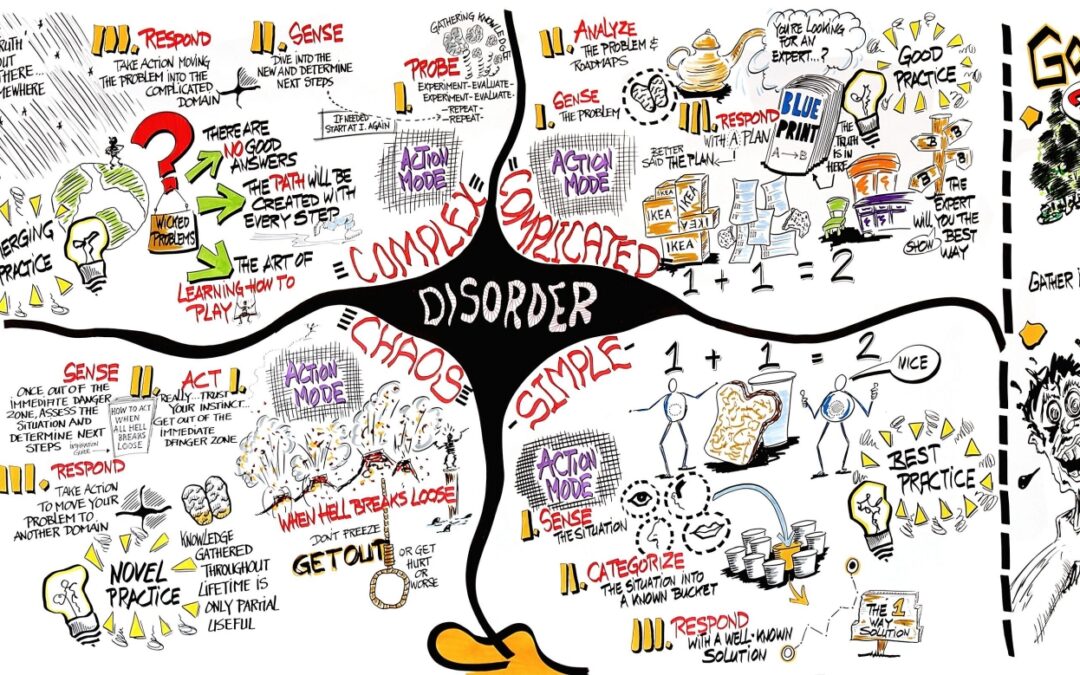
The Cynefin framework recognizes that leadership and problem-solving must be contextual to be effective. Using the Welsh word for “habitat,” the framework is a tool to understand and name the context of a situation and identify the approaches best suited for managing or solving the situation.
It’s grounded in the idea that every context – situation, challenge, problem, opportunity – exists somewhere on a spectrum between Ordered and Unordered. At the Ordered end of the spectrum, cause and affect are obvious and immediate and the path forward is based on objective, immutable facts. Unordered contexts, however, have no obvious or immediate relationship between cause and effect and moving forward requires people to recognize patterns as they emerge.
Both VUCA and BANI point out the obvious – we’re spending more time on the Unordered end of the spectrum than ever. Unlike the acronyms, Cynefin helps leaders decide and act.
5 Contexts. 5 Ways Forward
The Cynefin framework identifies five contexts, each with its own best practices for making decisions and progress.
On the Ordered end of the spectrum:
- Simple contexts are characterized by stability and obvious and undisputed right answers. Here, patterns repeat, and events are consistent. This is where leaders rely on best practices to inform decisions and delegation, and direct communication to move their teams forward.
- Complicated contexts have many possible right answers and the relationship between cause and effect isn’t known but can be discovered. Here, leaders need to rely on diverse expertise and be particularly attuned to conflicting advice and novel ideas to avoid making decisions based on outdated experience.
On the Unordered end of the spectrum:
- Complex contexts are filled with unknown unknowns, many competing ideas, and unpredictable cause and effects. The most effective leadership approach in this context is one that is deeply uncomfortable for most leaders but familiar to innovators – letting patterns emerge. Using small-scale experiments and high levels of collaboration, diversity, and dissent, leaders can accelerate pattern-recognition and place smart bets.
- Chaos are contexts fraught with tension. There are no right answers or clear cause and effect. There are too many decisions to make and not enough time. Here, leaders often freeze or make big bold decisions. Neither is wise. Instead, leaders need to think like emergency responders and rapidly response to re-establish order where possible to bring the situation into a Complex state, rather than trying to solve everything at once.
The final context is Disorder. Here leaders argue, multiple perspectives fight for dominance, and the organization is divided into fractions. Resolution requires breaking the context down into smaller parts that fit one of the four previous contexts and addressing them accordingly.
The Only Way Out is Through
Our VUCA/BANI world isn’t going to get any simpler or easier. And fighting it, freezing, or fleeing isn’t going to solve anything. Organizations need leaders with the courage to move forward and the wisdom and flexibility to do so in a way that is contextually appropriate. Cynefin is their map.

by Robyn Bolton | Sep 23, 2025 | Articles

by Robyn Bolton | Sep 23, 2025 | Innovation, Metrics, Tips, Tricks, & Tools
It’s time for your company’s All-Hands meeting. Your CEO stands on stage and announces ambitious innovation goals, talking passionately about the importance of long-term thinking and breakthrough results. Everyone nods enthusiastically, applauds politely, and returns to their desks to focus on hitting this quarter’s numbers. After all, that’s what their bonuses depend on.
Kate Dixon, compensation expert and founder of Dixon Consulting, has watched this contradiction play out across Fortune 500 companies, B Corps, and startups. Her insight cuts to the heart of why so many innovation initiatives fail: we’re asking people to think long-term while paying them to deliver short-term.
In our conversation, Kate revealed why most companies are inadvertently sabotaging their own innovation efforts through their compensation structures—and what the smartest organizations are doing differently.
Robyn Bolton: Kate, when I first heard you say, “compensation is the expression of a company’s culture,” it blew my mind. What do you mean by that?
Kate Dixon: If you want to understand what an organization values, look at how they pay their people: Who gets paid more? Who gets paid less? Who gets bigger bonuses? Who moves up in the organization and who doesn’t? Who gets long-term incentives?
The answers to these questions, and a million others, express the culture of the organization. How we reward people’s performance, either directly or indirectly, establishes and reinforces cultural norms. Compensation is usually the biggest, if not the biggest, expenses that a company has so they’re very thoughtful and deliberate about how it is used. Which is why it tells you what the company actually does value.
RB: What’s the biggest mistake companies make when trying to incentivize innovation?
KD: Let’s start by what companies are good at when it comes to compensations and incentives. They’re really good about base pay, because that’s the biggest part of pay for most people in an organization. Then they spend the next amount of time and effort trying to figure out the annual bonus structure. After that comes other benefits, like long term incentives, assuming they don’t fall by the wayside.
As you know, innovation can take a long time to payout, so long-term incentives are key to encouraging that kind of investment. Stock options and restricted shares are probably the most common long-term incentives but cash bonuses, phantom stock, and ESOP shares in employee-owned companies are also considered long term incentives.
Large companies are pretty good using some equity as an incentive, but they tie it t long term revenue goals, not innovation. As you often remind us, “innovation is a means to the end, which is growth,” so tying incentives to growth isn’t bad but I believe that we can do better. Tying incentives to the growth goals and how they’re achieved will go a long way towards driving innovation.
RB: I’ve worked in and with big companies and I’ve noticed that while they say, “innovation is everyone’s job,” the people who get long-term incentives are typically senior execs. What gives?
Long-term incentives are definitely underutilized, below the executive level, and maybe below the director level. Assuming that most companies’ innovation efforts aren’t moonshots that take decades to realize, it makes a ton of sense to use long-term incentives throughout the organization and its ecosystem. However, when this idea is proposed, people often pushback because “it’s too complex” for folks lower in the organization, “they wouldn’t understand.” or “they won’t appreciate it”. That stance is both arrogant and untrue. I’ve consistently seen that when you explain long-term incentives to people, they do get it, it does motivate them, and the company does see results.
RB: Are there any examples of organizations that are getting this right?
We’re seeing a lot more innovative and interesting risk-taking behaviors in companies that are not primarily focused on profit.
Our B Corp clients are doing some crazy, cool stuff. We have an employee-owned company that is a consulting firm, but they had an idea for a software product. They launched it and now it’s becoming a bigger and bigger part of their business.
Family-owned or public companies that have a single giganto shareholder are also hotbeds of long-term thinking and, therefore, innovation. They don’t have that same quarter to quarter pressure that drives a relentless focus on what’s happening right now and allows people to focus on the future.
What’s the most important thing leaders need to understand about compensation and innovation?
If you’re serious about innovation, you should be incentivizing people all over the organization. If you want innovation to be a more regular piece of the culture so you get better results, you’ve got to look at long term incentives. Yes, you should reward people for revenue and short-term goals. But you also need to consider what else is a precursor to our innovation. What else is makes the conditions for innovating better for people, and reward that, too.
Kate’s insight reveals the fundamental contradiction at the heart of most companies’ innovation struggles: you can’t build long-term value with short-term thinking, especially when your compensation system rewards only the latter.
What does your company’s approach to compensation say about its culture and values?