
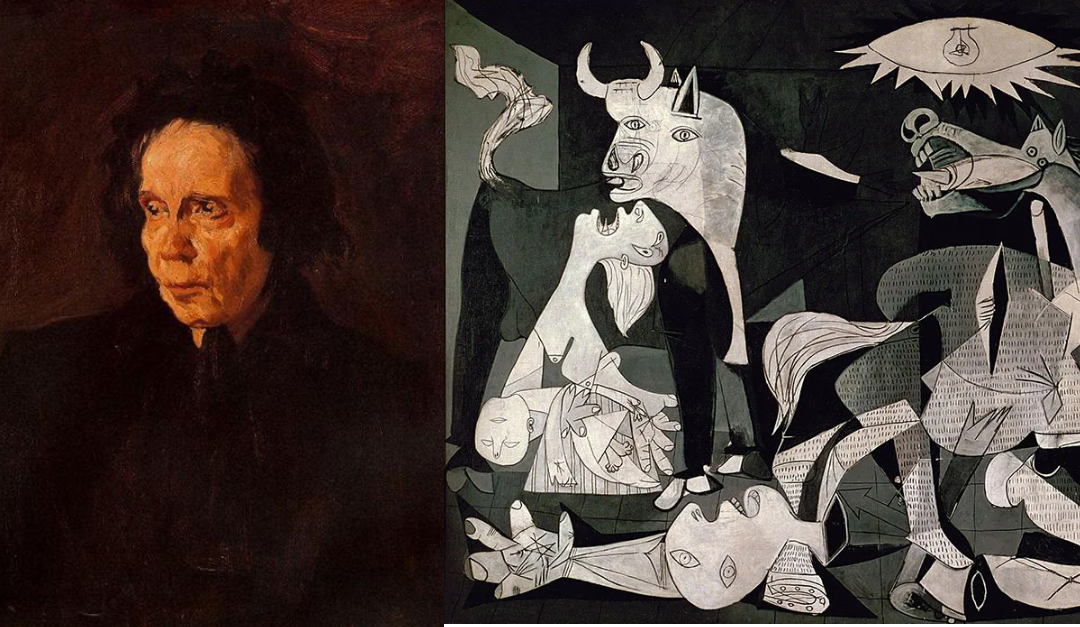
Spain, 1896
At the tender age of 14, Pablo Ruiz Picasso painted a portrait of his Aunt Pepa a work of brilliant academic realism that would go on to be hailed as “without a doubt one of the greatest in the whole history of Spanish painting.”
In 1901, he abandoned his mastery of realism, painting only in shades blue and blue-green.
There’s debate over why Picasso’s Blue Period began. Some argue that it’s a reflection of the poverty and desperation he experienced as a starving artist in Paris. Others claim it was a response to the suicide of his friend, Carles Casagemas. But Bill Gurley, a longtime venture capitalist, has a different theory.
Picasso abandoned realism because of the Kodak Brownie.
Introduced on February 1, 1900, the Kodak Brownie made photography widely available, fulfilling George Eastman’s promise that “you press the button, we do the rest.”
An ocean away, Gurley argues, Picasso’s “move toward abstraction wasn’t a rejection of skill; it was a recognition that realism had stopped being the frontier….So Picasso moved on, not because realism was wrong, but because it was finished.”
Washington DC, 2004
Three years before Drive took the world by storm, Daniel Pink published his third book, A Whole New Mind: Why Right-Brainers Will Rule the Future.
In it, he argues that a combination of technological advancements, higher standards of living, and access to cheaper labor are pushing us from a world that values left brain skills like linear thought, analysis, and optimization towards one that requires right brain skills like artistry, empathy, and big picture thinking.
As a result, those who succeed in the future will be able to think like designers, tell stories with context and emotional impact, and combine disparate pieces into a whole greater than the sum of its parts. Leaders will need to be empathetic, able to create “a pathway to more intense creativity and inspiration,” and guide others in the pursuit of meaning and significance.
California, 2026
Barry O’Reilly, author of Unlearn, published his monthly blog post, “Six Counterintuitive Trends to Think about for 2026,” in which he outlines what he believes will be the human reactions to a world in which AI is everywhere.
Leadership, he asserts, will cease to be measured by the resources we control (and how well we control them to extract maximum value) but by judgment. Specifically, a leader’s ability to:
- Ask better questions
- Frame decisions clearly
- Hold ambiguity without freezing
- Know when not to use AI
The Price of Safety vs the Promise of Greatness
Picasso walked away from a thriving and lucrative market where he was an emerging star to suffer the poverty, uncertainty, and desperation of finding what was next. It would take more than a decade for him to find international acclaim. He would spend the rest of his life as the most famous and financially successful artist in the world.
Are you willing to take that same risk?
You can cling to the safety of what you know, the markets, industries, business models, structures, incentives that have always worked. You can continue to demand immediate efficiency, obedience, and profit while experimenting with new tech and playing with creative ideas.
Or you can start to build what’s next. You don’t have to abandon what works, just as Picasso didn’t abandon paint. But you do have to start using your resources in new ways. You must build the characteristics and capabilities that Daniel Pink outlines. You must become the “counterintuitive” leader that embraces ambiguity, role models critical thinking, and rewards creativity and risk-taking.
Do you have the courage to be counterintuitive?
Are you willing to embrace your inner Picasso?